Clinical Scorecard: Diagnosis-to-Transplant Interval and Survival in IPSS-M Higher-Risk MDS-IB: A Single-Hospital Cohort Study
At a Glance
Category
Detail
Condition
IPSS-M higher-risk myelodysplastic syndromes with increased blasts (MDS-IB)
Key Mechanisms
The authors report that the apparent survival advantage with transplantation within 3 months was driven predominantly by reduced non-relapse mortality rather than reduced relapse; verify this against the full source because the supplied context is truncated before the supporting results.
Target Population
325 patients with IPSS-M higher-risk MDS-IB who underwent allogeneic hematopoietic stem cell transplantation at one hospital
Care Setting
Single-hospital transplant cohort evaluating diagnosis-to-transplant interval and post-transplant outcomes.
Key Highlights
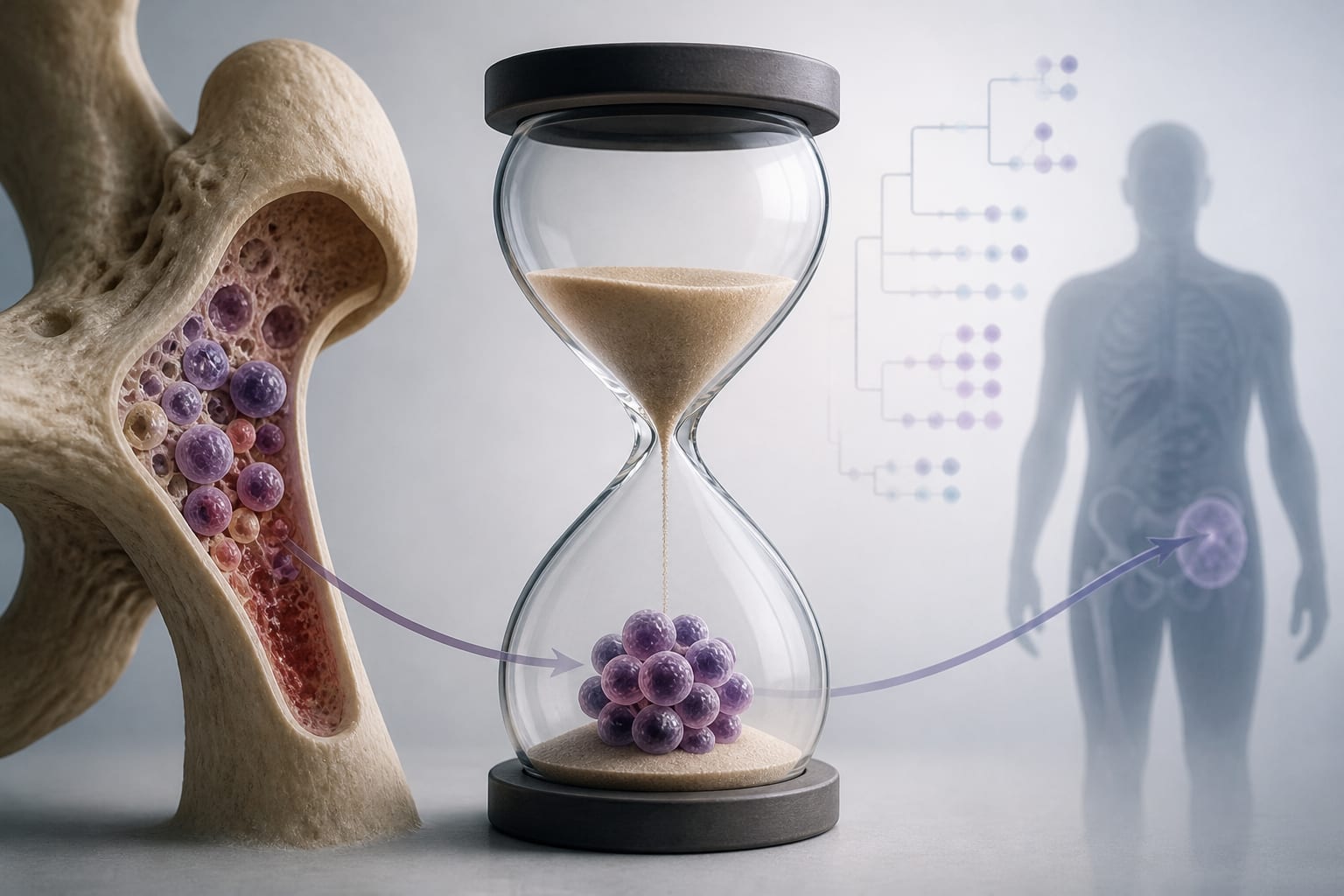
In a single-hospital cohort of 325 patients, the data-derived diagnosis-to-transplant threshold was 3 months; spline analysis showed the lowest mortality hazard at approximately 2–3 months.
Three-year overall survival was 76.5% with transplantation within 3 months versus 68.7% with transplantation after 3 months (HR 0.62, 95% CI 0.39–0.98; P = 0.039).
Three-year disease-free survival was 76.6% with transplantation within 3 months versus 65.8% after 3 months (HR 0.63, 95% CI 0.41–0.97; P = 0.037).
The overall-survival association was supported by inverse probability of treatment weighting; the time-dependent Cox estimate was directionally consistent but imprecise.
The study was observational, and adjusted overall- and disease-free-survival estimates showed trends that did not reach conventional statistical significance (both P = 0.06).
Guideline-Based Recommendations
Diagnosis
IPSS-M values were derived from diagnostic targeted sequencing and cytogenetic findings.
Management
The article states that current guidelines advise transplantation for higher-risk MDS but do not specify an exact diagnosis-to-transplant interval.
In this observational cohort, transplantation within 3 months was associated with higher 3-year overall and disease-free survival than transplantation after 3 months.
Monitoring & Follow-up
The study assessed overall survival, disease-free survival, cumulative incidence of relapse, and non-relapse mortality after transplantation.
Risks
HCT-CI ≥ 3 and TP53 mutation independently predicted adverse outcomes in the reported multivariable analysis.
Patient & Prescribing Data
The cohort included 325 patients with IPSS-M higher-risk MDS-IB who underwent allo-HSCT; median age was 45.3 years, and median follow-up after transplantation was 24.4 months.
A total of 128 patients underwent transplantation within 3 months and 197 after 3 months. Supportive care alone was more frequent in the early group, while HMA- or VEN-based bridging was more frequent in the late group.
Clinical Best Practices
The study used IPSS-M derived from molecular and cytogenetic information to classify risk.
The study reported an association between transplantation within 3 months of diagnosis and better survival outcomes in this cohort; adjusted estimates did not reach conventional statistical significance, and the time-dependent estimate was imprecise.
Interpret the reported association in the context of the observational design and baseline differences.
Autolomous CEO Alexander Seyf says advanced therapy manufacturers need to digitize before they embrace AI – and that human expertise must remain in the loop
A phase 1 clinical trial now recruiting at Roswell Park Comprehensive Cancer Center is evaluating HWK-007, the first antibody-drug conjugate targeting protein tyrosine kinase 7 (PTK7).