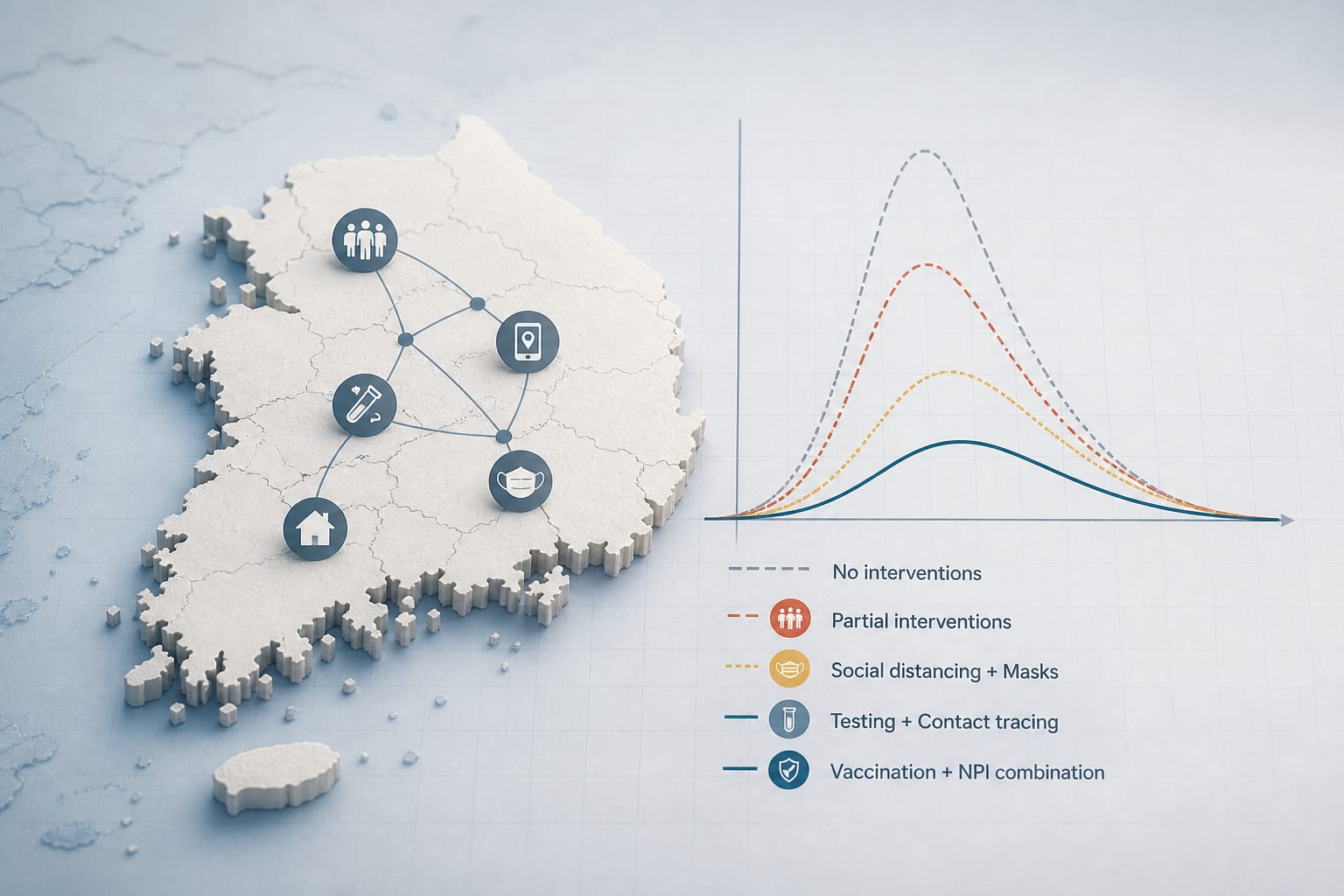
Evaluation of COVID-19 Mitigation Strategies in South Korea: A Modeling Study Based on Counterfactual Scenarios
-
By
-
Suyoung Jo
-
Kyung-Duk Min
-
Sung-il Cho
-
August 12, 2026
Clinical Scorecard: Evaluation of COVID-19 Mitigation Strategies in South Korea: A Modeling Study Based on Counterfactual Scenarios
At a Glance
Category | Detail |
|---|
Condition | COVID-19 |
Key Mechanisms | Vaccination, testing, contact tracing, quarantine, and social distancing |
Target Population | South Korean population, stratified by age |
Care Setting | National public health response and epidemiological modeling |
Key Highlights
South Korea used NPIs to contain COVID-19 without nationwide lockdowns.
Vaccination began in early 2021, initially prioritizing high-risk populations and health care workers.
Counterfactual modeling evaluated four COVID-19 control policies.
Analyses covered pre-Delta and Delta-dominant periods.
The model was calibrated using national surveillance data.
Guideline-Based Recommendations
Diagnosis
Management
Monitoring & Follow-up
Monitor age-specific confirmed cases, vaccination counts, variant prevalence, and the proportion quarantined at diagnosis.
Risks
Patient & Prescribing Data
The population was divided into ages 0–19, 20–64, and 65 years or older.
The study used population-level, anonymized surveillance data; it did not report individual patient or prescribing data.
Clinical Best Practices
Maintain diagnostic testing and contact tracing throughout an epidemic.
Secure vaccine supplies early and support timely deployment.
Use surveillance-informed modeling to evaluate policy scenarios.
Adjust social distancing in response to resurgence signals.
Related Resources & Content