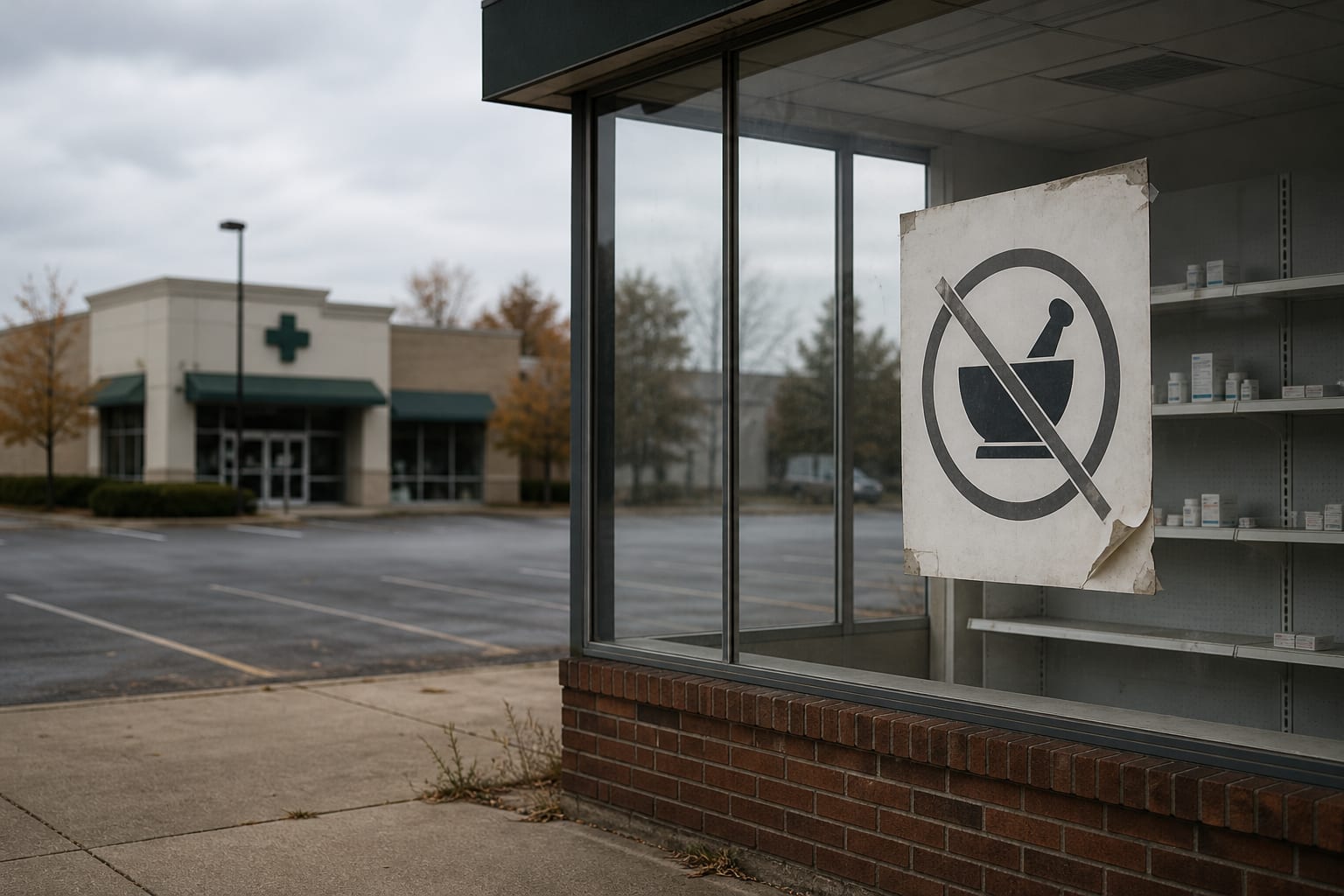
Clinical Scorecard: Medicare Part D Prescription Volume and Pharmacy Closure Risk
At a Glance
Category
Detail
Condition
Clinical topic addressed by the source article: Medicare Part D Prescription Volume and Pharmacy Closure Risk
Key Mechanisms
Mechanisms or clinical associations described in the source article.
Target Population
The analytic cohort included 56,998 retail pharmacies identified in 100% Medicare Part D claims that had operated for at least 1 year as of December 2022; closures were followed through December 2023.
Care Setting
Care setting described in the source article.
Key Highlights
Among 56,998 pharmacies in the analytic cohort, 2,220 (3.9%) closed during the subsequent 1-year period.
Each 1,000-prescription reduction in annual volume was associated with higher closure odds (OR, 1.07; 95% CI, 1.07-1.08).
Pharmacies with limited network participation had higher closure odds before volume adjustment (OR, 1.30; 95% CI, 1.19-1.41); after adjustment, the association was attenuated (OR, 0.91; 95% CI, 0.83-0.99).
Closure rates were higher among pharmacies primarily serving Black patients and among those serving at least 20% DE-LIS beneficiaries.
The authors stated that policymakers should consider strategies to protect lower-volume pharmacies, especially those serving racially and ethnically minoritized and low-income beneficiaries, along with independent pharmacies and pharmacies participating in limited networks.
Guideline-Based Recommendations
Diagnosis
The study defined closure as the first month without Medicare Part D claims.
Management
The authors stated that policymakers should consider strategies to protect lower-volume pharmacies, particularly those serving racially and ethnically minoritized and low-income beneficiaries, as well as independent pharmacies and pharmacies participating in limited networks.
The authors identified broader, more equitable Part D pharmacy networks and increased Medicare reimbursement for lower-volume pharmacies as potential policy approaches.
Monitoring & Follow-up
The study assessed pharmacy characteristics during the 12 months before closure or study end.
Measures included prescription volume, pharmacy type, network participation, predominant race and ethnicity served, DE-LIS patient share, county urbanicity, zip-code poverty, and pharmacies within 1 mile.
Risks
Lower prescription volume was associated with increased closure risk across the study’s subgroups.
Closures were more common among pharmacies primarily serving Black rather than White patients and among pharmacies serving at least 20% DE-LIS beneficiaries.
The authors noted that the study lacked data on pharmacy reimbursement, revenue, and prescription volume from non-Part D payers.
Patient & Prescribing Data
Medicare Part D beneficiaries using retail pharmacies; pharmacy-level patient characteristics included predominant race and ethnicity served and the proportion of users who were DE-LIS beneficiaries.
This study evaluated pharmacy closure, not medication treatment or prescribing outcomes. Pharmacies that closed had lower median annual prescription volume than those that remained operational.