Late recurrence and histological progression of a cervical intradural extramedullary solitary fibrous tumor after gross total resection: a case report - Scorecard - MDSpire
Advertisement
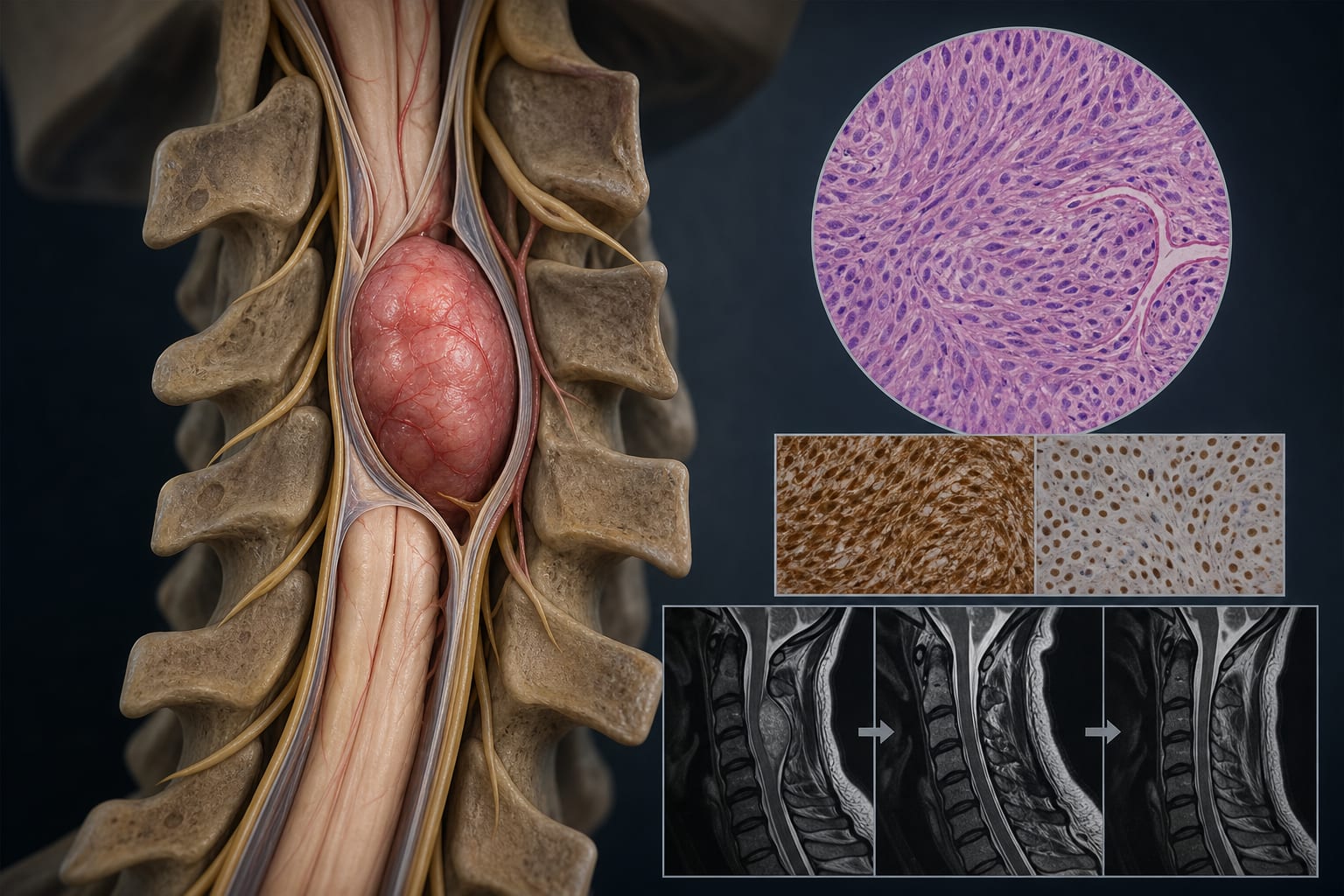
Late recurrence and histological progression of a cervical intradural extramedullary solitary fibrous tumor after gross total resection: a case report
Clinical Scorecard: Delayed Recurrence and Histological Advancement of a Solitary Fibrous Tumor in the Cervical Intradural Extramedullary Space Following Complete Resection: A Case Study
At a Glance
Category
Detail
Condition
Solitary Fibrous Tumor (SFT)
Key Mechanisms
Characterized by NAB2–STAT6 fusion, nuclear STAT6 expression, and unpredictable biological behavior.
Target Population
Adults with solitary fibrous tumors in the cervical intradural extramedullary space.
Care Setting
Neurosurgical and oncological care settings.
Key Highlights
SFT can exhibit delayed recurrence and histological progression despite gross total resection.
Initial histological grade can change from WHO grade 2 to grade 3 upon recurrence.
Long-term radiological follow-up is recommended for patients with initially low-grade lesions.
Guideline-Based Recommendations
Diagnosis
Histopathological and immunohistochemical evaluation for accurate grading.
Management
Gross total resection is the mainstay of treatment.
Monitoring & Follow-up
Close radiological surveillance is recommended postoperatively.
Risks
Potential for late local recurrence and distant metastasis.
Patient & Prescribing Data
39-year-old male with progressive cervical myelopathy.
Microsurgical gross total resection performed with intraoperative neurophysiological monitoring.
Clinical Best Practices
Consider multidisciplinary evaluation for recurrent or higher-grade tumors.
Implement long-term follow-up strategies for patients post-resection.
by Yergen N. Kenzhegulov, Daniyar K. Zhamoldin, Viktor G. Aleinikov, Talgat T. Kerimbayev, Berik Zhetpisbaev, Makar P. Solodovnikov, Aisa Z. Nurpeisov, Serik Akshulakov