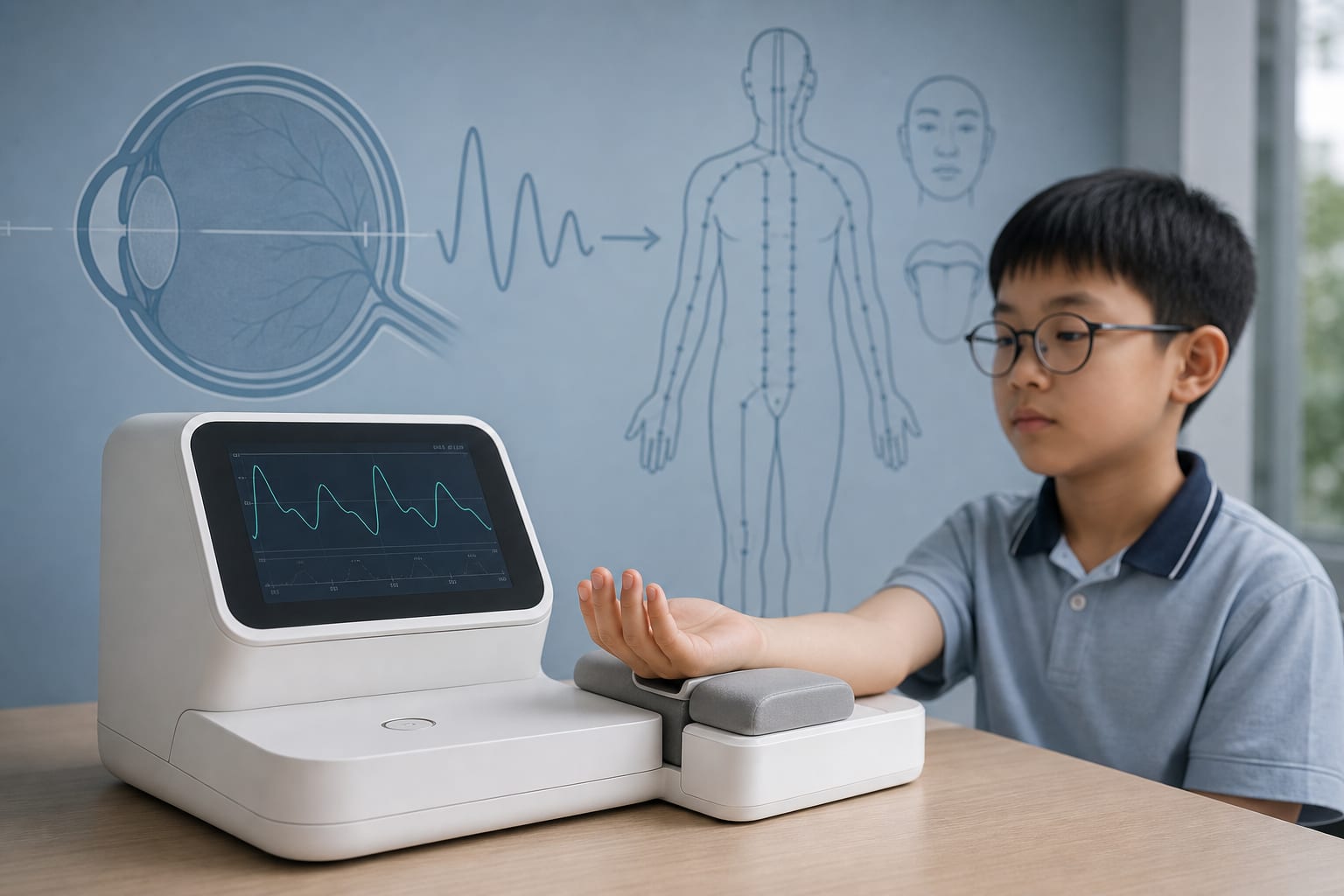
Objective pulse wave amplitude as a potential systemic correlate in childhood myopia: a digital TCM-based study
-
By
-
Sha, Fang
-
Guo, Bin
-
Wang, Dongfang
-
Hu, Yuanyuan
-
Gao, Yane
-
Du, Xiujuan
-
Ding, Meihua
-
Feng, Jiaojiao
-
Song, Jike
-
Bi, Hongsheng
-
April 13, 2026
-
Clinical Scorecard: Evaluating Objective Pulse Wave Amplitude as a Systemic Indicator in Pediatric Myopia: Insights from a Digital TCM Study
At a Glance
| Category | Detail |
|---|
| Condition | Pediatric Myopia |
| Key Mechanisms | Pulse wave amplitude as a systemic correlate |
| Target Population | Children aged 7–14 years |
| Care Setting | School-based assessments in Shandong Province, China |
Key Highlights
- 53.15% of children assessed were diagnosed with myopia.
- Diminished h1 amplitude linked to myopia severity.
- No significant correlations found with tongue or facial parameters.
- Higher occurrence of biased TCM constitutions in myopic children.
- Study utilized digital tools for objective assessments.
Guideline-Based Recommendations
Diagnosis
- Myopia defined as cycloplegic spherical equivalent (SE) ≤−0.50 D.
Management
- Consider systemic evaluation through pulse wave amplitude in myopia studies.
Monitoring & Follow-up
- Monitor pulse wave amplitude as a potential indicator of myopia progression.
Risks
- Higher risk of myopia associated with biased TCM constitutions.
Patient & Prescribing Data
Children aged 7–14 years with myopia
Focus on holistic approaches integrating TCM insights.
Clinical Best Practices
- Utilize objective measures for assessing pediatric myopia.
- Incorporate TCM diagnostic parameters in myopia evaluations.
Related Resources & Content