Clinical Scorecard: Rethinking the 2-Hour Rule: Equilibrium and Saturation in Polymyxin B Hemoadsorption
At a Glance
Category
Detail
Condition
Endotoxin removal by polymyxin B hemoadsorption in sepsis and other cited clinical indications
Key Mechanisms
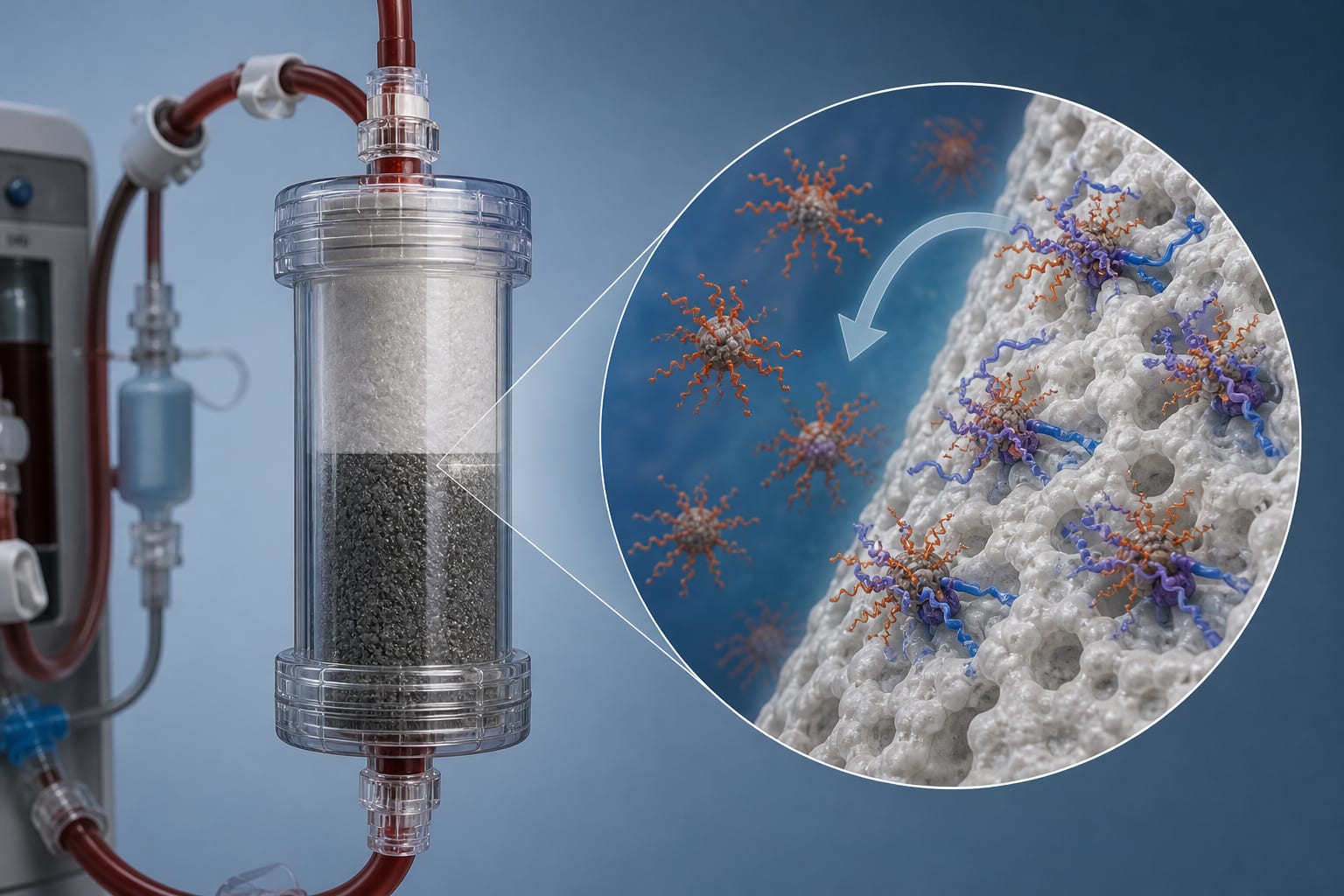
In closed in-vitro recirculating systems, falling fluid-phase LPS levels can produce adsorption–desorption equilibrium and a concentration plateau; this does not establish cartridge saturation.
Target Population
Patients receiving polymyxin B hemoperfusion, including the Tigris trial population with endotoxin activity (EA) 0.60–0.89 and patients with septic shock or acute exacerbation of idiopathic pulmonary fibrosis discussed in the article.
Care Setting
Clinical hemoperfusion and experimental evaluation of polymyxin B cartridges; the article also describes extended treatment use in Japan.
Key Highlights
The article disputes the claim that a PMX-20R cartridge is limited to approximately 10–20 µg of LPS or approaches saturation after one 2-hour session.
The cited 2-hour plateau experiments used a single 15-µg LPS spike in closed, in-vitro recirculating loops; the authors interpret the plateau as dynamic adsorption equilibrium rather than demonstrated saturation.
In a 24-hour continuous-loading model using a neonatal PMX-01R cartridge, cumulative adsorption reached 4.73 µg without saturation; fiber-mass scaling was estimated to correspond to 66.2 µg for PMX-20R.
A cited clinical study reported a median 74.4% endotoxin removal rate after 24 hours among septic shock patients whose pre-cartridge endotoxin levels exceeded the assay detection limit.
The optimal duration and clinical benefits of prolonged PMX treatment, particularly for patients with EA ≥0.90, remain undetermined.
Guideline-Based Recommendations
Diagnosis
The article reports that the Tigris trial evaluated a predefined population with EA values of 0.60–0.89.
Management
The article states that Japanese labeling recommends PMX treatment lasting 6–24 hours per cartridge for acute exacerbation of idiopathic pulmonary fibrosis.
The authors call for renewed consideration of treatment duration; they state that optimal duration and possible clinical benefits remain undetermined.
Monitoring & Follow-up
The cited 24-hour septic shock study measured plasma endotoxin levels before and after PMX treatment.
Risks
The authors caution that assuming saturation after 2 hours could deter consideration of prolonged treatment and could offer a misleading explanation for the apparent absence of benefit among patients with EA ≥0.90.
Patient & Prescribing Data
The article discusses Tigris participants with EA 0.60–0.89, septic shock patients treated with PMX-20R, and patients with acute exacerbation of idiopathic pulmonary fibrosis in Japan.
The article describes 24-hour PMX treatment in a septic shock study and Japanese labeling of 6–24 hours per cartridge for acute exacerbation of idiopathic pulmonary fibrosis. It does not establish the optimal duration or clinical benefit of prolonged treatment.
Clinical Best Practices
Distinguish a concentration plateau in a closed, single-dose in-vitro loop from demonstrated cartridge saturation.
Interpret the continuous-loading neonatal-cartridge findings in light of the model and the authors’ fiber-mass scaling estimate; these are not direct PMX-20R clinical measurements.
Do not treat the article as establishing an optimal PMX treatment duration or clinical benefit for patients with EA ≥0.90.
Investigators linked distinct odor patterns to life stage, sex, and skin microbes, while limited longitudinal evidence leaves their clinical utility uncertain.