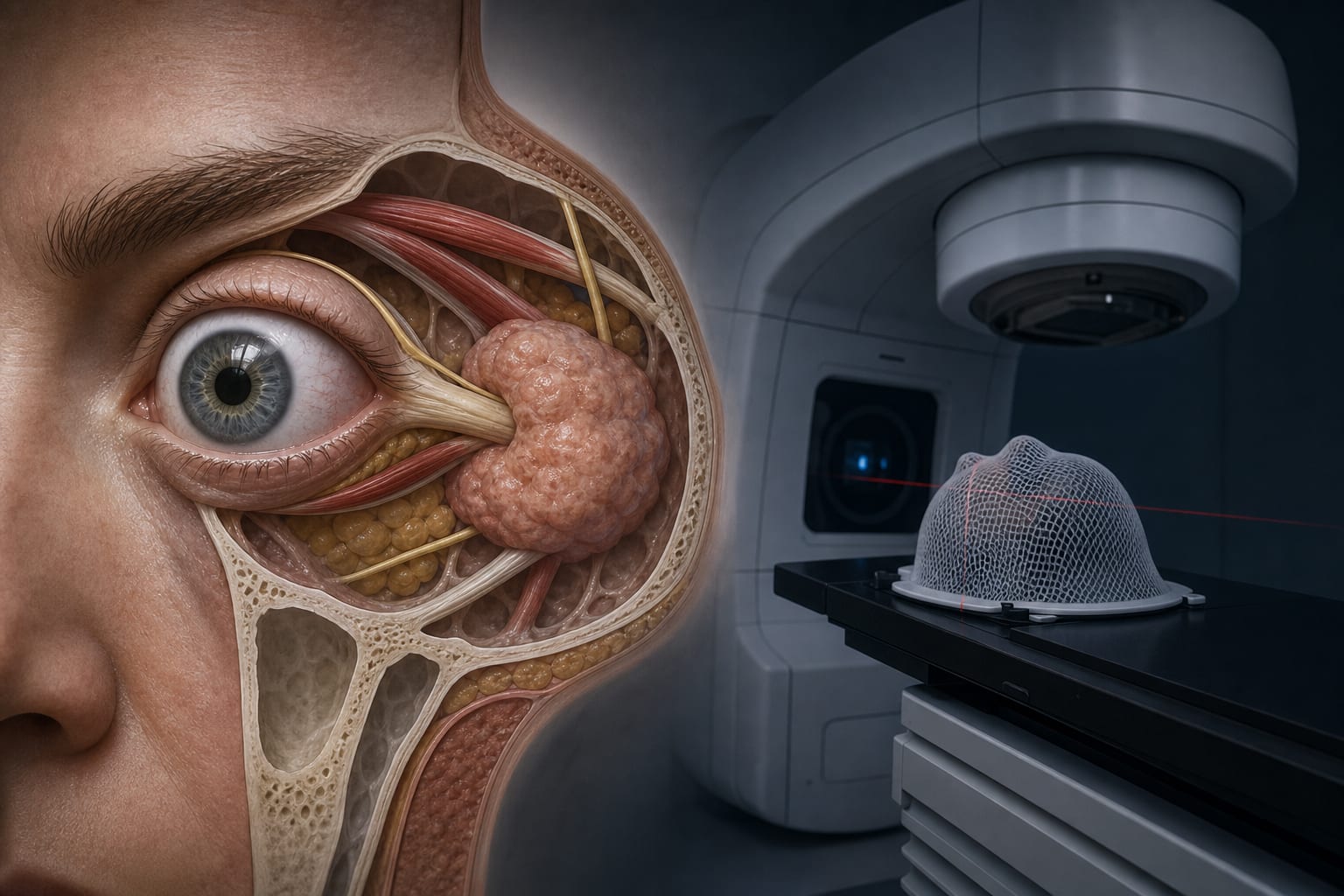
Long-term management of orbital Rosai–Dorfman disease with re-irradiation for locoregional recurrence: a case report
Clinical Scorecard: Management of Recurring Orbital Rosai-Dorfman Disease Through Re-irradiation: A Case Study
At a Glance
| Category | Detail |
|---|
| Condition | Rosai-Dorfman Disease (RDD) |
| Key Mechanisms | Accumulation of activated histiocytes in nodal and extranodal sites, with orbital involvement presenting diagnostic challenges. |
| Target Population | Patients with recurrent orbital Rosai-Dorfman Disease. |
| Care Setting | Clinical management of rare histiocytic disorders. |
Key Highlights
- RDD is a rare non-Langerhans histiocytic disorder with potential for extranodal involvement.
- Initial corticosteroid therapy provided partial relief, followed by successful image-guided radiotherapy.
- Re-irradiation achieved durable local control and improved visual function.
- Histopathological evaluation is crucial for accurate diagnosis and differentiation from other conditions.
- Surgical excision may be limited due to the proximity of lesions to critical structures.
Guideline-Based Recommendations
Diagnosis
- Histopathology remains the gold standard for diagnosing RDD.
- Immunohistochemical profiling (S100+, CD68+, CD1a–) aids in diagnosis.
Management
- Initial management may include corticosteroids.
- Radiotherapy is a valuable option for recurrent orbital RDD.
Monitoring & Follow-up
- Regular MRI follow-ups to assess disease progression and treatment response.
Risks
- Surgical intervention carries risks of morbidity, including vision loss.
Patient & Prescribing Data
A 58-year-old male with recurrent orbital RDD.
Initial corticosteroid therapy followed by image-guided radiotherapy and re-irradiation.
Clinical Best Practices
- Careful histopathological evaluation to distinguish RDD from other conditions.
- Consideration of re-irradiation for patients with recurrent disease after initial radiotherapy.
Related Resources & Content