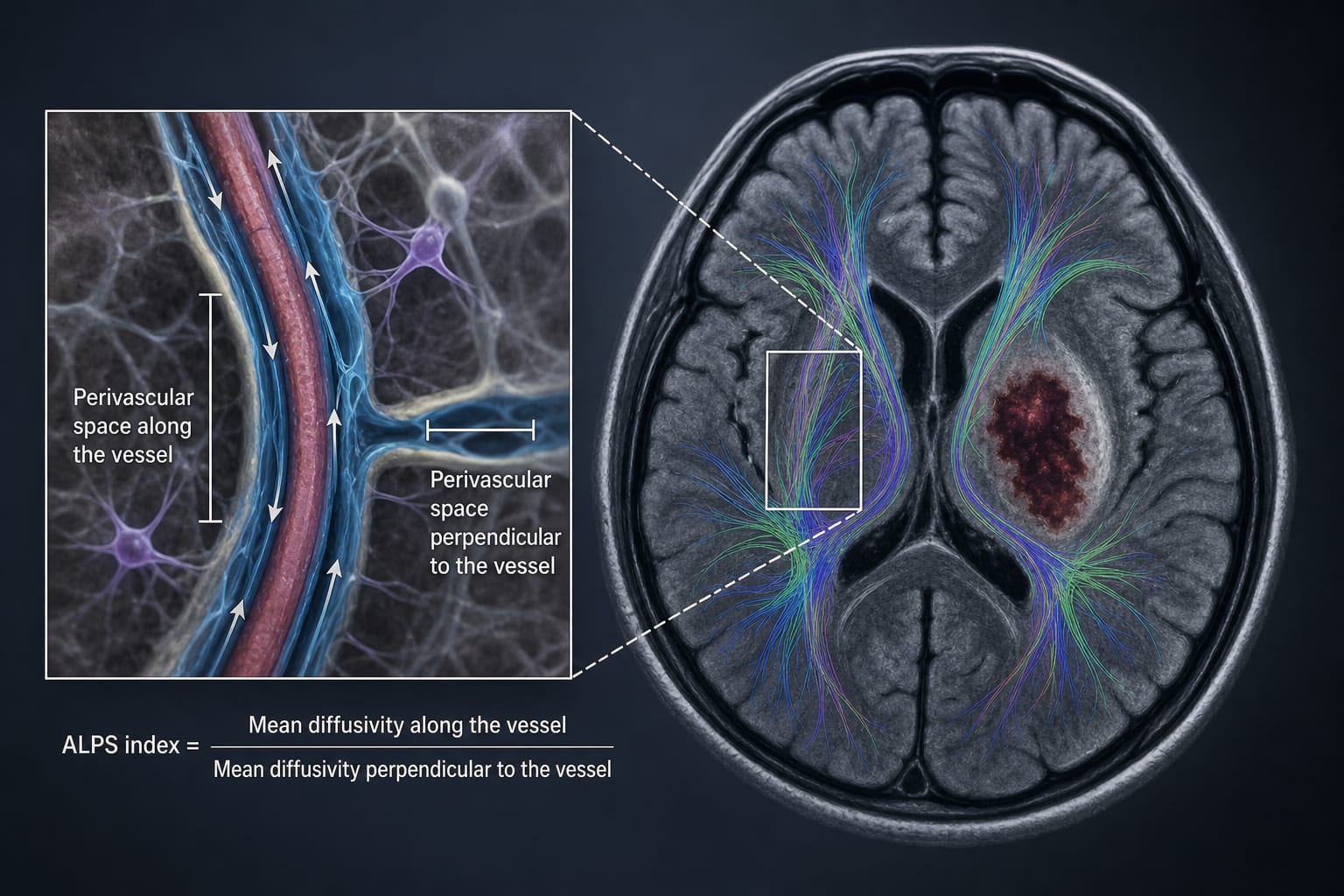
Longitudinal changes in the ALPS index and its clinical correlates in patients with basal ganglia hemorrhage
-
By
-
Zhaofeng Su
-
Jiajia Chen
-
Peng Wu
-
Rongjun Zhang
-
Xiaochi Yang
-
Nan Dong
-
Zhihui Fu
-
July 9, 2026
-
Clinical Scorecard: Temporal Variations in the ALPS Index and Its Clinical Associations in Individuals Experiencing Basal Ganglia Hemorrhage
At a Glance
| Category | Detail |
|---|
| Condition | Basal Ganglia Hemorrhage |
| Key Mechanisms | Impaired glymphatic function and mechanical effects on fiber tracts due to hematoma. |
| Target Population | Patients with spontaneous intracerebral hemorrhage, particularly in the basal ganglia region. |
| Care Setting | Clinical assessment using Diffusion Tensor Imaging (DTI) for evaluating brain injury. |
Key Highlights
- ALPS index significantly lower in patients compared to healthy controls.
- No significant correlation between ALPS index and Brunnstrom recovery stage or hematoma volume overall.
- Significant negative correlation between ALPS index and hematoma volume in the ≤ 10 mL subgroup.
- ALPS index shows potential for assessing microstructural changes post-hemorrhage.
- Partial recovery of ALPS index observed after 3 months.
Guideline-Based Recommendations
Diagnosis
- Use DTI to assess ALPS index in patients with basal ganglia hemorrhage.
Management
- Current management is primarily conservative; surgical intervention lacks evidence for improved outcomes.
Monitoring & Follow-up
- Monitor ALPS index changes over time to evaluate recovery.
Risks
- Patients may experience delayed neurological injury, cardiac complications, and depression.
Patient & Prescribing Data
Patients experiencing spontaneous intracerebral hemorrhage, particularly in the basal ganglia.
Focus on conservative management and monitoring of imaging biomarkers.
Clinical Best Practices
- Utilize DTI-ALPS index for noninvasive assessment of glymphatic function.
- Consider stratified analysis of hematoma volume when assessing ALPS index correlations.
Related Resources & Content