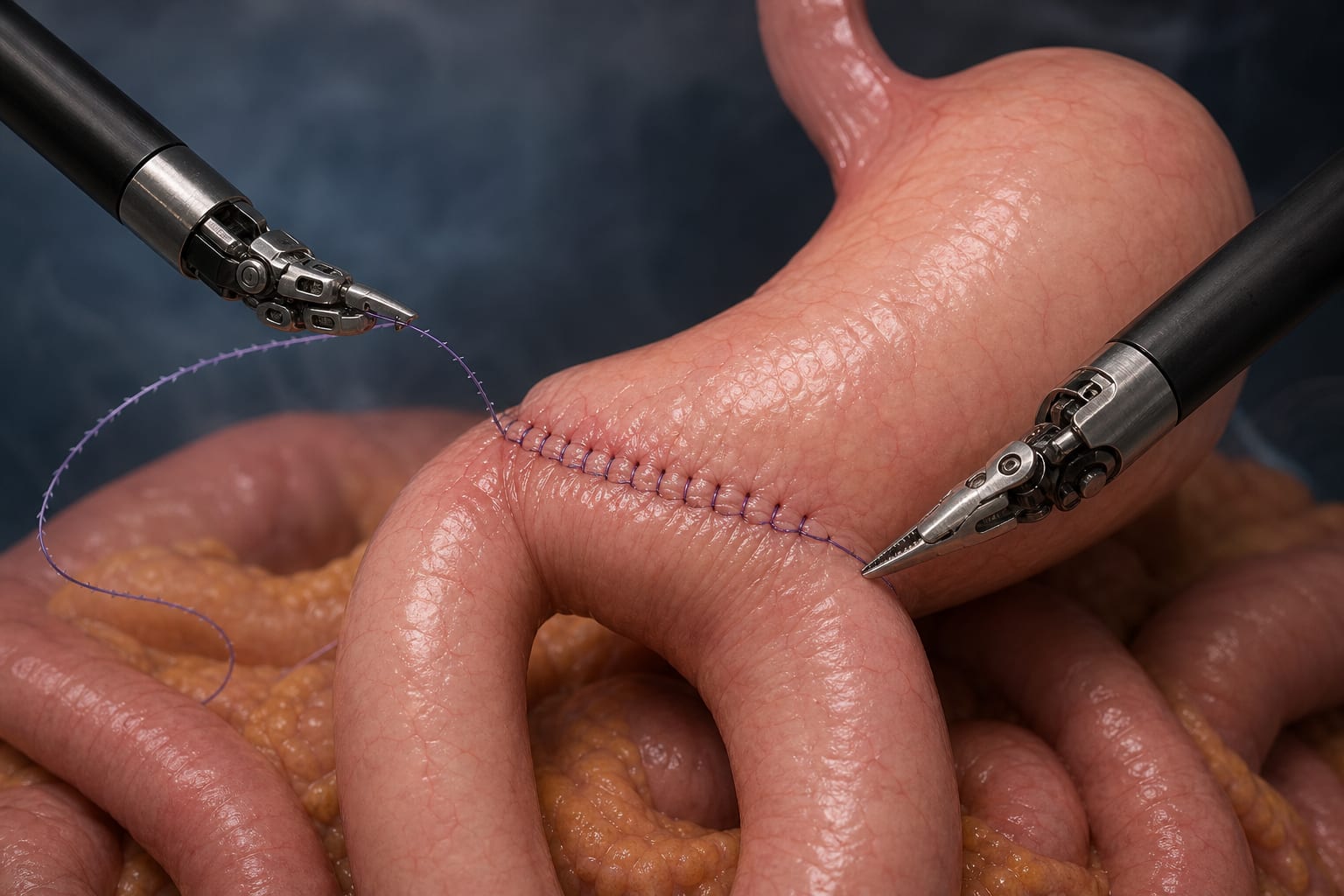
Knotless tissue control devices for hand-sewn gastrojejunostomy in robotic-assisted Roux-en-Y gastric bypass
-
By
-
Stephen Johnston
-
Najmuddin Gunja
-
Aakash Jha
-
Walter Danker
-
Shanthi Krishnaswami
-
Zhun Cao
-
Barbara Johnson
-
Jörg Tomaszewski
-
June 17, 2026
-
Clinical Scorecard: Barbed Suture Devices for Hand-Sewn Gastrojejunostomy in Robotic Roux-en-Y Gastric Bypass Procedures
At a Glance
| Category | Detail |
|---|
| Condition | |
| Key Mechanisms | Utilization of barbed sutures for tissue approximation without the need for tying surgical knots. |
| Target Population | |
| Care Setting | |
Key Highlights
- Barbed sutures may reduce localized stress on approximated tissues.
- KTCD devices allow for quicker tissue approximation.
- Limited data exists on barbed sutures for hand-sewn gastrojejunostomy in RYGB.
- Study evaluates post-operative outcomes of KTCD vs. alternative anastomosis methods.
- Safety and effectiveness of KTCD for gastrointestinal anastomoses remain unestablished.
Guideline-Based Recommendations
Diagnosis
- Use ICD-10-CM coding for clinical outcomes assessment.
Management
- Consider KTCD for hand-sewn gastrojejunostomy in robotic-assisted RYGB.
Monitoring & Follow-up
- Monitor for complications such as anastomotic leak, bleeding, and infection.
Risks
- Potential complications include anastomotic leak, bleeding, and bowel obstruction.
Patient & Prescribing Data
Patients undergoing robotic-assisted RYGB with either KTCD or alternative means of anastomosis.
All cases in the KTCD cohort utilized STRATAFIX Spiral PDS/PDO sutures.
Clinical Best Practices
- Conduct thorough patient demographic and clinical characteristic evaluations.
- Utilize a composite measure of complications for outcome assessment.
- Ensure compliance with health data privacy regulations during data collection.
Related Resources & Content