IL21 is predominantly produced by a CXCL13 associated CD4+ T cell subset and shapes the immune microenvironment in colorectal cancer - Scorecard - MDSpire

IL21 is predominantly produced by a CXCL13 associated CD4+ T cell subset and shapes the immune microenvironment in colorectal cancer

  • By

  • Peiyu Lu

  • Hua Zhou

  • Hongwei Jiang

  • You Wu

  • Hanlin Yang

  • Yirui Liu

  • Shaoxian Wu

  • Min Yang

  • June 26, 2026

  • 0 min

Share

Clinical Scorecard: A CD4+ T cell subset associated with CXCL13 is the primary source of IL21, influencing the immune microenvironment in colorectal cancer

At a Glance

CategoryDetail
ConditionColorectal Cancer
Key MechanismsIL21 production by CXCL13-associated CD4+ T cells influences the immune microenvironment.
Target PopulationPatients with colorectal cancer, particularly those with microsatellite-stable disease.
Care SettingOncology and immunotherapy research.

Key Highlights

  • IL21 is predominantly expressed in CXCL13+CD4+ T cell populations in colorectal cancer.
  • Tissue-level analysis shows increased IL21 and IL21+CD4+ T cells in tumor tissues compared to normal tissues.
  • Correlation analysis indicates a positive association between IL21 expression and various CD4+ T cell subsets.
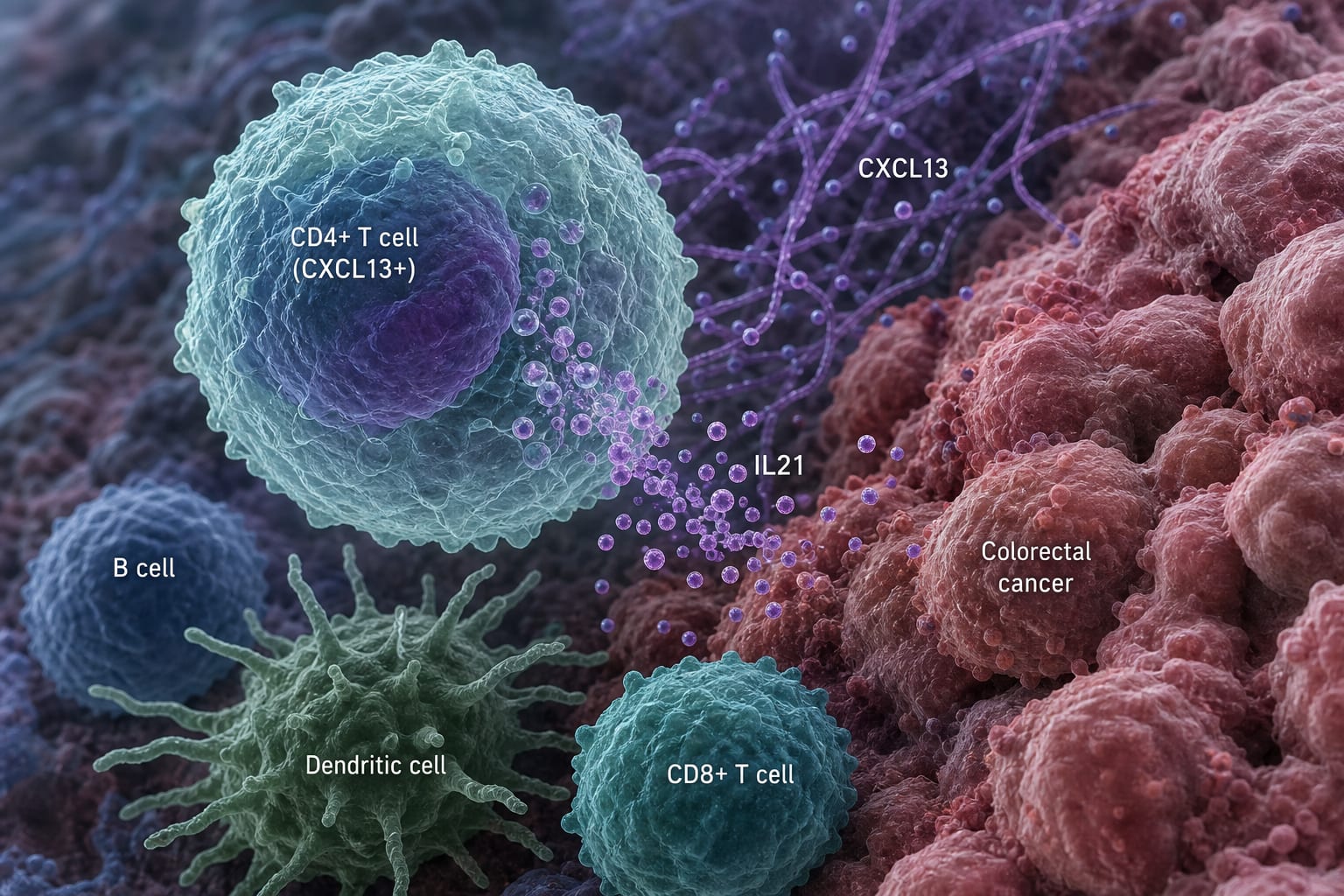
  • Exogenous IL21 induces transcriptional changes in murine colorectal tumor tissues, activating immune pathways.
  • SCENIC analysis identifies key transcription factors associated with CXCL13-associated CD4+ T cell subsets.

Guideline-Based Recommendations

Diagnosis

  • Utilize single-cell RNA sequencing to characterize immune cell populations in colorectal cancer.

Management

  • Consider the role of IL21 in shaping the immune microenvironment when developing immunotherapy strategies.

Monitoring & Follow-up

  • Assess IL21 levels and associated CD4+ T cell populations in tumor microenvironments.

Risks

  • Patients with microsatellite-stable colorectal cancer may derive limited benefit from current immune checkpoint inhibitors.

Patient & Prescribing Data

Patients with colorectal cancer, especially those with microsatellite-stable disease.

IL21 may serve as a potential target for enhancing antitumor immunity in colorectal cancer.

Clinical Best Practices

  • Integrate single-cell technologies to evaluate T cell diversity in colorectal cancer.
  • Focus on the functional roles of specialized CD4+ T cell subsets in the tumor microenvironment.

Related Resources & Content

Original Source(s)

Related Content