Integrating Flexible Fall-Prevention Strategies Into Primary Care: Modest Changes, Wider Impact
-
By
-
Junyi Peng
-
Rebecca Ivers
-
Maoyi Tian
-
October 16, 2026
Clinical Scorecard: Integrating Flexible Fall-Prevention Strategies Into Primary Care: Modest Changes, Wider Impact
At a Glance
| Category | Detail |
|---|---|
| Condition | Clinical topic addressed by the source article: Integrating Flexible Fall-Prevention Strategies Into Primary Care |
| Key Mechanisms | Mechanisms or clinical associations described in the source article. |
| Target Population | Population described in the source article. |
| Care Setting | Routine primary care in an integrated US health system |
Key Highlights
- The eSTEPS matched-pair cluster randomized trial included 11,945 adults aged 65 years or older across 22 primary care practices.
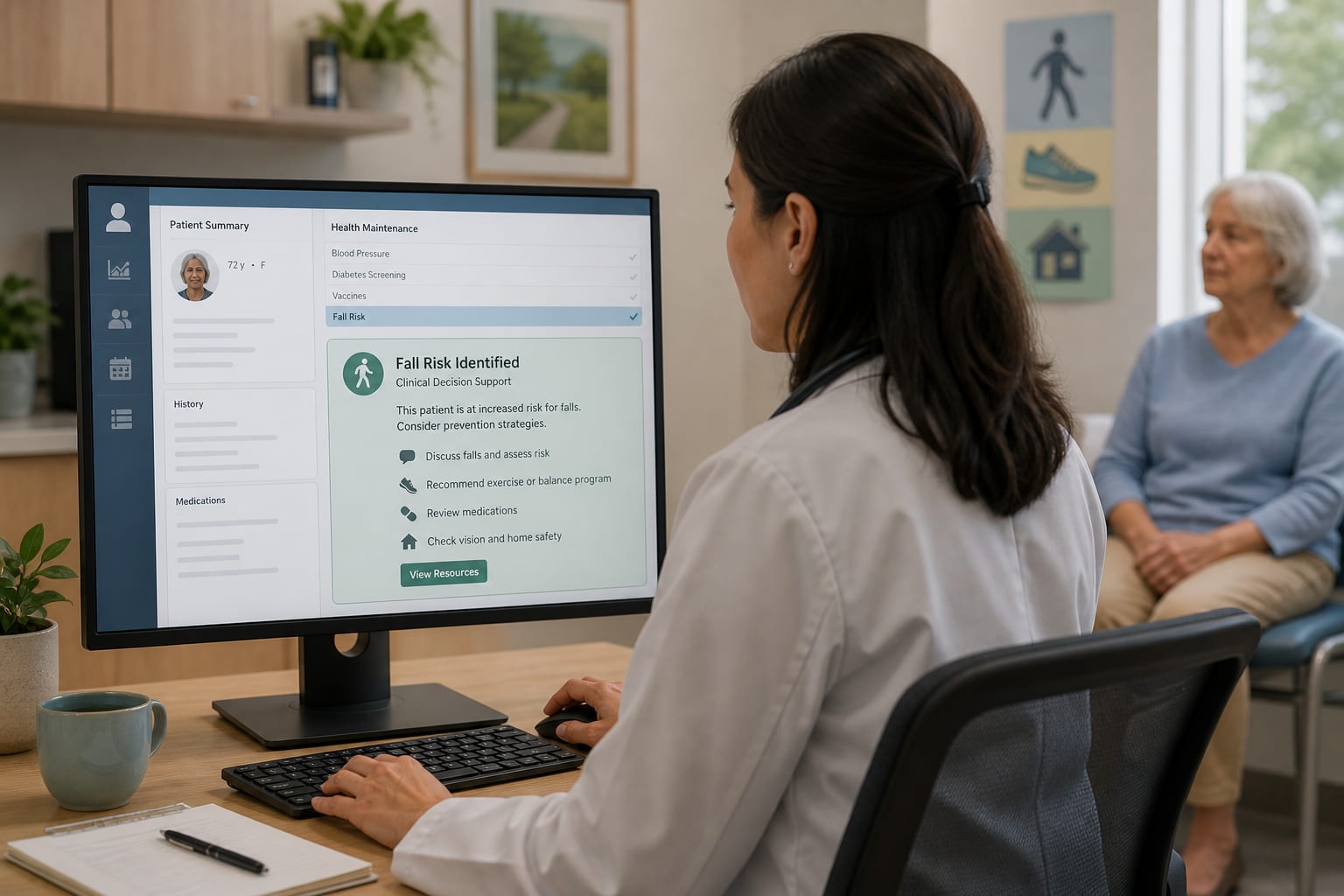
- The EHR tool provided a noninterruptive care-gap alert, individualized strength and balance exercises, optional physical therapy referral, and patient-facing materials.
- Adjusted outcome rates favored intervention practices for ICD-10–coded falls, ICD-10–coded fall-related injuries, and participant-reported falls or injuries.
- Absolute differences were approximately 1.9 fewer patients with a recorded fall and 1.0 fewer with a recorded fall-related injury per 100 patient-years.
- Exercise prescriptions were provided to 22.1% of patients in intervention practices; the trial did not include an economic evaluation.
Guideline-Based Recommendations
Diagnosis
- The eSTEPS workflow incorporated fall-risk identification and clinical decision-making into routine primary care; the article does not specify a diagnostic protocol.
Management
- The eSTEPS intervention offered individualized strength and balance exercises and an optional physical therapy referral.
Monitoring & Follow-up
- eSTEPS supplied participant-facing materials through print resources, after-visit summaries, a website, and a mobile application.
- The article notes that digital systems can extend exercise instruction, monitoring, reminders, and behavior-change support beyond the clinical encounter.
Risks
- The article identifies health limitations, financial expenses, transportation barriers, limited availability of appropriate services, and personal beliefs about falls and exercise as potential barriers to participation.
- Digital approaches may need to account for differences in technology access and digital literacy among older adults.
Patient & Prescribing Data
The eSTEPS cohort included 11,945 adults aged 65 years or older; mean age was 77.1 years, 67.3% were women, and 81.6% had a Charlson Comorbidity Index of 2 or higher.
Exercise prescriptions were provided to 22.1% of patients in intervention practices. The article notes that exercise prescription alone does not establish sustained behavioral change and discusses supplementary behavioral and social support.
Clinical Best Practices
- Integrate fall-risk identification, clinical decision-making, exercise prescription, referral options, and patient resources into established primary care workflows.
- Consider supplementary behavioral and social support to help older adults begin and continue exercise participation.
- The article describes a potential model combining EHR-based identification and exercise prescription with caregiver participation, community engagement, and suitable human support.
Related Resources & Content
Based on findings from:
Embedding Adaptable Fall-Prevention Interventions in Primary Care—Small Steps, Broad Reach
Junyi Peng, Rebecca Ivers, Maoyi Tian. Jama Network Open, 2026.
https://jamanetwork.com/journals/jamanetworkopen/fullarticle/2855393
This content is an AI-generated, fully rewritten summary based on a published scholarly article. It does not reproduce the original text and is not a substitute for the original publication. Readers are encouraged to consult the source for full context, data, and methodology.