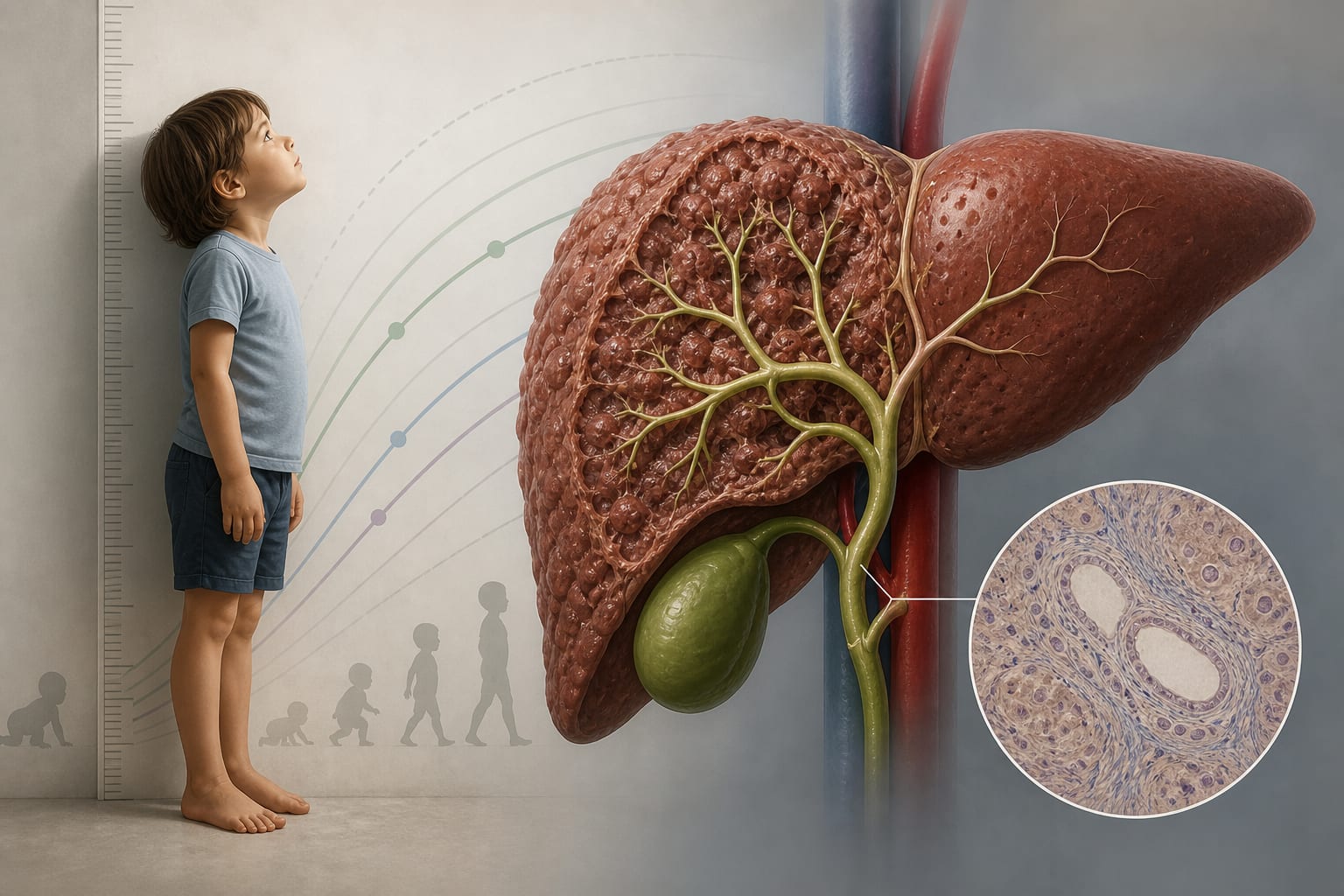
Child Growth and Fibrosis Associated with Biliary Atresia: Findings from a Retrospective Cohort Analysis
Clinical Scorecard: Child Growth and Fibrosis Associated with Biliary Atresia: Findings from a Retrospective Cohort Analysis
At a Glance
| Category | Detail |
|---|
| Condition | Biliary Atresia |
| Key Mechanisms | Inflammatory disorder affecting bile ducts, leading to liver fibrosis and potential liver failure. |
| Target Population | Children diagnosed with biliary atresia, aged 0-18 years. |
| Care Setting | Tertiary referral center for pediatric liver diseases. |
Key Highlights
- Biliary atresia occurs in approximately 1/14,000 to 1/20,000 births in Europe.
- Without treatment, children develop cirrhosis within 6 months and liver failure within 1 year.
- Growth impairment is documented in children with biliary atresia, affecting final height.
- Liver transplantation may be necessary after unsuccessful Kasai procedure.
- Liver fibrosis severity is assessed using non-invasive measures like APRI and FIB-4.
Guideline-Based Recommendations
Diagnosis
- Diagnosis of biliary atresia is confirmed through clinical evaluation and imaging.
Management
- Management includes hepato-portoenterostomy (Kasai) for bile drainage.
Monitoring & Follow-up
- Regular monitoring of growth parameters and liver function tests is essential.
Risks
- Risk of cirrhosis and liver failure without timely intervention.
Patient & Prescribing Data
Children with biliary atresia, both with and without liver transplantation.
Catch-up growth potential may be influenced by the timing of liver transplantation.
Clinical Best Practices
- Perform regular anthropometric measurements to assess growth.
- Utilize non-invasive fibrosis assessment tools like APRI and FIB-4.
- Ensure multidisciplinary care involving pediatric surgeons and hepatologists.
Related Resources & Content