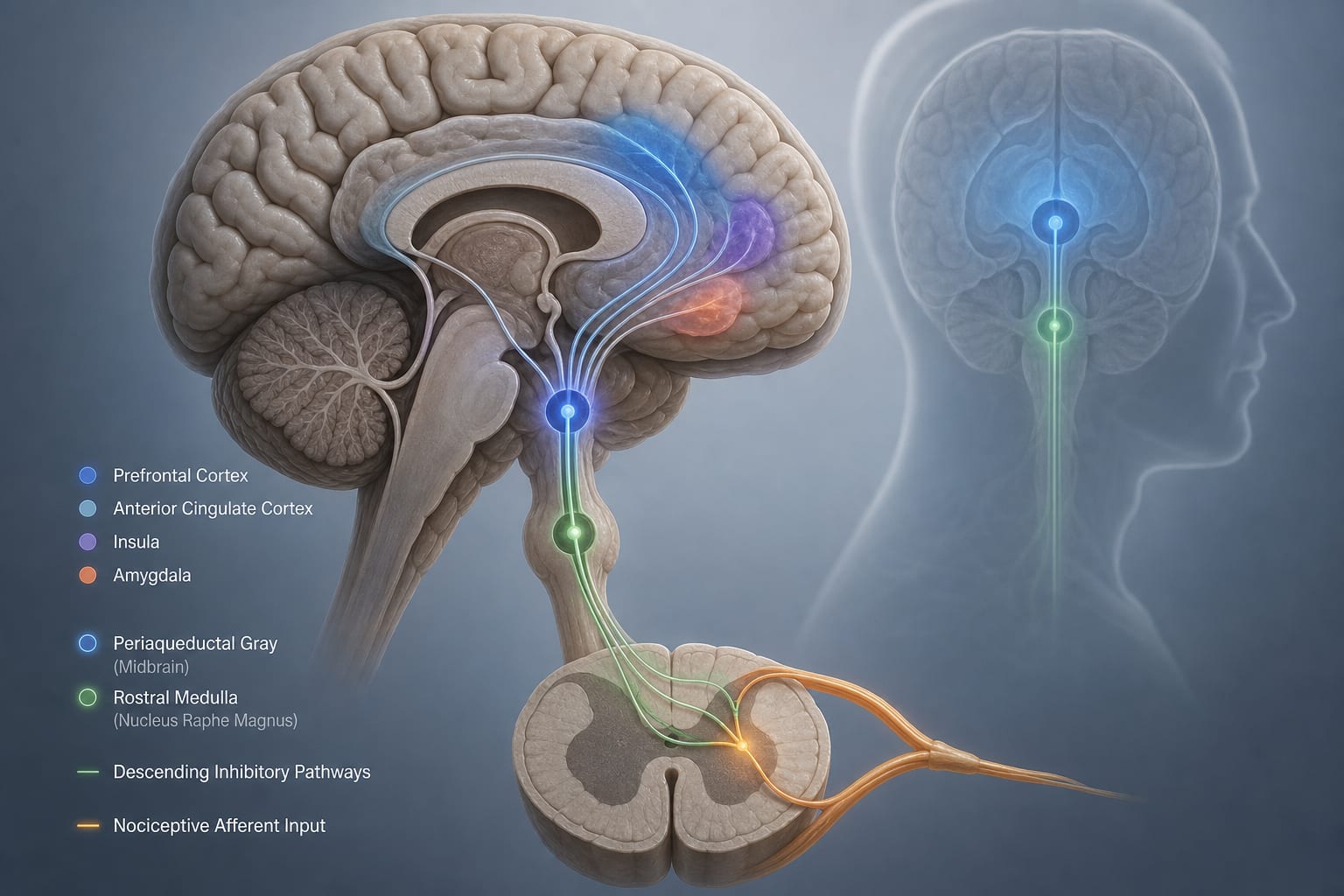
An Examination of Descending Pain Modulation Mechanisms in Humans
By
Christopher D’Souza
Eden Brander-Whittingham
Shima Hassanpour
Brieana Keast
Jessica Merletti
Matthew Kong
Hannan Algitami
Patrick Stroman
June 4, 2026
Clinical Scorecard: An Examination of Descending Pain Modulation Mechanisms in Humans
At a Glance
Category Detail
Condition Descending Pain Modulation Key Mechanisms Involves periaqueductal grey and rostral medulla as central hubs, with contributions from cortical regions. Target Population Human populations experiencing pain modulation. Care Setting Clinical and research settings focusing on pain management.
Key Highlights
Descending pain modulation involves both inhibitory and facilitatory pathways. Cognitive and emotional factors influence pain modulation through altered connectivity. Therapeutic applications include transcranial direct current stimulation and spinal cord stimulation. Guideline-Based Recommendations
Diagnosis
Utilize neuroimaging and neuropsychological assessments to evaluate descending pain pathways. Management
Consider cognitive and emotional interventions to enhance pain modulation. Monitoring & Follow-up
Assess functional connectivity in descending pain networks during treatment. Risks
Monitor for variability in pain modulation responses due to psychological factors. Patient & Prescribing Data
Individuals with pain modulation issues.
Opioid agonist treatment can enhance functional connectivity in pain modulation pathways.
Clinical Best Practices
Incorporate psychological assessments in pain management strategies. Utilize multimodal approaches to address both physiological and psychological aspects of pain. Related Resources & Content