Case Report: KIF5B-ALK–rearranged renal cell carcinoma
-
By
-
Jiaxi Yao
-
Zhifei Xie
-
Guangyao Shi
-
Ming Tan
-
Zhuo Liu
-
Min Lu
-
Hongxian Zhang
-
June 15, 2026
-
Clinical Scorecard: Case Study: Renal Cell Carcinoma Associated with KIF5B-ALK Rearrangement
At a Glance
| Category | Detail |
|---|
| Condition | ALK-rearranged renal cell carcinoma (ALK-RCC) |
| Key Mechanisms | Fusion of the ALK gene with KIF5B leading to oncogenic activation. |
| Target Population | Patients with renal cell carcinoma, particularly those with ALK rearrangements. |
| Care Setting | Oncology and surgical settings, specifically for renal tumors. |
Key Highlights
- ALK-RCC is a rare subtype, accounting for 0.3% of all RCC cases.
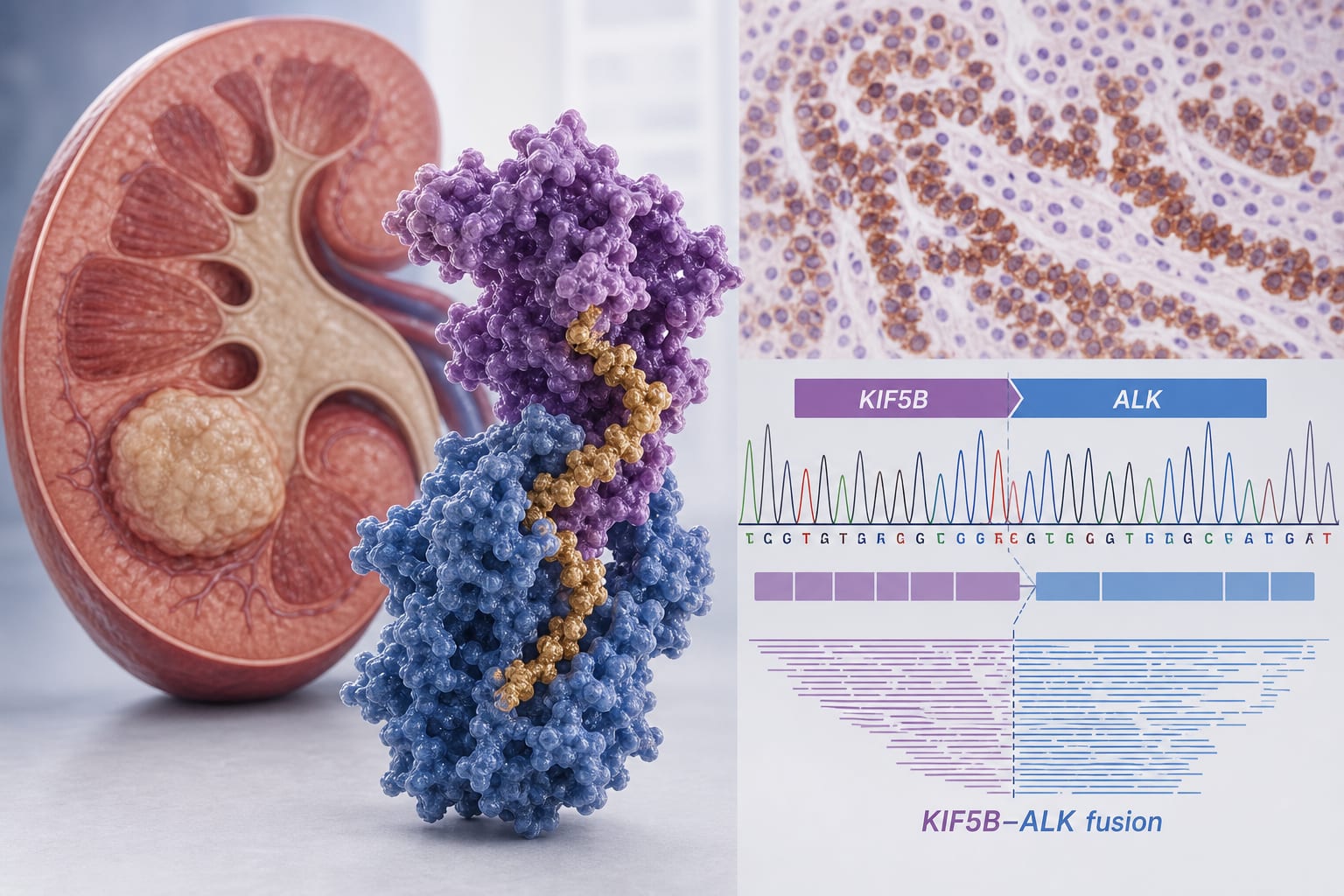
- KIF5B-ALK gene fusion confirmed via next-generation sequencing.
- Histopathological examination revealed atypical morphology and renal epithelial differentiation.
- Immunohistochemistry excluded other tumor entities.
- Management of ALK-RCC is challenging due to its rarity and limited treatment options.
Guideline-Based Recommendations
Diagnosis
- Next-generation sequencing to confirm ALK gene fusion.
Management
- Consider targeted therapies directed at the ALK gene.
Monitoring & Follow-up
- Regular imaging and clinical follow-up post-surgery.
Risks
- Limited treatment options due to the rarity of the condition.
Patient & Prescribing Data
39-year-old male with no significant medical history.
Partial nephrectomy performed with complete tumor removal.
Clinical Best Practices
- Utilize imaging techniques for accurate diagnosis.
- Perform immunohistochemistry to differentiate from other tumor types.
- Incorporate molecular testing in the diagnostic workup.
Related Resources & Content