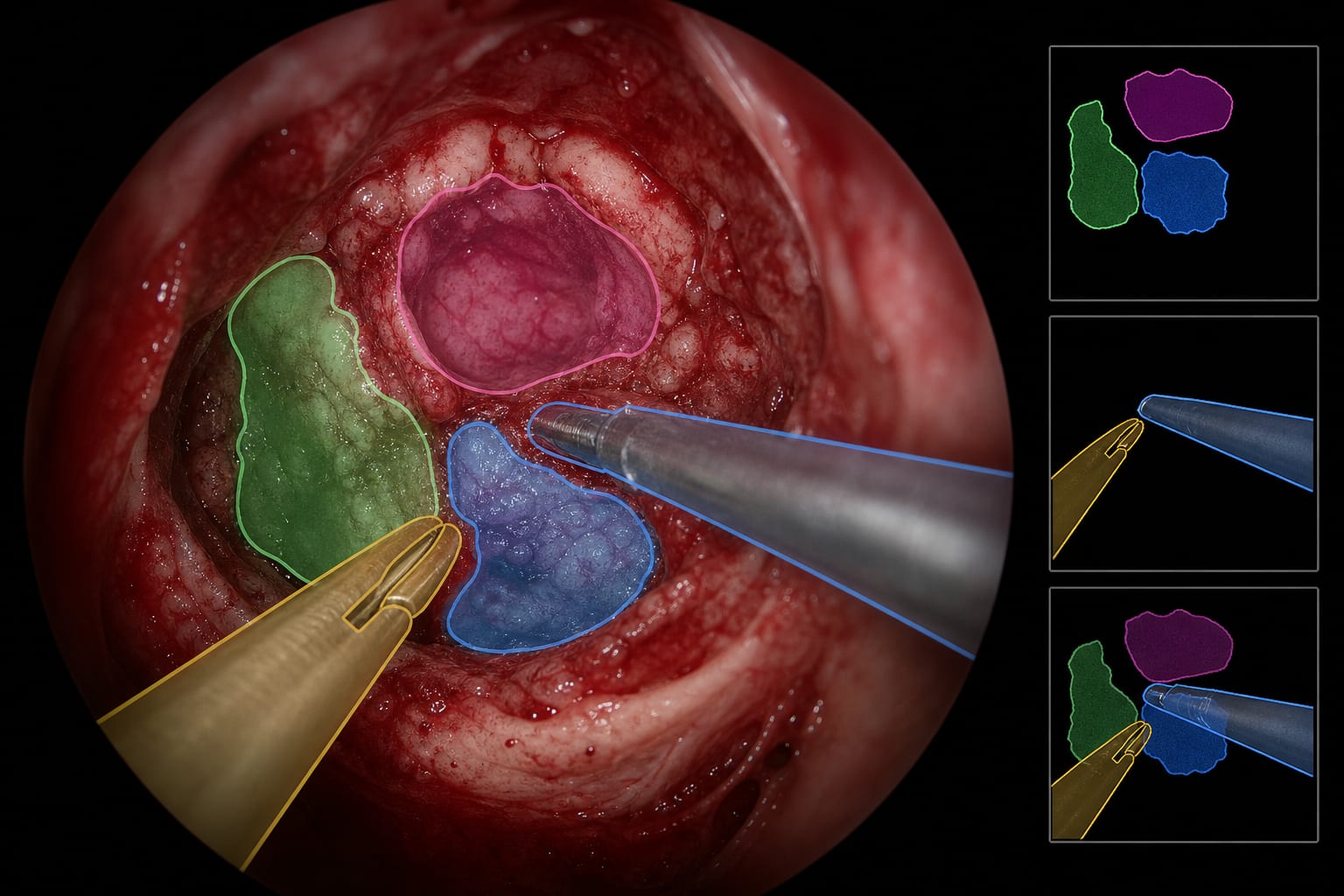
Evaluating Techniques for Segmenting Surgical Instruments in Endoscopic Pituitary Procedures
-
By
-
Kendall Feeny
-
Anjana Wijekoon
-
Wenhua Wei
-
Danyal Zaman Khan
-
Danail Stoyanov
-
Hani J. Marcus
-
Sophia Bano
-
May 21, 2026
Clinical Scorecard: Evaluating Techniques for Segmenting Surgical Instruments in Endoscopic Pituitary Procedures
At a Glance
| Category | Detail |
|---|
| Condition | |
| Key Mechanisms | Endoscopic transsphenoidal approach (eTSA) for surgical removal of pituitary adenomas, emphasizing the challenges and workflow analysis. |
| Target Population | |
| Care Setting | |
Key Highlights
- First benchmark of multi-class semantic instrument segmentation (SIS) models in eTSA pituitary surgery
- Dataset includes 50 videos and 37,547 frames with 27,934 instrument masks
- Transformer architectures outperformed convolutional models in segmentation tasks
- EoMT achieved the highest performance with 315 million trainable parameters
- Class imbalance affected performance, particularly in less frequent instrument classes
Guideline-Based Recommendations
Diagnosis
- Consider using semantic segmentation for improved diagnostic accuracy in surgical settings.
Management
- Implement training protocols that include class balance strategies for surgical teams.
Monitoring & Follow-up
- Regularly assess model performance and update training datasets to reflect current surgical practices.
Risks
- Identify potential risks associated with class imbalances in instrument recognition during surgery.
Patient & Prescribing Data
Patients undergoing endoscopic pituitary surgery
Semantic segmentation models can enhance surgical workflow analysis
Clinical Best Practices
- Utilize transformer-based architectures for improved instrument segmentation
- Address class imbalances in training datasets to enhance model performance
- Incorporate temporal modeling and domain-specific foundational models for future research
Related Resources & Content