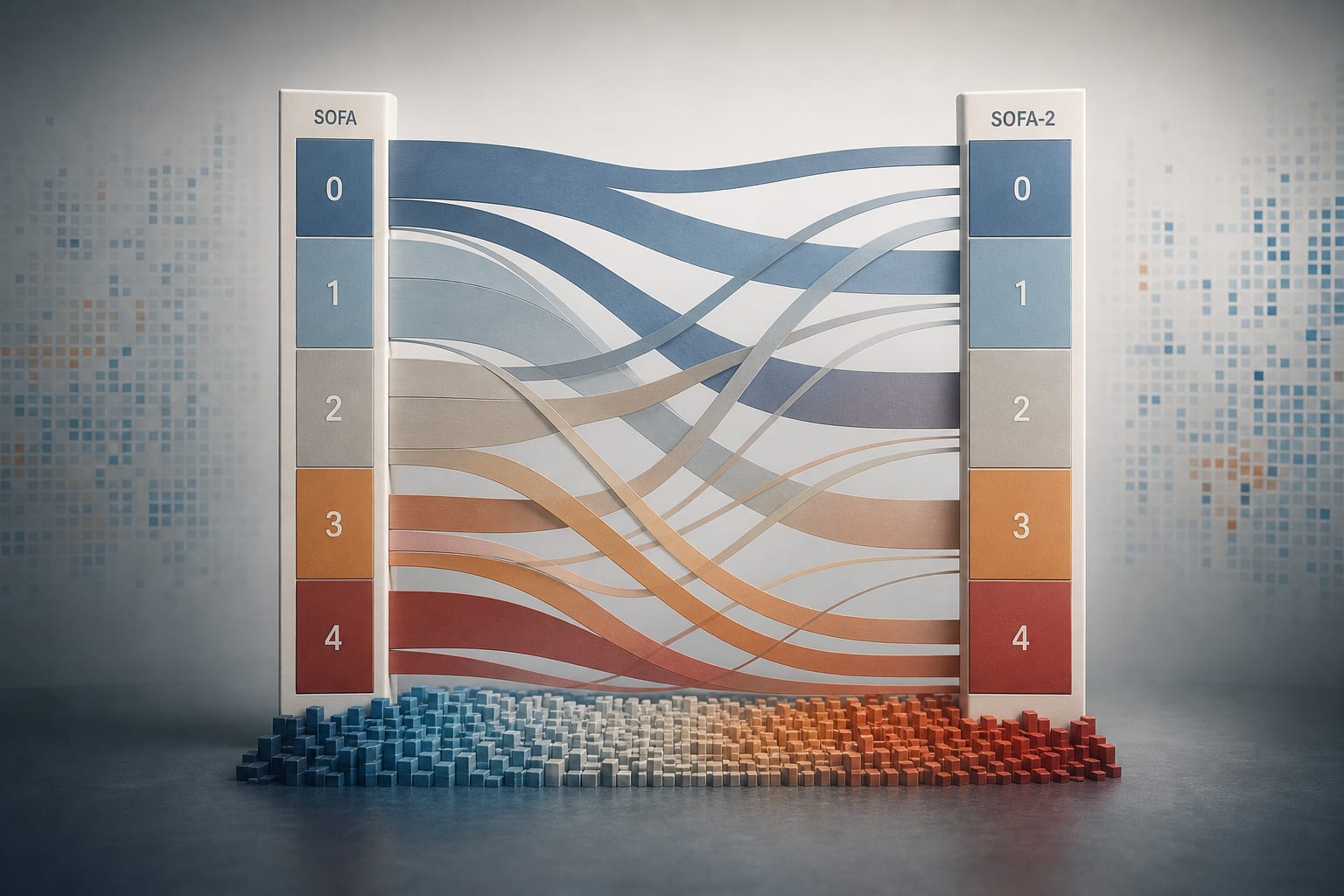
Reevaluation of SOFA-2: Assessing Data Accessibility and Enhanced Prognostic Insights
-
By
-
Dilek Kuzukıran Kocataş
-
August 20, 2026
Clinical Scorecard: Reevaluation of SOFA-2: Assessing Data Accessibility and Enhanced Prognostic Insights
At a Glance
| Category | Detail |
|---|
| Condition | Organ Dysfunction Assessment |
| Key Mechanisms | Comparison of Sequential Organ Failure Assessment (SOFA) and SOFA-2 scores |
| Target Population | Patients in intensive care units (ICUs) |
| Care Setting | ICU and critical care settings |
Key Highlights
- SOFA-2 improves data accessibility for organ dysfunction assessment.
- Significant differences in data availability between SOFA and SOFA-2 components.
- dSOFA (difference between SOFA-2 and SOFA) does not directly indicate incremental prognostic value.
- Weighting strategies and their implications for analysis require clearer specification.
- Matching analyses reveal heterogeneity in mortality risk despite identical severity levels.
Guideline-Based Recommendations
Diagnosis
- Utilize SOFA-2 for improved classification of organ dysfunction.
Management
- Consider the implications of data availability on score interpretation.
Monitoring & Follow-up
- Assess the impact of score discordance on patient outcomes.
Risks
- Be aware of potential biases introduced by unequal data availability.
Patient & Prescribing Data
ICU admissions with varying degrees of organ dysfunction.
SOFA-2 allows for more effective use of routinely available clinical data.
Clinical Best Practices
- Conduct sensitivity analyses to assess the impact of missing data on score classification.
- Report and clarify covariates used in propensity-score models.
- Directly test the incremental prognostic value of score discordance.
Related Resources & Content