Relationship between family–school–peer risks and problematic Internet use among boarding high school students in China: based on a latent profile analysis - Scorecard - MDSpire
Advertisement
Relationship between family–school–peer risks and problematic Internet use among boarding high school students in China: based on a latent profile analysis
Clinical Scorecard: Exploring the Impact of Family, School, and Peer Risk Factors on Problematic Internet Use in Chinese Boarding High School Students: A Latent Profile Analysis Approach
At a Glance
Category
Detail
Condition
Problematic Internet Use
Key Mechanisms
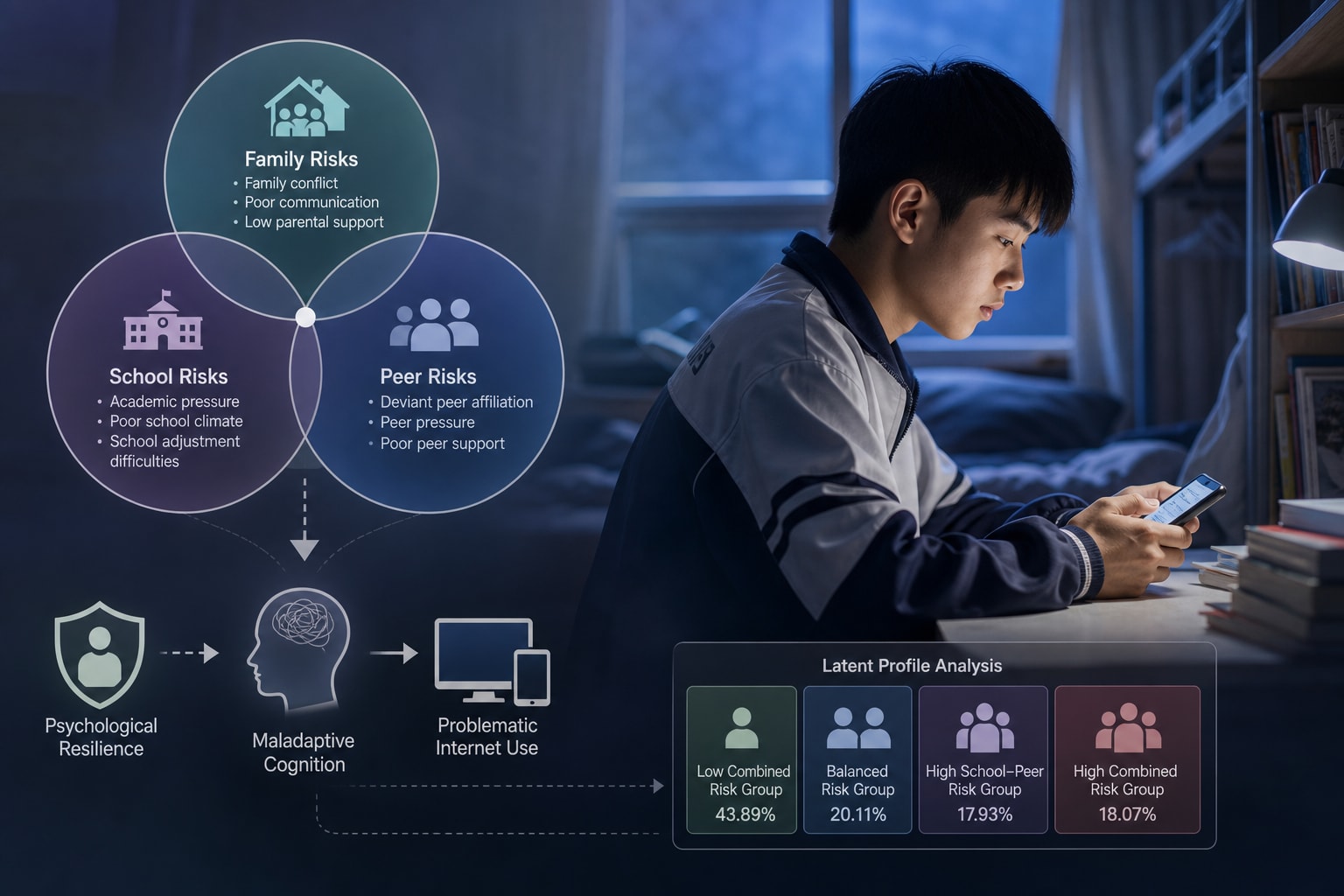
Family, school, and peer risk configurations; maladaptive cognition; psychological resilience
Target Population
Chinese boarding high school students
Care Setting
Educational and psychological contexts
Key Highlights
Four risk profiles identified: Low Combined Risk Group, Balanced Risk Group, High School–Peer Risk Group, High Combined Risk Group
High Combined Risk Group reported the highest level of problematic Internet use
Maladaptive cognition partially mediates the association between high-risk profiles and problematic Internet use
Psychological resilience attenuates the direct association between risk profiles and problematic Internet use
Guideline-Based Recommendations
Diagnosis
Assess configurations of family, school, and peer risks in adolescents
Management
Implement interventions targeting maladaptive cognition and enhancing psychological resilience
Monitoring & Follow-up
Regularly evaluate students' Internet use patterns and associated risk factors
Risks
Consider the impact of low family socioeconomic status, parent–child conflict, teacher–student conflict, deviant peer affiliation, and peer victimization
Patient & Prescribing Data
Boarding high school students in China
Focus on psychological resilience and cognitive-behavioral strategies
Clinical Best Practices
Utilize latent profile analysis to identify risk configurations
Incorporate ecological systems perspective in assessments
Address both environmental and cognitive factors in interventions