Automated surgical phase recognition in pediatric laparoscopic fundoplication using deep learning: a retrospective video-based study - Scorecard - MDSpire
Clinical Scorecard: Deep Learning–Based Identification of Surgical Phases in Pediatric Laparoscopic Fundoplication: A Retrospective Video Study
At a Glance
Category
Detail
Condition
Surgical phase recognition during laparoscopic fundoplication
Key Mechanisms
Deep learning analysis of operative video to classify surgical phases, reconstruct workflow, and estimate phase duration.
Target Population
Patients undergoing laparoscopic fundoplication at University of Tsukuba Hospital from January 2015 through December 2025; the final retrospective dataset included 38 videos. Ages at surgery ranged from 4 to 316 months.
Care Setting
Hospital-based laparoscopic surgery and retrospective surgical-video analysis.
Key Highlights
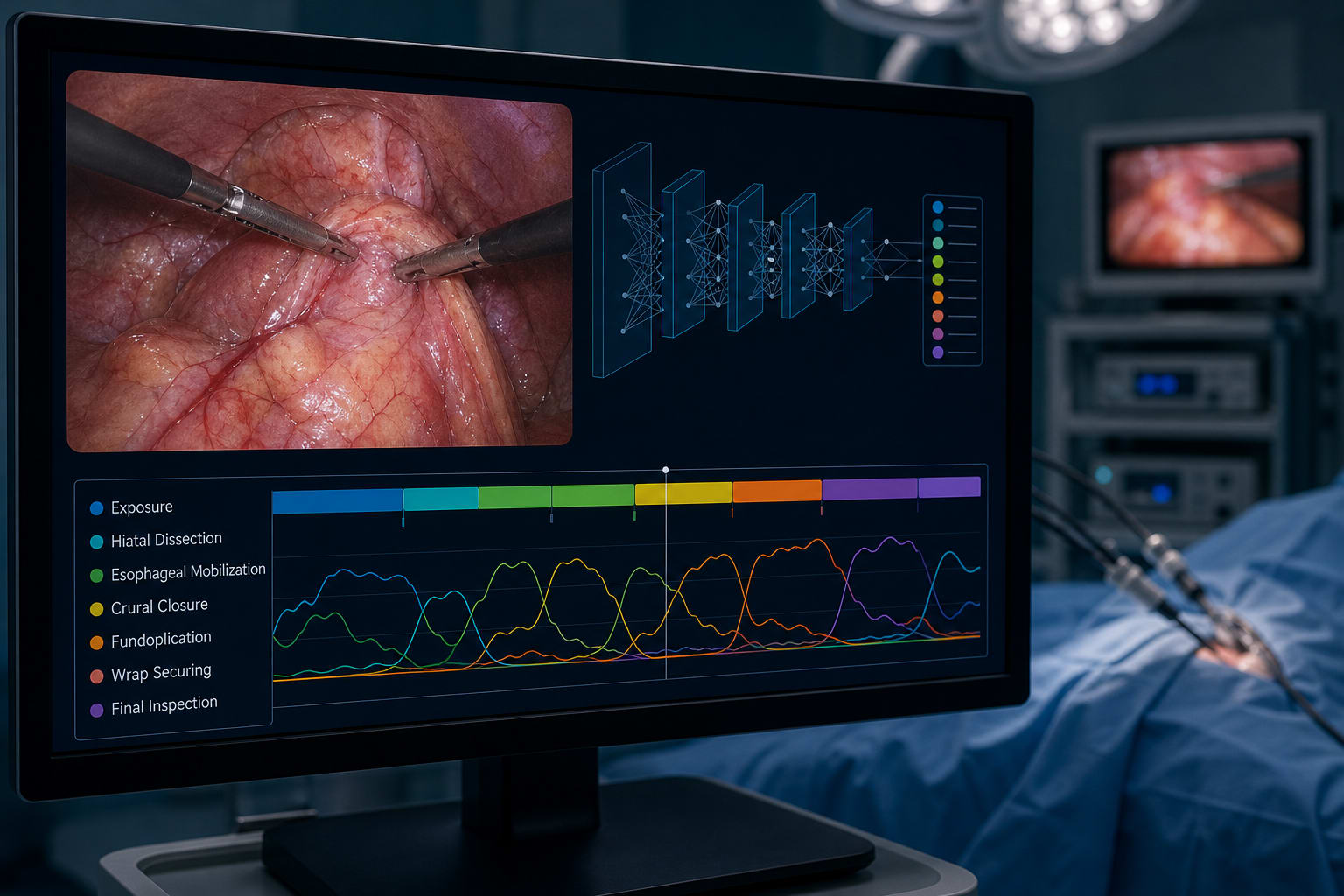
The study developed a deep learning system to recognize phases in laparoscopic fundoplication.
The final dataset comprised 38 operative videos recorded from January 2015 through December 2025.
Investigators defined a 10-phase workflow taxonomy; phases 1–8 were principal procedural stages, phase 9 denoted camera cleaning, and phase 10 denoted nonstandard intra-abdominal scenes.
Assessment included phase classification, reconstruction of operative workflow, and estimation of phase duration.
Guideline-Based Recommendations
Diagnosis
Management
Monitoring & Follow-up
Risks
Patient & Prescribing Data
The final sample included 38 patients undergoing laparoscopic fundoplication. Ages at surgery ranged from 4 to 316 months; 4 patients were at least 18 years old.
This was a retrospective video-analysis study, not a treatment comparison. The source describes fundoplication technique and operative workflow but provides no prescribing recommendations.
Harold Burstein, MD, PhD, and Laura S. Dominici, MD, FACS, discuss highlights from the SENOMAC trial which sheds light on whether some patients with early breast cancer and limited lymph node involvement can safely avoid additional axillary surgery.
Breast cancer management is becoming increasingly biology-driven, with treatment decisions extending well beyond anatomic stage and conventional receptor classification.