High FCRL5 expression predicts poor treatment response and survival in newly diagnosed multiple myeloma: a retrospective study
-
By
-
Cainan Yu
-
Minghua Zhang
-
Jie Hui
-
Mengqing Zhu
-
Zengtian Sun
-
Yueyue Sun
-
Qian Sun
-
Zhiling Yan
-
Feng Zhu
-
Mingshan Niu
-
Depeng Li
-
Kunming Qi
-
June 29, 2026
-
Clinical Scorecard: Elevated FCRL5 Levels Correlate with Adverse Treatment Outcomes and Survival Rates in Newly Diagnosed Multiple Myeloma: A Retrospective Analysis
At a Glance
| Category | Detail |
|---|
| Condition | Newly Diagnosed Multiple Myeloma |
| Key Mechanisms | High FCRL5 expression correlates with inferior treatment response and survival outcomes. |
| Target Population | Patients with newly diagnosed multiple myeloma (NDMM). |
| Care Setting | Single-center retrospective study. |
Key Highlights
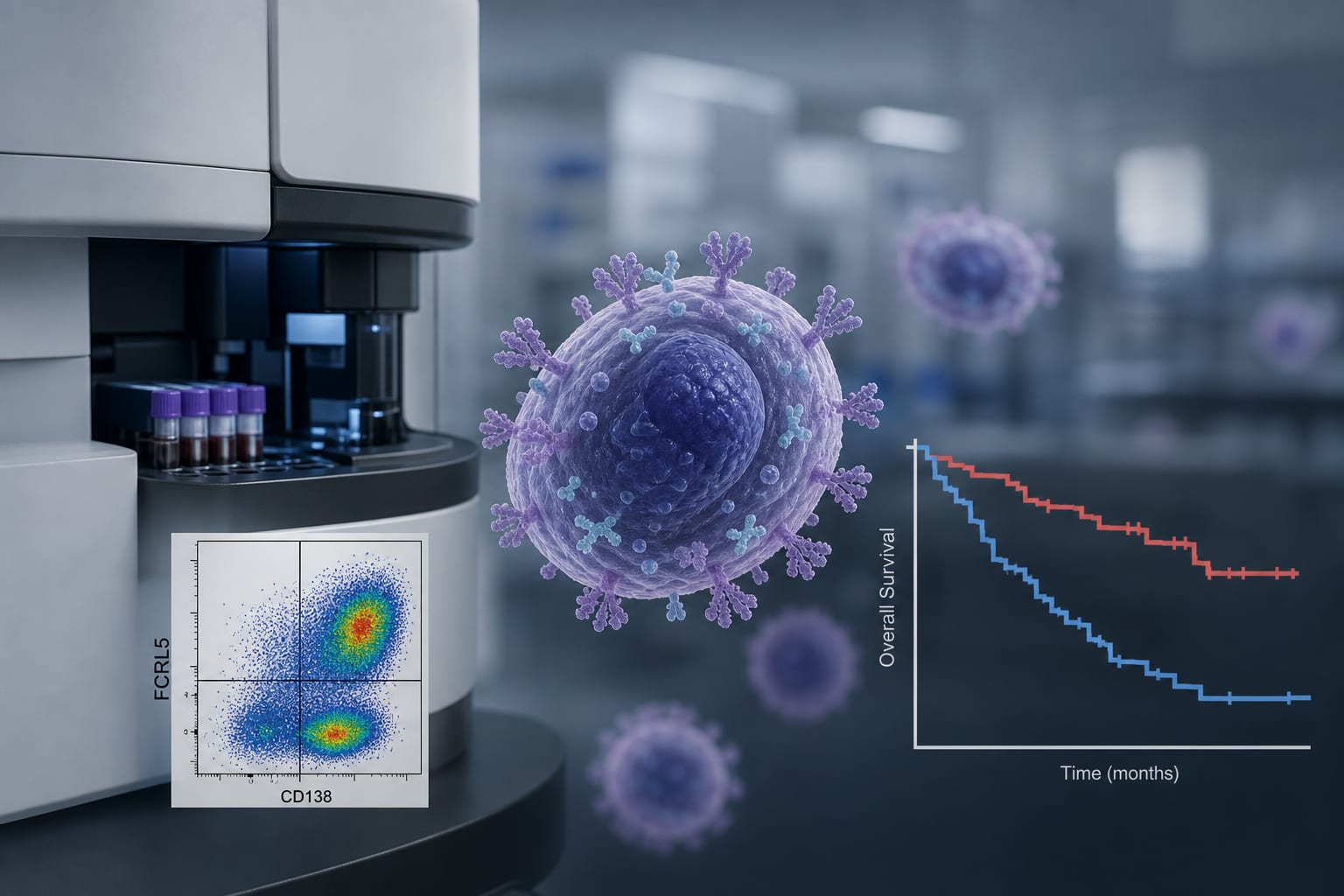
- High FCRL5 expression linked to lower complete response rates (25.93% vs. 51.85%).
- Median progression-free survival (PFS) significantly shorter in high FCRL5 group (10.6 months vs. not reached).
- High FCRL5 expression identified as an independent adverse prognostic factor for both PFS and overall survival (OS).
Guideline-Based Recommendations
Diagnosis
- Confirmed NDMM diagnosis per the 2016 diagnostic criteria established by the International Myeloma Working Group.
Management
- Consider FCRL5 expression levels for risk stratification in treatment planning.
Monitoring & Follow-up
- Monitor treatment response and survival outcomes in relation to FCRL5 expression.
Risks
- High FCRL5 expression associated with aggressive disease features and inferior survival outcomes.
Patient & Prescribing Data
54 patients with NDMM treated between January 2024 and January 2025.
High FCRL5 expression may indicate a need for more aggressive treatment strategies.
Clinical Best Practices
- Utilize FCRL5 as a biomarker for early risk stratification in NDMM.
- Incorporate FCRL5 expression analysis in routine clinical assessments.
Related Resources & Content