Case Report: Iatrogenic left main coronary artery dissection during premature ventricular contraction ablation managed with emergent coronary artery bypass grafting - Scorecard - MDSpire
Conexiant’s news site is now MDSpire News. Learn more
Advertisement
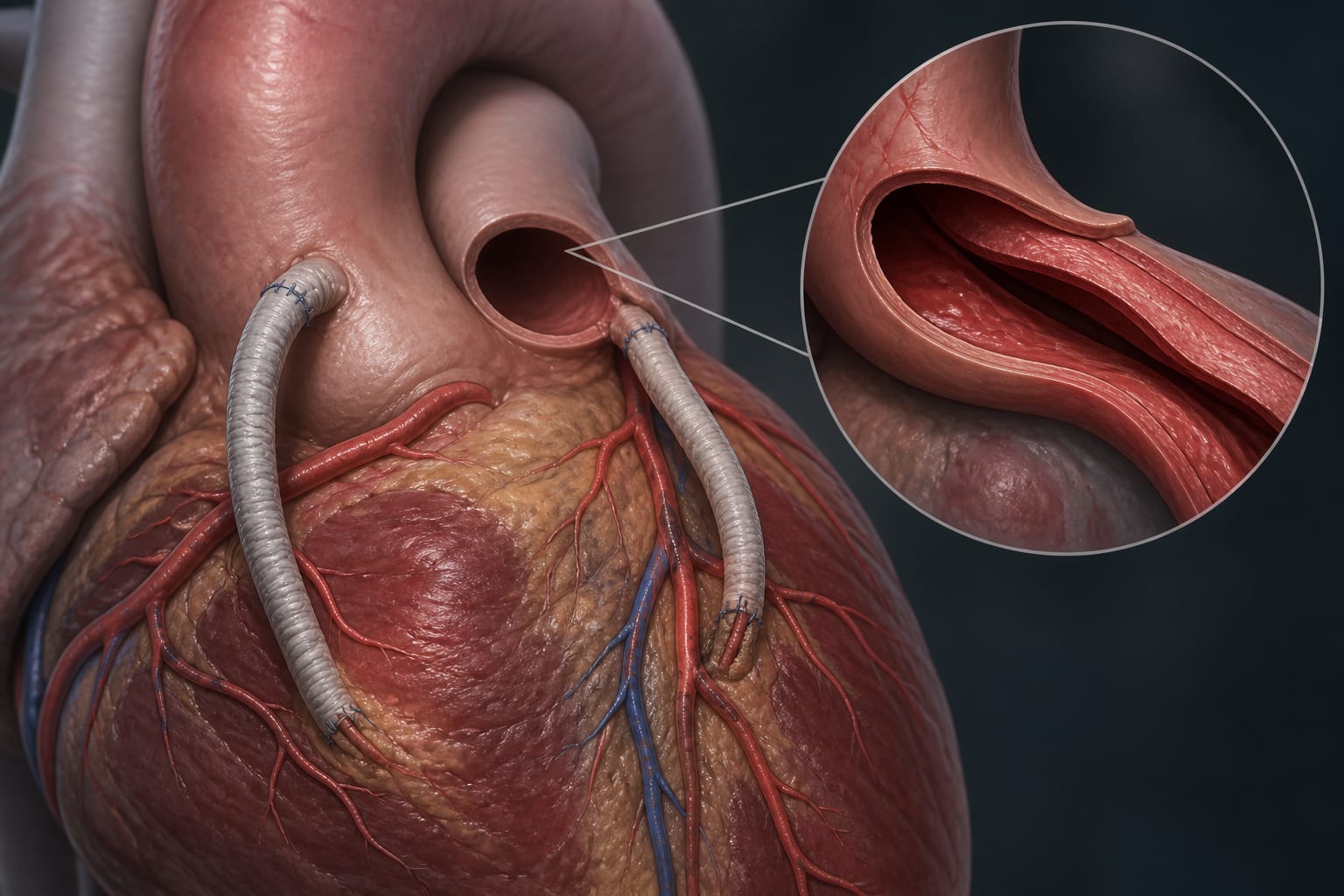
Management of Iatrogenic Left Main Coronary Artery Dissection During Ablation of Premature Ventricular Contractions with Emergency Coronary Artery Bypass Grafting: A Case Study
Clinical Scorecard: Management of Iatrogenic Left Main Coronary Artery Dissection During Ablation of Premature Ventricular Contractions with Emergency Coronary Artery Bypass Grafting: A Case Study
At a Glance
Category
Detail
Condition
Iatrogenic Left Main Coronary Artery Dissection
Key Mechanisms
Iatrogenic injury during PVC ablation leading to dissection and occlusion.
Target Population
Patients undergoing PVC ablation with risk of coronary artery injury.
Care Setting
Elective ablation procedures in a cardiac care environment.
Key Highlights
Iatrogenic LMCA dissection is a rare but serious complication of PVC ablation.
Emergent CABG was successfully performed following LMCA dissection.
IVUS was crucial for assessing dissection extent and guiding management.
Prompt recognition of ST-segment elevation is essential for timely intervention.
Multidisciplinary Heart Team involvement is critical in managing acute complications.
Guideline-Based Recommendations
Diagnosis
Perform emergent coronary angiography in cases of acute chest pain post-ablation.
Management
Consider emergent CABG for hemodynamically unstable patients with LMCA dissection.
Monitoring & Follow-up
Continuous monitoring for ST-segment changes during and after ablation procedures.
Risks
Iatrogenic coronary artery injury during catheter ablation procedures.
Patient & Prescribing Data
60-year-old male with symptomatic, medication-refractory PVCs.
CABG was chosen over PCI due to high-risk anatomy and hemodynamic instability.
Clinical Best Practices
Utilize IVUS for detailed assessment of coronary artery dissections.
Activate a Heart Team early in cases of acute coronary complications.
Surveys captured nearly 7 times as many menopause observations as structured clinical records, with high agreement when both sources identified menopause.