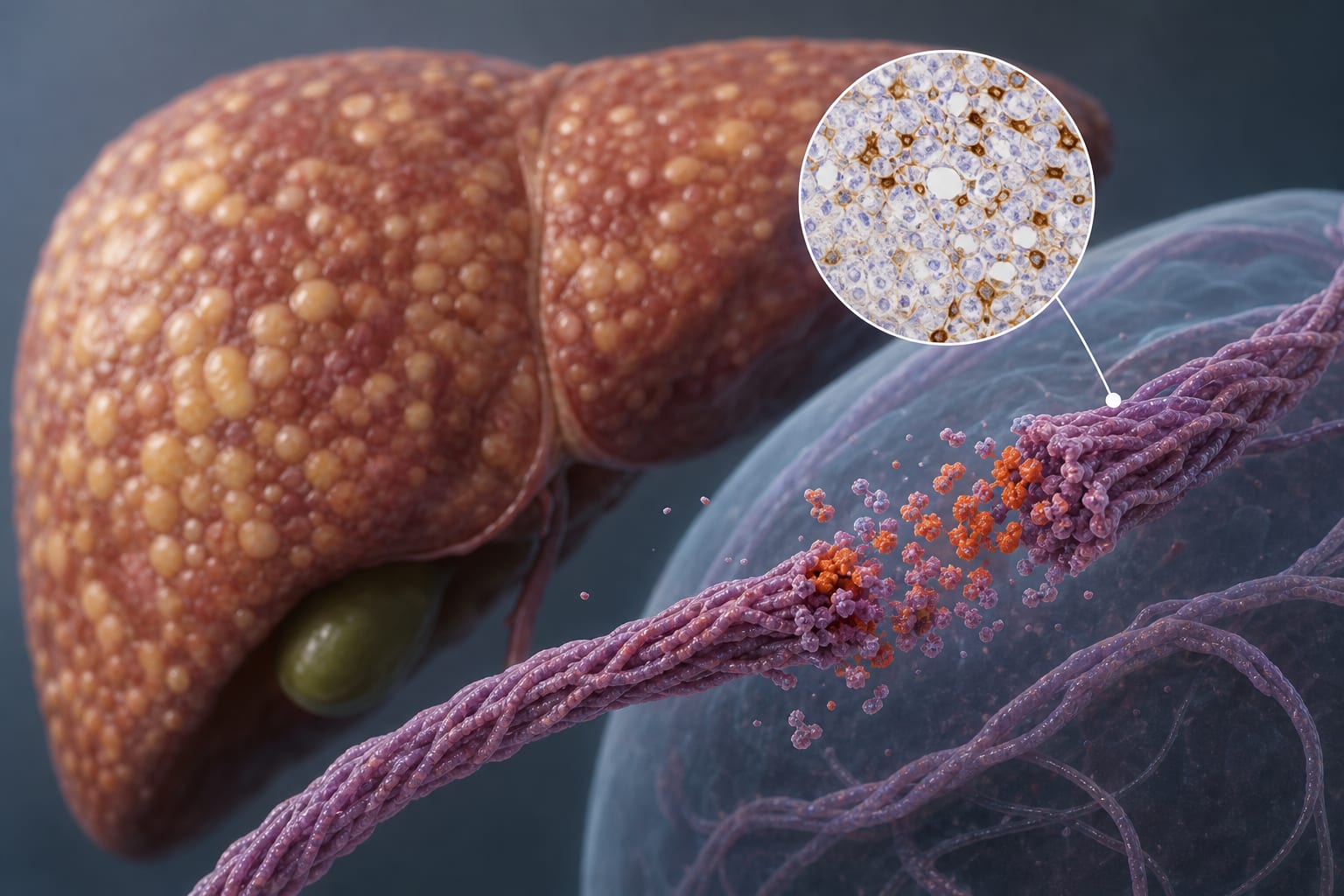
Increased FASN-driven lipogenesis in aged macrophages plays a role in the advancement of liver fibrosis
-
By
-
Hongliang Dong
-
Chuanfang Shu
-
Ran Liu
-
Mingpei Zhao
-
Kaiyue Zhang
-
Ziqun Qu
-
Lili Wang
-
Jing Fan
-
Wei Ye
-
July 14, 2026
Clinical Scorecard: Increased FASN-driven lipogenesis in aged macrophages plays a role in the advancement of liver fibrosis
At a Glance
| Category | Detail |
|---|
| Condition | Liver fibrosis |
| Key Mechanisms | FASN-mediated enhancement of fatty acid synthesis and cellular senescence in macrophages |
| Target Population | Middle-aged individuals with chronic liver diseases |
| Care Setting | Clinical research and pathology |
Key Highlights
- Middle-aged mice exhibited more severe liver fibrosis compared to young mice.
- Senescent macrophages showed upregulation of pro-inflammatory cytokines and chemokines.
- FASN protein stability was affected by both ubiquitin-proteasome and autophagy pathways.
- Conditioned medium from senescent macrophages promoted hepatic stellate cell activation.
- Pharmacological inhibition of FASN reduced DNA damage response in senescent macrophages.
Guideline-Based Recommendations
Diagnosis
- Evaluate liver function and immune microenvironment through histopathology and serum biochemistry.
Management
- Consider targeting senescent macrophages and FASN in therapeutic strategies for liver fibrosis.
Monitoring & Follow-up
- Monitor hepatic collagen deposition and fibrosis progression in patients with chronic liver diseases.
Risks
- Increased risk of cirrhosis and hepatocellular carcinoma due to advanced liver fibrosis.
Patient & Prescribing Data
Individuals with chronic liver diseases, particularly those aged 12 months or older.
Pharmacological strategies targeting FASN may mitigate liver fibrosis progression.
Clinical Best Practices
- Assess the presence of senescent macrophages in fibrotic livers.
- Utilize transcriptome sequencing to identify regulatory pathways in liver fibrosis.
- Implement strategies to modulate the senescence-associated secretory phenotype (SASP).
Related Resources & Content