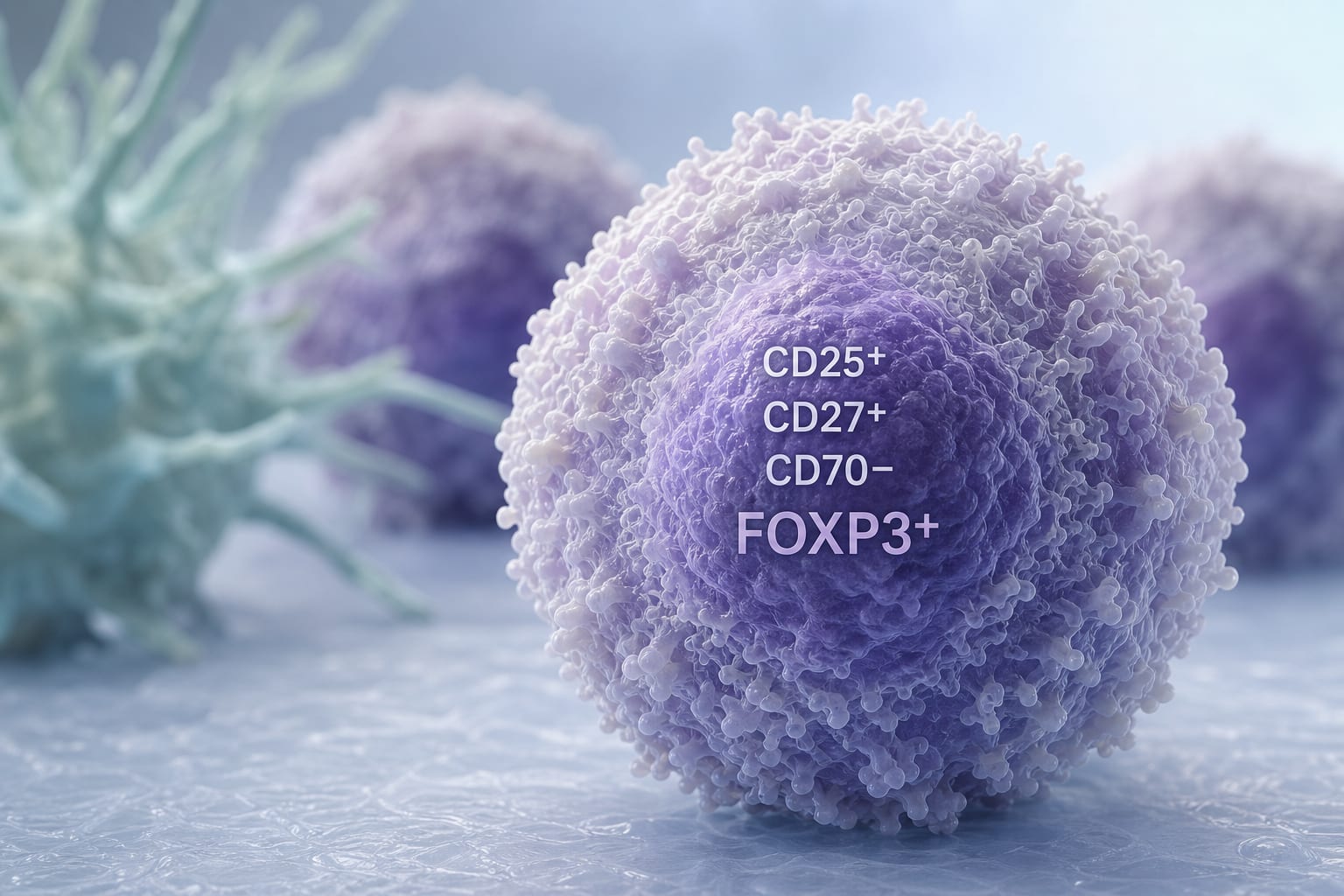
CD25+CD27+CD70− alloantigen-specific Tregs: promising stable immunotherapy for transplantation
By
Arimelek Cortés-Hernández
Saúl Arteaga-Cruz
Iyari I. Martínez Iturbe
Katya Rosas-Cortina
Marco A. Vigil Mora
Erick Legorreta-Anguiano
Judith E. Reyes Barrientos
Evelyn K. Álvarez-Salazar
Alejandra Cervera
Beatriz E. Sánchez-Hernández
Armando Gamboa Domínguez
Gloria Soldevila
June 10, 2026
Clinical Scorecard: Isolation and Expansion of CD25+CD27+CD70− Alloantigen-Specific Tregs: A Stable Approach for Immunotherapy in Transplantation
At a Glance
Category Detail
Condition Transplantation and allograft tolerance Key Mechanisms Isolation and expansion of CD25+CD27+CD70− alloantigen-specific regulatory T cells (AS-Tregs) Target Population Transplant recipients requiring immune regulation Care Setting Clinical transplantation and immunotherapy
Key Highlights
Developed a strategy for isolating and expanding CD25+CD27+CD70− AS-Tregs. Achieved >95% purity and 434-fold expansion of AS-Tregs. Expanded AS-Tregs maintained >60% FOXP3-TSDR demethylation. Exhibited robust immunoregulatory phenotype and antigen-specific suppression. Demonstrated resilience under inflammatory conditions. Guideline-Based Recommendations
Diagnosis
Identify potential transplant recipients with low circulating FOXP3+ Tregs. Management
Utilize expanded CD27+ AS-Tregs for promoting allograft tolerance. Monitoring & Follow-up
Assess FOXP3-TSDR demethylation and immunoregulatory signatures post-expansion. Risks
Monitor for potential pathogenic conversion of Tregs during ex vivo expansion. Patient & Prescribing Data
Transplant recipients at risk of rejection
Expanded AS-Tregs may reduce reliance on systemic immunosuppression.
Clinical Best Practices
Integrate alloantigen-driven proliferation with CD27+ selection. Ensure phenotypic homogeneity and lineage stability in expanded Tregs. Utilize chemokine receptors for effective homing to lymphoid tissues and graft sites. Related Resources & Content