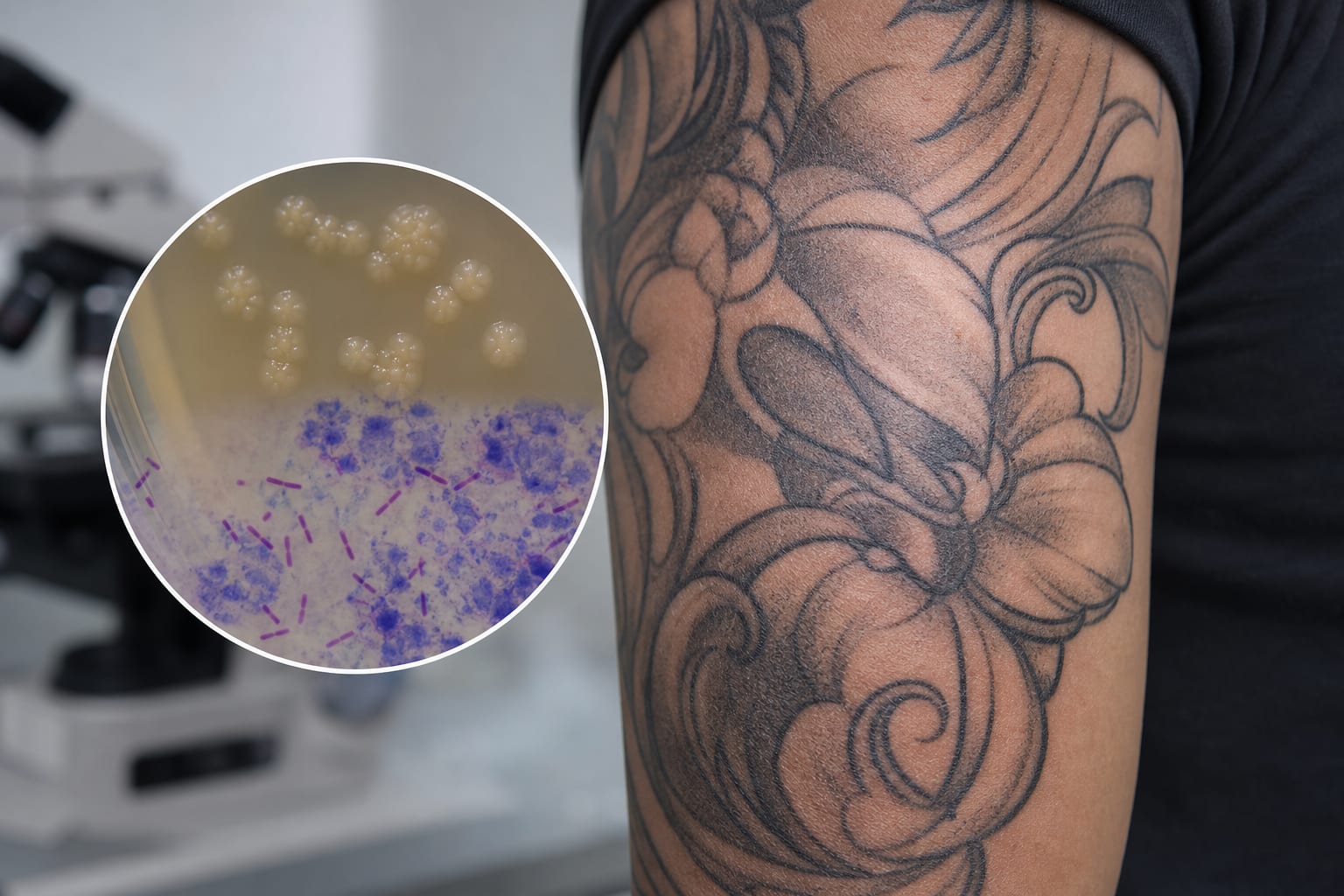
Asymptomatic Cutaneous Nontuberculous Mycobacterial Infection Following Tattooing: A Case Report
-
By
-
Chris Alihosseini
-
Milana Stein
-
Ana Sofia Acosta Madiedo
-
Roksana Hesari
-
Matthew Kauffman
-
Martin N Zaiac
-
October 30, 2026
Clinical Scorecard: Asymptomatic Cutaneous Nontuberculous Mycobacterial Infection Following Tattooing: A Case Report
At a Glance
| Category | Detail |
|---|---|
| Condition | Clinical topic addressed by the source article: Asymptomatic Cutaneous Nontuberculous Mycobacterial Infection Following Tattooing |
| Key Mechanisms | NTM can cause skin and soft tissue infection after direct inoculation, including during tattooing; tattoo-associated infections have frequently involved rapidly growing mycobacteria. |
| Target Population | Patients with atypical eruptions in tattooed skin, including asymptomatic papules and patients without typical local or systemic infection symptoms. |
| Care Setting | Care setting described in the source article. |
Key Highlights
- A 28-year-old immunocompetent man developed an asymptomatic eruption two months after tattooing, affecting tattooed skin at two separate sites.
- Papules were concentrated in gray and blue tattooed regions; the patient had no local or systemic symptoms.
- Biopsy showed folliculitis and lichenoid vacuolar interface dermatitis rather than the granulomatous inflammation often associated with cutaneous NTM.
- Acid-fast bacilli culture confirmed NTM infection; prolonged incubation can delay diagnosis.
- After confirmation of M abscessus complex, treatment was planned with doxycycline 100 mg twice daily and clarithromycin 500 mg for three months; the source does not state clarithromycin frequency.
Guideline-Based Recommendations
Diagnosis
- The authors advise considering infection in atypical tattoo-associated eruptions, including chronic papules restricted to tattoo pigment, even when classic infectious symptoms are absent.
- In this case, skin biopsy was used for histopathologic assessment and tissue culture, including acid-fast bacilli culture.
- The authors note that histopathology alone may not identify NTM: this case had an atypical lichenoid vacuolar interface pattern.
Management
- While cultures were pending, this patient received triamcinolone acetonide 0.1% ointment twice daily and doxycycline 100 mg for one week; the source describes this as empiric treatment consistent with standard treatment of inflammatory tattoo reactions.
- After M abscessus complex was confirmed, treatment was escalated to doxycycline 100 mg twice daily and clarithromycin 500 mg, planned for three months; clarithromycin frequency is not specified in the source.
- The authors describe prolonged dual-agent therapy for mild NTM skin and soft tissue infection as consistent with recommendations intended to minimize antimicrobial resistance risk.
Monitoring & Follow-up
- The authors note that prolonged culture incubation can delay organism growth and diagnosis.
- The article does not specify a clinical follow-up or laboratory monitoring schedule.
Risks
- The article notes that tattoo-associated NTM infection may be underrecognized because of an indolent course, variable morphology, and delayed culture growth.
- The authors state that misdiagnosis may delay appropriate therapy, lead to unnecessary treatment, and prolong morbidity.
- The source describes M abscessus complex as recognized for multidrug resistance.
Patient & Prescribing Data
A 28-year-old immunocompetent man with asymptomatic papules in tattooed areas on the right upper arm and left calf, beginning two months after tattooing.
While cultures were pending, he received empiric triamcinolone acetonide 0.1% ointment twice daily and doxycycline 100 mg for one week. Following culture confirmation of M abscessus complex, doxycycline 100 mg twice daily plus clarithromycin 500 mg was planned for three months; the source does not specify clarithromycin frequency.
Clinical Best Practices
- The authors recommend including infection in the differential diagnosis of atypical tattoo reactions, even without pain, pruritus, erythema, fever, or other systemic symptoms.
- In this case, separate tattoo sites were affected and lesions were concentrated in tattooed pigment; the authors considered an inoculation-related etiology.
- The authors used microbiologic testing, including acid-fast bacilli culture, because histopathologic findings may be atypical.
- The authors note that culture confirmation may require prolonged incubation.
Related Resources & Content
- Gonzalez-Santiago TM, Drage LA. Nontuberculous mycobacteria: skin and soft tissue infections. Dermatol Clin. 2015;33(3):563-577.
- Wang XY, Jia QN, Li J. Treatment of non-tuberculosis mycobacteria skin infections. Front Pharmacol. 2023;14:1242156.
- Chalarca-Cañas D, et al. Tattoos: risks and complications, clinical and histopathological approach. An Bras Dermatol. 2024;99(4):491-502.
Based on findings from:
Asymptomatic Tattoo-Associated Cutaneous Nontuberculous Mycobacterial Infection: Case Report
Chris Alihosseini, Milana Stein, Ana Sofia Acosta Madiedo, Roksana Hesari, Matthew Kauffman, Martin N Zaiac. Jmir Dermatology, 2026.
https://derma.jmir.org/2026/1/e108587
This content is an AI-generated, fully rewritten summary based on a published scholarly article. It does not reproduce the original text and is not a substitute for the original publication. Readers are encouraged to consult the source for full context, data, and methodology.