Clinical Scorecard: Optimal Timing for Parathyroidectomy in Candidates for Kidney Transplantation: A Systematic Review and Proposed Clinical Guidelines
At a Glance
Category
Detail
Condition
Secondary Hyperparathyroidism (SHPT)
Key Mechanisms
Parathyroidectomy (PTx) is used to manage SHPT in kidney transplant candidates, impacting graft loss and renal function.
Target Population
Adult kidney transplant candidates with severe SHPT.
Care Setting
Clinical decision-making for kidney transplantation.
Key Highlights
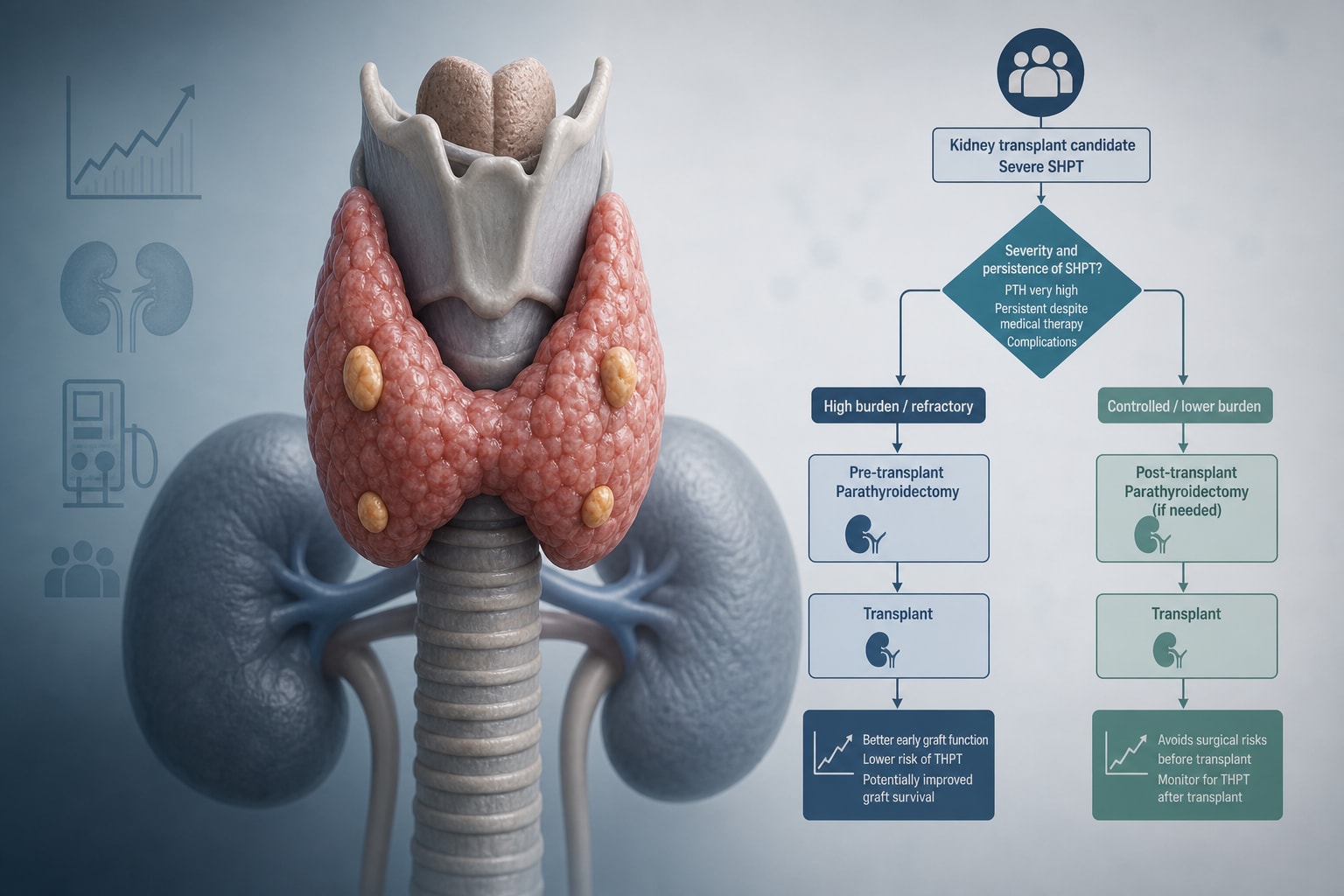
Pre-transplant PTx may lower graft loss compared to post-transplant PTx.
No long-term differences in eGFR or serum creatinine between pre- and post-transplant PTx.
Pre-transplant PTx associated with higher 30-day composite morbidity.
THPT incidence definitions varied across studies with no consistent differences.
Proposed a risk-stratified algorithm for PTx timing.
Guideline-Based Recommendations
Diagnosis
Assess SHPT in kidney transplant candidates using PTH levels and renal function.
Management
Consider pre-transplant PTx to mitigate risks of post-transplant THPT.
Monitoring & Follow-up
Monitor renal function and PTH levels post-transplant to identify THPT.
Risks
Evaluate surgical risks associated with pre-transplant PTx.
Patient & Prescribing Data
Patients with advanced CKD and severe SHPT awaiting kidney transplantation.
Personalized approach using a proposed algorithm based on waitlist time, PTH level, and dialysis vintage.
Clinical Best Practices
Utilize a validated nomogram to guide PTx timing.
Incorporate individual patient risk factors into clinical decision-making.