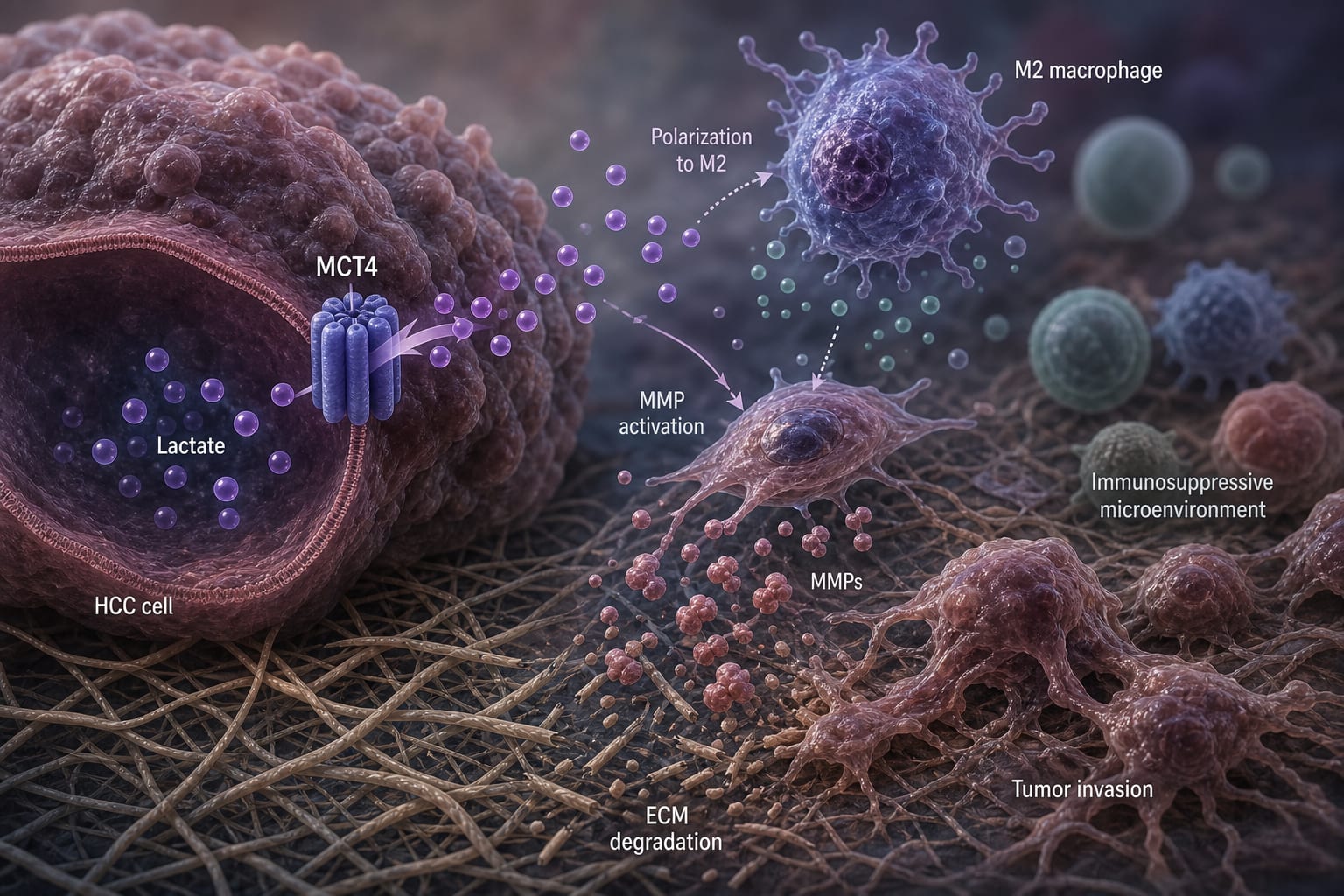
MCT4 drives HCC progression by activating MMPs and polarizing M2 macrophages
-
By
-
Kaiyuan Zhang
-
Xiaochen Ni
-
Chuhang Wang
-
Jianing Guo
-
Wei Fan
-
Tao Sun
-
Tao Jiang
-
Guangji Zhang
-
July 1, 2026
-
Clinical Scorecard: MCT4 Facilitates Hepatocellular Carcinoma Advancement Through MMP Activation and M2 Macrophage Polarization
At a Glance
| Category | Detail |
|---|
| Condition | Hepatocellular carcinoma (HCC) |
| Key Mechanisms | MCT4 enhances MMP-mediated invasion and promotes M2 macrophage polarization. |
| Target Population | Patients with hepatocellular carcinoma. |
| Care Setting | Oncology and cancer research. |
Key Highlights
- MCT4 is significantly upregulated in HCC tissues and correlates with advanced tumor stage.
- High MCT4 expression is linked to poor survival outcomes in HCC patients.
- MCT4 knockdown reduces MMP1, MMP2, and MMP9 expression, inhibiting HCC cell migration and invasion.
- MCT4 contributes to an immunosuppressive tumor microenvironment characterized by M2 macrophage polarization.
- MCT4 is proposed as a therapeutic target for restoring antitumor immunity in HCC.
Guideline-Based Recommendations
Diagnosis
- Evaluate MCT4 expression levels in HCC tissues for prognostic assessment.
Management
- Consider targeting MCT4 to inhibit HCC progression and enhance immune response.
Monitoring & Follow-up
- Monitor MMP expression levels as potential biomarkers for HCC progression.
Risks
- High MCT4 expression is associated with increased risk of metastasis and poor survival.
Patient & Prescribing Data
Patients diagnosed with hepatocellular carcinoma.
Targeting MCT4 may improve treatment outcomes by modulating tumor microenvironment.
Clinical Best Practices
- Integrate bioinformatic analyses with experimental validation in HCC research.
- Assess immune cell infiltration and polarization in HCC for comprehensive evaluation.
Related Resources & Content