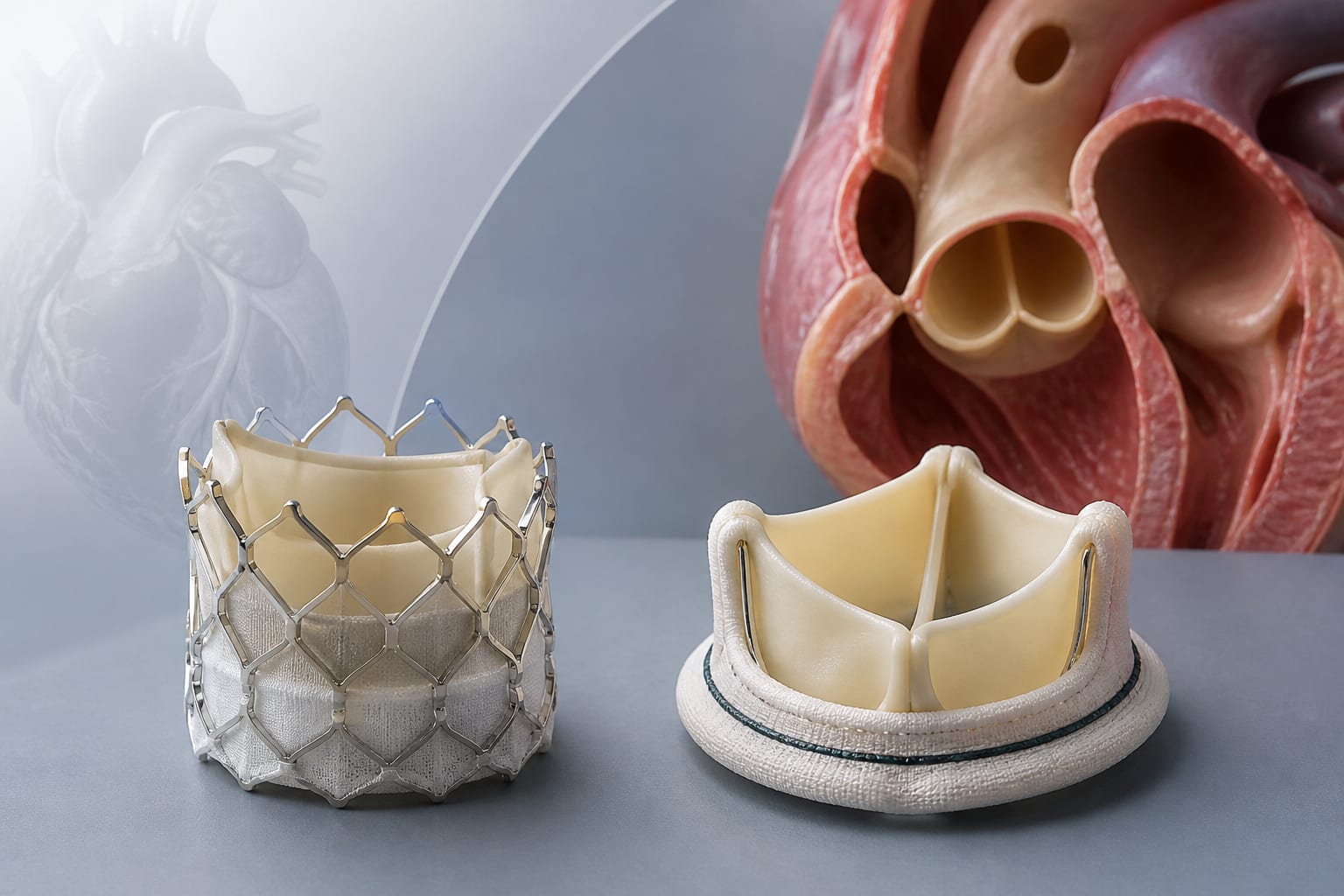
Reply: Interpreting Seven-Year Valve Durability Findings From PARTNER 3
-
By
-
Philippe Pibarot
-
Julien Ternacle
-
Rebecca Hahn
-
November 1, 2026
Clinical Scorecard: Reply: Interpreting Seven-Year Valve Durability Findings From PARTNER 3
At a Glance
| Category | Detail |
|---|---|
| Condition | Long-term durability of transcatheter and surgical bioprosthetic aortic valves |
| Key Mechanisms | Bioprosthetic valve failure (BVF) includes reintervention, valve-related death, and irreversible severe bioprosthetic valve dysfunction; structural valve deterioration (SVD) is a cause of BVF. |
| Target Population | Patients with aortic stenosis undergoing TAVR or surgical valve replacement, with PARTNER 3 enrolling low-risk patients. |
| Care Setting | Randomized-trial comparison of TAVR and surgical aortic valve replacement, interpreted in the context of contemporary valve selection and lifetime management. |
Key Highlights
- Sensitivity analyses excluding Trifecta and Mitroflow valves found comparable all-cause BVF rates for TAVR and surgery (6.9% vs 5.4%; P = .42).
- SVD-attributable BVF rates were also comparable between TAVR and surgery (3.9% vs 3.4%; P = .69) in those sensitivity analyses.
- The authors describe all-cause BVF as a more comprehensive durability end point than reintervention alone because it also includes valve-related death and irreversible severe valve dysfunction.
- Mechanical valve replacement was largely infeasible in PARTNER 3: no participants were younger than 50 years, and 9.5% were aged 50 to 65 years.
- The possibility that Resilia tissue could improve TAVR durability relative to surgery is described as hypothetical.
Guideline-Based Recommendations
Diagnosis
Management
- The authors state that guidelines recommend mechanical valve replacement for patients younger than 50 years and indicate it may be considered for those aged 50 to 65 years.
- In PARTNER 3, surgeons selected the surgical bioprosthetic valve they judged most likely to achieve optimal patient-specific hemodynamic, clinical, and durability outcomes.
Monitoring & Follow-up
Risks
Patient & Prescribing Data
PARTNER 3 included low-risk patients; none were younger than 50 years, and 9.5% were aged 50 to 65 years.
The surgical arm reflected contemporary standard-of-care practice during enrollment, with surgeons choosing among available bioprosthetic valves. Mechanical valve replacement was largely infeasible in this trial population.
Clinical Best Practices
- The authors describe all-cause BVF as encompassing reintervention, valve-related death, and irreversible severe bioprosthetic valve dysfunction.
- The authors state that surgical bioprosthetic valves do not demonstrate a uniform class effect and that their durability is not equivalent.
- The authors describe selection among approved valve platforms according to patient clinical and anatomic characteristics and lifetime-management considerations.
Related Resources & Content
Based on findings from:
Interpreting 7-Year Valve Durability in PARTNER 3—Reply
Philippe Pibarot, Julien Ternacle, Rebecca Hahn. Jama Cardiology, 2026.
https://jamanetwork.com/journals/jamacardiology/fullarticle/2854525
This content is an AI-generated, fully rewritten summary based on a published scholarly article. It does not reproduce the original text and is not a substitute for the original publication. Readers are encouraged to consult the source for full context, data, and methodology.