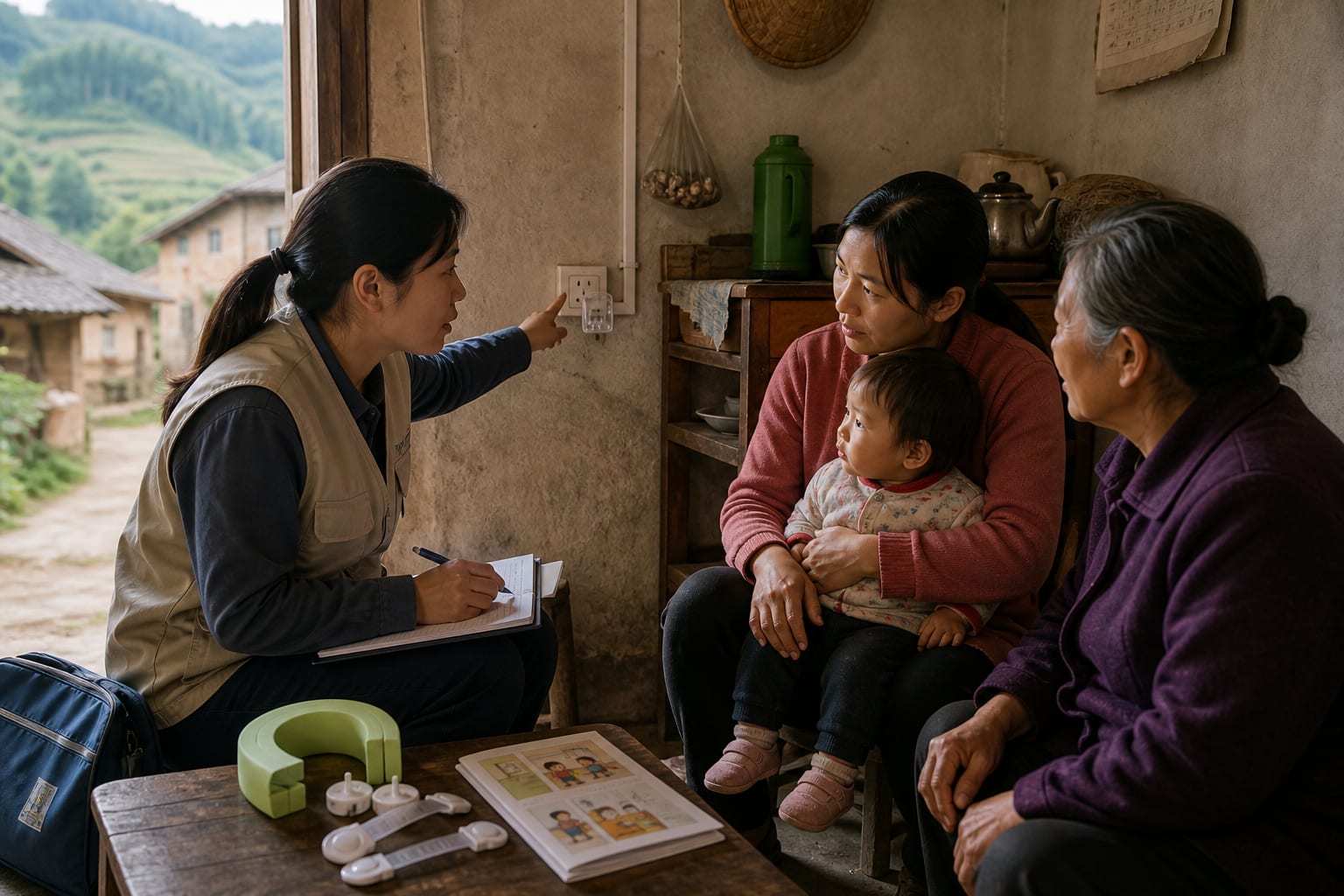
Community-Based Strategies to Prevent Child Injuries in Rural China
-
By
-
Ning Tang
-
Ye Jin
-
Maoyi Tian
-
November 11, 2026
Clinical Scorecard: Community-Based Strategies to Prevent Child Injuries in Rural China
At a Glance
| Category | Detail |
|---|---|
| Condition | Clinical topic addressed by the source article: Community-Based Strategies to Prevent Child Injuries in Rural China |
| Key Mechanisms | Mechanisms or clinical associations described in the source article. |
| Target Population | Patients or participants described in the source article. |
| Care Setting | Community-based household prevention delivered by trained civil society organization social workers. |
Key Highlights
- An outcome assessor–blinded cluster randomized trial evaluated the program in 24 rural communities and 360 households.
- The intervention comprised three structured monthly home visits and a follow-up visit at month 4, compared with routine social worker services.
- Among households with observed outcomes, cumulative injury incidence over 4 months was 11.8% in the intervention group and 19.1% in the control group.
- In intention-to-treat analysis, intervention exposure was associated with lower odds of injury (adjusted odds ratio, 0.36; 95% CI, 0.18-0.73).
- At month 4, adjusted caregiver supervisory behavior scores were higher and household environmental hazard scores were lower in the intervention group; the source reports differences of 17.08 and 36.66 points, respectively.
Guideline-Based Recommendations
Diagnosis
- The article describes a prevention trial and does not provide diagnostic criteria for child injuries.
Management
- In the evaluated program, trained community social workers made repeated home visits to identify hazards, facilitate practical remediation, and reinforce safety behaviors.
Monitoring & Follow-up
- The program reassessed households through repeated visits, including a follow-up at month 4.
- The article calls for extended follow-up to assess whether changes persist after structured visits end.
Risks
- The primary outcome relied on caregiver reports from participants aware of group assignment; reporting bias could not be ruled out.
- The trial could not determine which intervention components produced the observed changes.
- The article identifies training, supervision, personnel time, travel, tool-kit costs, workforce capacity, and fidelity as considerations for broader implementation.
Patient & Prescribing Data
The trial included 360 households with children aged 3 to 12 years in 24 rural communities in Guizhou and Shaanxi provinces, China.
The intervention consisted of three structured monthly home visits plus a month 4 follow-up, delivered by trained civil society organization social workers using standardized home safety and first aid tool kits. The comparator was routine social worker services.
Clinical Best Practices
- The evaluated program used home visits to identify household-specific hazards and support practical remediation.
- The program reinforced caregiver supervision and safety skills during household visits.
- The program used standardized procedures, trained community workers, practical tool kits, and fidelity monitoring.
- The article notes that household risks can change over time and calls for longer-term outcome assessment and evaluation of delivery resources.
Related Resources & Content
- Wen and colleagues: Caregiver and Child Home Safety Support (CnC-HSS) cluster randomized clinical trial
- Sustainable Development Goals
- Every Woman Every Child Global Strategy
Based on findings from:
Child Injury Prevention via Community-Based Delivery in Rural China
Ning Tang, Ye Jin, Maoyi Tian. Jama Network Open, 2026.
https://jamanetwork.com/journals/jamanetworkopen/fullarticle/2856480
This content is an AI-generated, fully rewritten summary based on a published scholarly article. It does not reproduce the original text and is not a substitute for the original publication. Readers are encouraged to consult the source for full context, data, and methodology.