Tumor-associated macrophages and lineage plasticity in prostate cancer: from established myeloid programs to emerging spatial hypotheses - Scorecard - MDSpire
Advertisement
Tumor-associated macrophages and lineage plasticity in prostate cancer: from established myeloid programs to emerging spatial hypotheses
Clinical Scorecard: Macrophages in Tumors and Lineage Flexibility in Prostate Cancer: Transitioning from Established Myeloid Pathways to New Spatial Theories
At a Glance
Category
Detail
Condition
Prostate Cancer
Key Mechanisms
Tumor-associated macrophages (TAMs) influence tumor-cell state transitions and therapeutic resistance through various signaling pathways.
Target Population
Men with advanced prostate cancer, particularly those exhibiting therapy-resistant disease states.
Care Setting
Oncology and research settings focusing on advanced prostate cancer treatment.
Key Highlights
Androgen receptor signaling inhibitors (ARSIs) have transformed advanced prostate cancer treatment but face resistance.
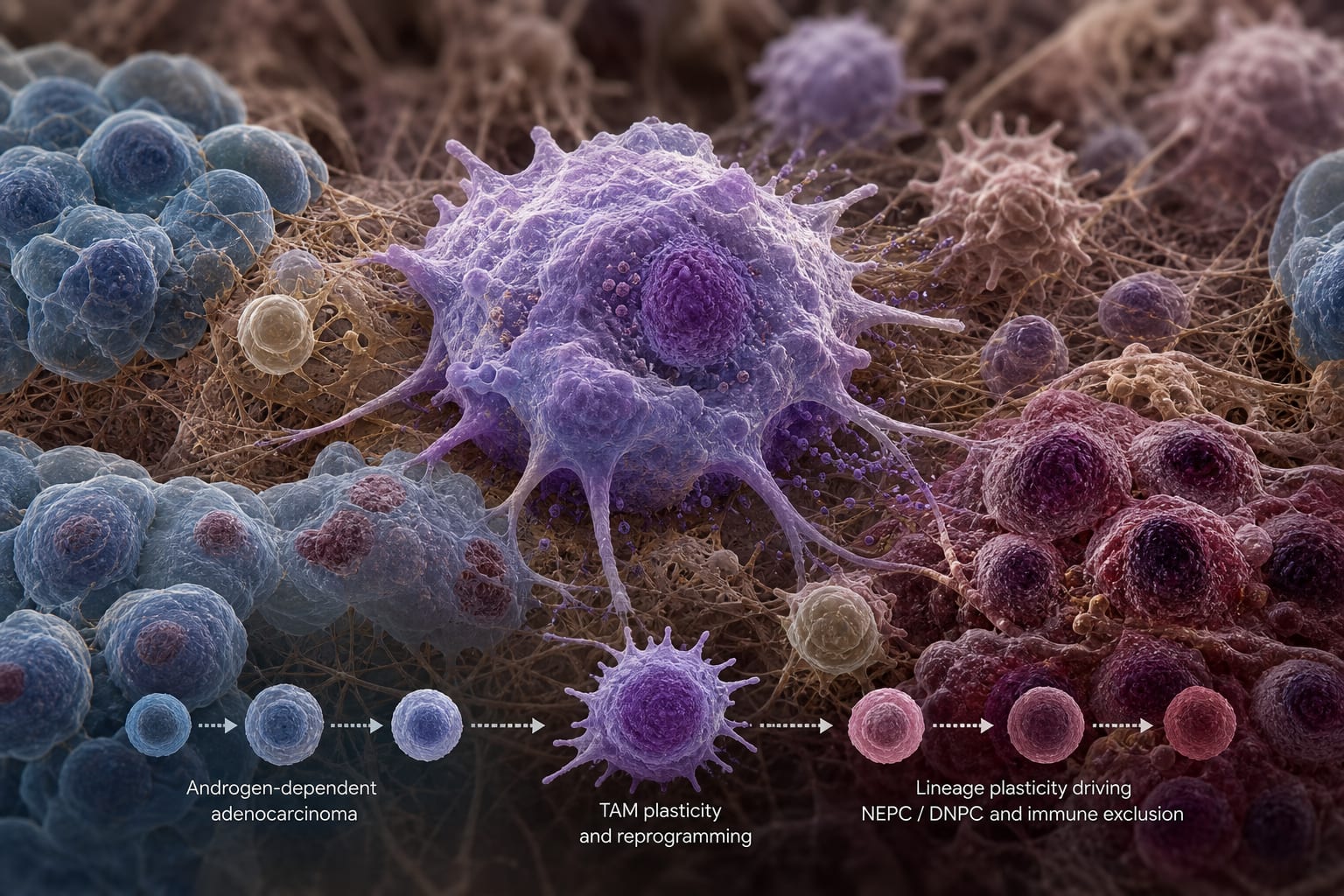
TAM heterogeneity is linked to lineage plasticity and therapy resistance in prostate cancer.
Emerging TAM states such as PLAC8+ TAMs may contribute to ARSI-induced remodeling.
Guideline-Based Recommendations
Diagnosis
Identify advanced prostate cancer and assess for therapy-resistant states such as neuroendocrine prostate cancer (NEPC) and double-negative prostate cancer (DNPC).
Management
Consider TAM-directed therapies and validate findings through independent cohorts and functional perturbation.
Monitoring & Follow-up
Utilize spatial transcriptomic and proteomic technologies to map TAM states and their associations with tumor progression.
Risks
Therapy resistance and adverse clinical outcomes associated with specific TAM states.
Patient & Prescribing Data
Men with advanced prostate cancer experiencing resistance to conventional therapies.
TAMs play a critical role in mediating therapeutic resistance and may serve as targets for novel treatment strategies.
Clinical Best Practices
Differentiate between established and emerging TAM states in clinical assessments.
Employ single-cell and spatial technologies for a comprehensive understanding of TAM heterogeneity.