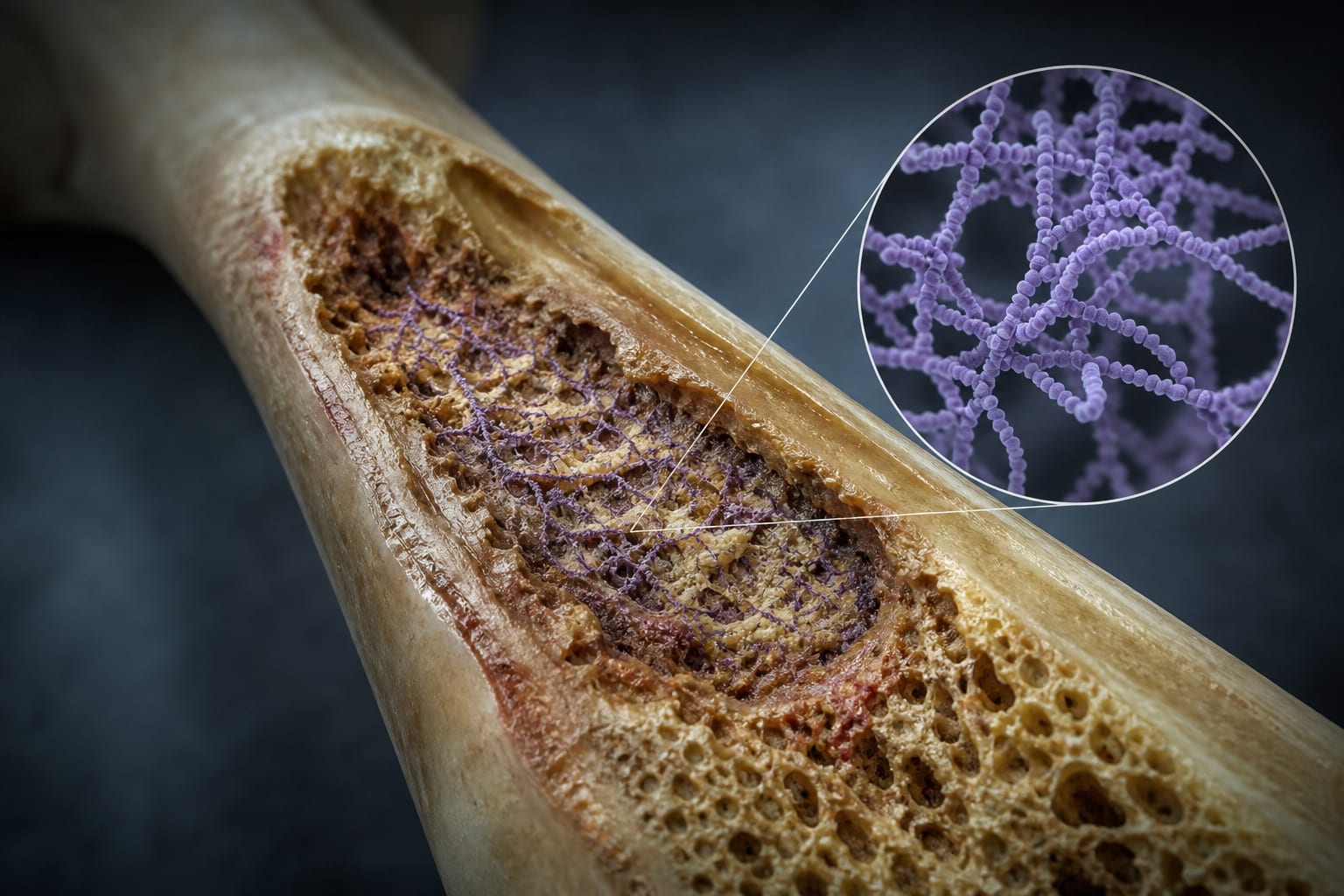
Clinical Scorecard: Chronic Osteomyelitis of the Fibula Associated with Schaalia turicensis: A Case Study and Review of Existing Literature
At a Glance
Category
Detail
Condition
Chronic osteomyelitis
Key Mechanisms
Persistent inflammation and progressive bone destruction associated with chronic infection, including infection caused by low-virulence pathogens such as Schaalia turicensis.
Target Population
Adults with primary actinomycotic osteomyelitis of the extremities, including rare cases in immunocompetent adults.
Care Setting
Infectious diseases and orthopedic surgical care.
Key Highlights
Chronic osteomyelitis may follow trauma or surgery and can involve persistent infection and progressive bone destruction.
Meticulous acquisition of viable deep-tissue specimens from the site of infection is important for accurate pathogen identification.
mNGS used alongside conventional culture can aid detection of fastidious, slow-growing, or culture-resistant pathogens.
Beta-lactam antibiotics are described as the first treatment choice for actinomycosis.
In the reported case, treatment was changed to oral clindamycin after culture identified Actinomyces species and methicillin-resistant Staphylococcus epidermidis (MRSE), followed by clinical improvement and discharge.
Guideline-Based Recommendations
Diagnosis
Obtain viable deep-tissue specimens from the epicenter of infection rather than relying on superficial samples.
Use conventional culture together with molecular diagnostics such as mNGS when evaluating chronic osteomyelitis, particularly when fastidious or slow-growing organisms are suspected.
Management
Beta-lactam antibiotics are the first treatment choice for actinomycosis.
Combine targeted antimicrobial therapy with appropriate surgical debridement in chronic osteomyelitis.
Monitoring & Follow-up
The source does not specify a standardized monitoring protocol. In the reported case, clinical improvement was observed after surgical debridement and targeted antimicrobial therapy, and the patient was subsequently discharged.
Risks
Actinomycotic osteomyelitis may be difficult to diagnose because of its insidious onset, nonspecific manifestations, and frequent polymicrobial presentation.
Diagnostic delay ranged from 1 month to 16 years in the reviewed cases, and the authors note that amputation may become necessary in patients with delayed diagnosis and recurrent, expanding infection.
Patient & Prescribing Data
The reported patient was a 57-year-old woman with more than 4 years of recurrent redness, swelling, ulceration, and exudation of the left lower leg after a remote traumatic ankle fracture.
After mNGS identified S. turicensis, intravenous penicillin G at 4.8 million units every 6 hours was initiated. Conventional culture 6 days later identified Actinomyces species and MRSE, and therapy was changed to oral clindamycin 300 mg 4 times daily, followed by clinical improvement and discharge.
Clinical Best Practices
Obtain deep-tissue specimens during surgical evaluation of chronic bone infection.
Integrate mNGS, conventional culture, and histopathologic findings to support pathogen identification.
Use targeted antimicrobial therapy together with adequate surgical debridement.
Consider low-virulence or indolent pathogens when chronic wounds fail to respond as expected.
Related Resources & Content
Gao Q, Liu Q, Zhang G, Lu Y, Li Y, Tang M, et al. “Identification of pathogen composition in a Chinese population with iatrogenic and native vertebral osteomyelitis by using mNGS.” Annals of Medicine. 2024;56:2337738.
Ryu DJ, Jeon YS, Kwon HY, Choi SJ, Roh TH, Kim MK. “Actinomycotic osteomyelitis of a long bone in an immunocompetent adult: a case report and literature review.” BMC Musculoskeletal Disorders. 2019;20:185.
Lee MJ, Ha YE, Park HY, Lee JH, Lee YJ, Sung KS, et al. “Osteomyelitis of a long bone due to Fusobacterium nucleatum and Actinomyces meyeri in an immunocompetent adult: a case report and literature review.” BMC Infectious Diseases. 2012;12:161.
Wang TKF, Tsang HF, Wong SCC, Leung SWM. “Cervical actinomycosis diagnosed via metagenomic next-generation sequencing of formalin-fixed paraffin-embedded tissue: a case report and literature review.” Microorganisms. 2025;13:1855.
Könönen E, Wade WG. “Actinomyces and related organisms in human infections.” Clinical Microbiology Reviews. 2015;28:419–442.