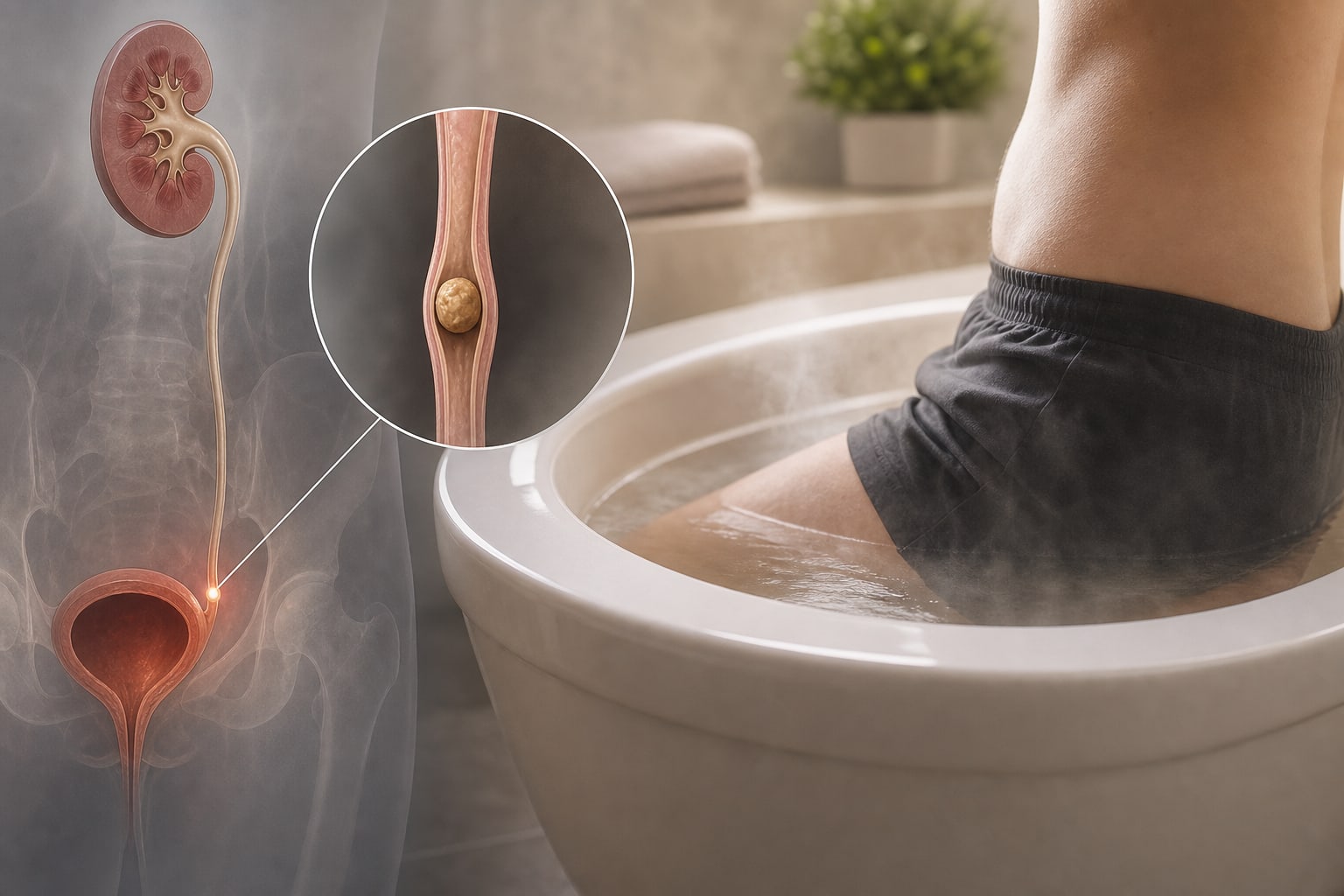
Warm sitz bath as an adjunctive therapy for distal ureteral calculi ≤5 mm: a prospective study
By
Li-diao Li
Jing-jing Lou
Ze-peng Wu
Xiang Hu
Hai-ou Lv
Yu-han He
July 1, 2026
Clinical Scorecard: Efficacy of Warm Sitz Baths as a Complementary Treatment for Distal Ureteral Stones ≤5 mm: A Prospective Investigation
At a Glance
Category Detail
Condition Distal Ureteral Calculi (DUC) ≤5 mm Key Mechanisms Warm sitz baths (WSB) may facilitate stone passage and alleviate pain. Target Population Patients aged 18–65 with DUC ≤5 mm presenting with renal colic. Care Setting Urological practice and outpatient management.
Key Highlights
WSB group had a shorter stone expulsion time (9.3 days vs. 14.3 days, P < 0.001). Higher stone expulsion rates at week 1 (40.7% vs. 21.0%, P = 0.019) and week 2 (81.4% vs. 61.3%, P = 0.015) in WSB group. WSB group reported fewer daily pain episodes (0.8 vs. 1.3, P < 0.001) and lower VAS scores (3.1 vs. 4.2, P < 0.001). No significant differences in adverse events between WSB and control groups. Overall 4-week stone expulsion rate was not significantly different (93.2% vs. 87.1%, P = 0.260). Guideline-Based Recommendations
Diagnosis
Diagnosis established by abdominal ultrasonography, KUB radiography, or non-contrast CT. Management
WSB as an adjunctive therapy for DUC ≤5 mm. Monitoring & Follow-up
Follow-up with ultrasonography as first-line imaging to assess stone passage. Risks
Potential for recurrent renal colic and urinary tract infection during observation. Patient & Prescribing Data
Patients with DUC ≤5 mm and normal renal function.
WSB is a non-pharmacological intervention that may reduce pain and facilitate stone expulsion.
Clinical Best Practices
Encourage adequate fluid intake (2.0 L daily) to facilitate stone passage. Consider WSB for symptom relief in patients with DUC ≤5 mm. Related Resources & Content