Case Report: A seventy-year-stable chest wall bronchogenic cyst with sudden enlargement: coincidence or connection with a concurrent thymic carcinoma? - Scorecard - MDSpire
Advertisement
Case Report: A seventy-year-stable chest wall bronchogenic cyst with sudden enlargement: coincidence or connection with a concurrent thymic carcinoma?
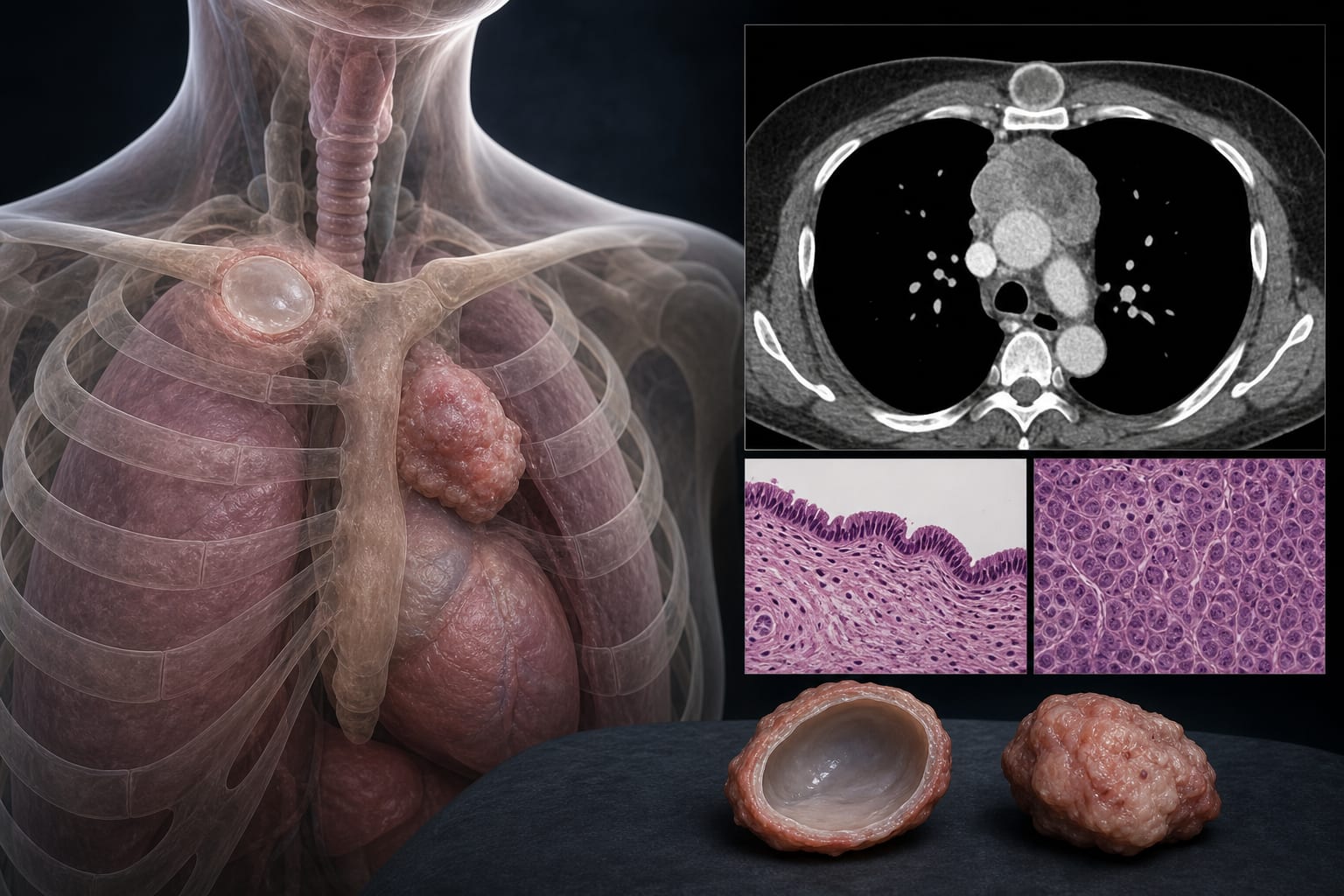
Clinical Scorecard: Case Study: Sudden Growth of a Long-Stable Chest Wall Bronchogenic Cyst in a 75-Year-Old Woman: Coincidence or Link to Concurrent Thymic Carcinoma?
At a Glance
Category
Detail
Condition
Bronchogenic cyst in the thoracic wall
Key Mechanisms
Delayed growth potentially influenced by paracrine signaling from adjacent thymic carcinoma
Target Population
Older adults, specifically those with long-standing thoracic masses
Care Setting
Surgical and oncological care settings
Key Highlights
Bronchogenic cyst remained stable for 70 years before sudden growth.
Concurrent thymic carcinoma identified during evaluation.
Histopathological analysis confirmed both lesions.
Patient had a favorable recovery with no recurrence at follow-up.
Potential pathological interplay between cyst and carcinoma suggested.
Guideline-Based Recommendations
Diagnosis
Use CT and ultrasound for differential diagnosis of thoracic masses.
Histopathology is essential for confirming bronchogenic cysts.
Management
Complete surgical excision of bronchogenic cysts is recommended.
Monitoring & Follow-up
Regular follow-up imaging to assess for recurrence post-surgery.
Risks
Potential for infection, compression, enlargement, and rare malignant transformation.
Patient & Prescribing Data
Older adults with chronic thoracic masses
Surgical intervention is effective for symptomatic or enlarging bronchogenic cysts.
Clinical Best Practices
Thorough assessment of chronic masses that exhibit changes.
Consideration of potential interactions between adjacent pathologies.