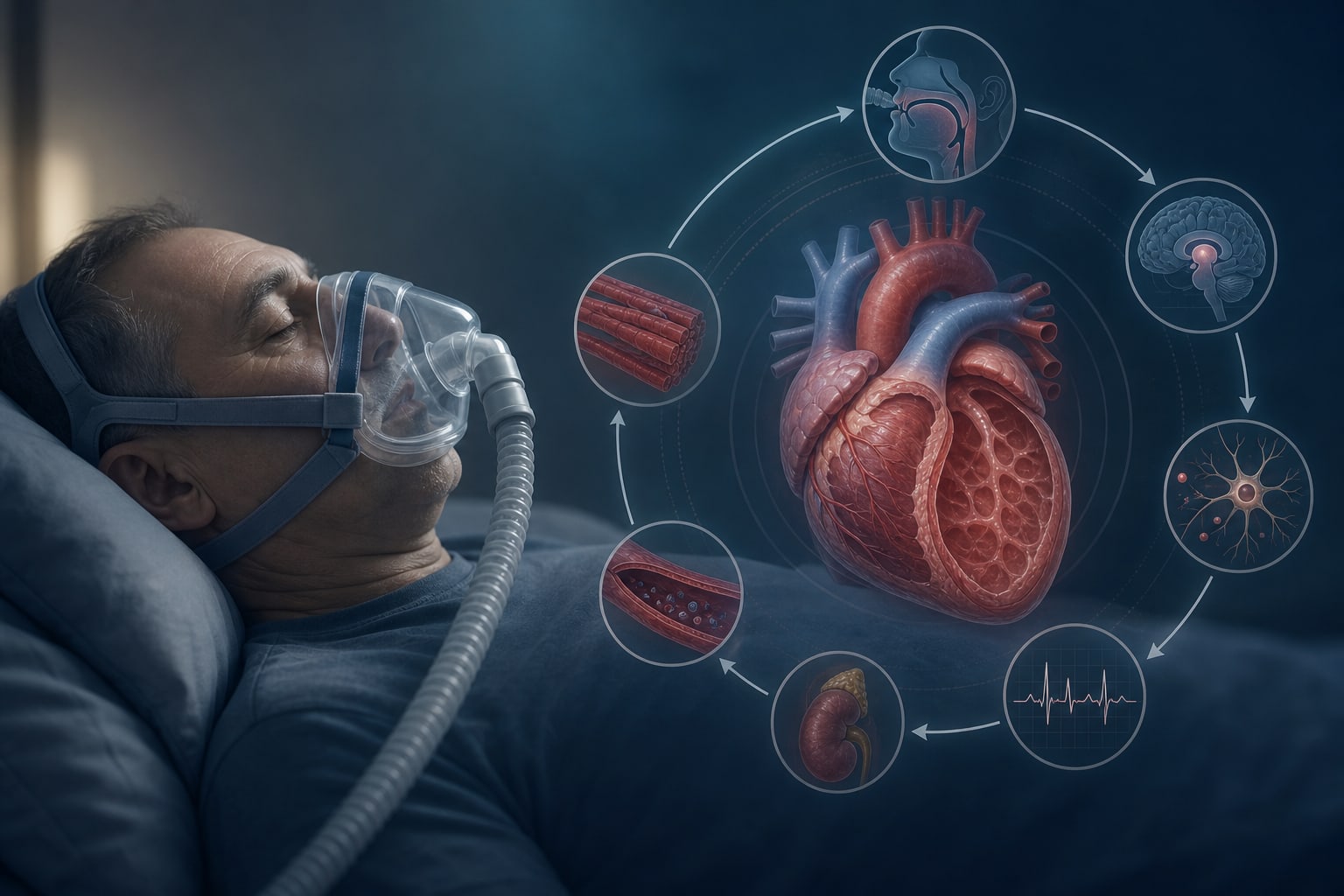
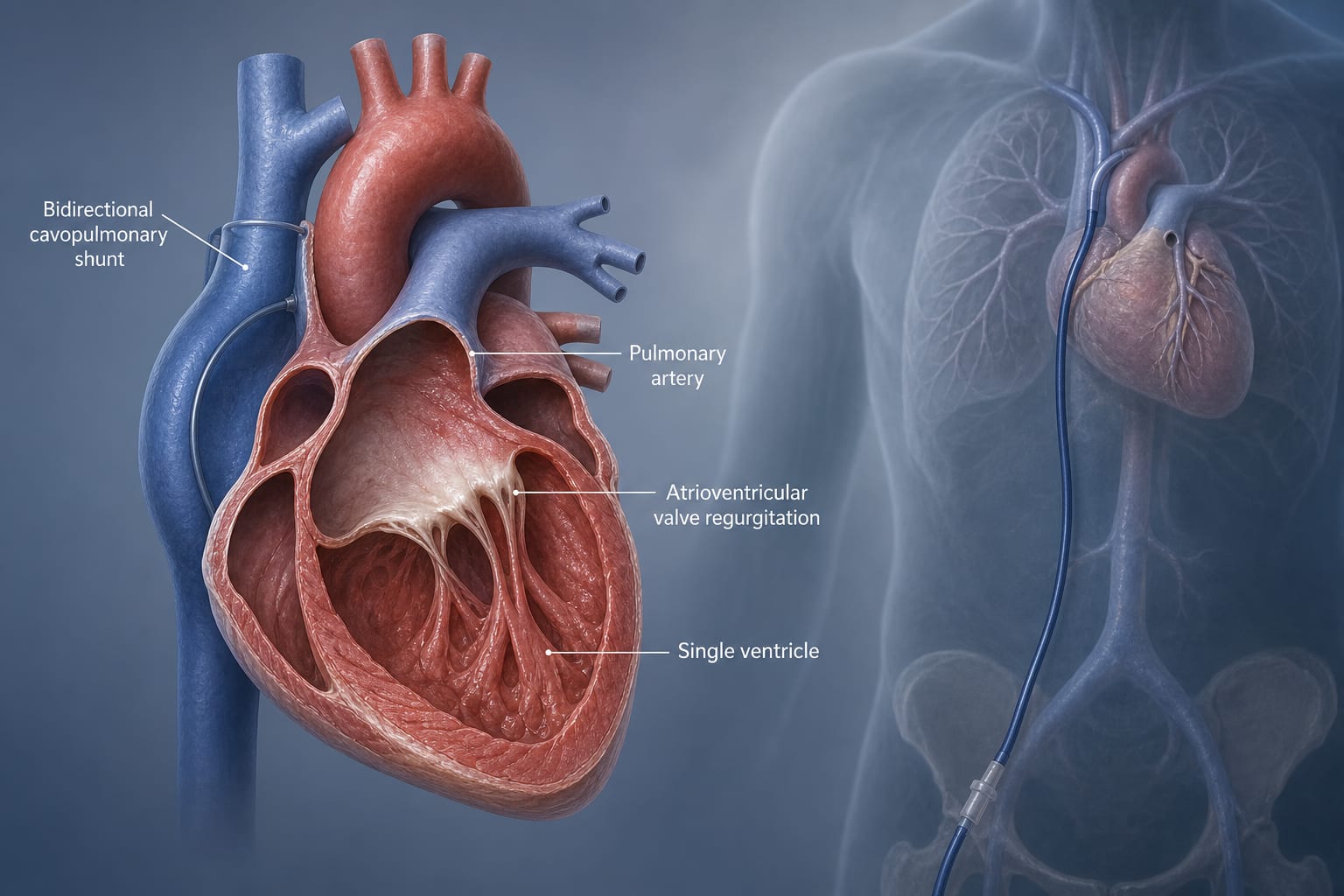
Breathing Disorders During Sleep in Heart Failure: Characterizations, Underlying Mechanisms, and Tailored Strategies
-
By
-
Huijie Yi
-
Luciano F. Drager
-
Xiao Wang
-
Takatoshi Kasai
-
Chi-Hang Lee
-
July 10, 2026
Clinical Scorecard: Breathing Disorders During Sleep in Heart Failure: Characterizations, Underlying Mechanisms, and Tailored Strategies
At a Glance
Category | Detail |
|---|---|
Condition | Heart failure with obstructive or central sleep apnea |
Key Mechanisms | OSA produces upper-airway obstruction, intermittent hypoxia, negative intrathoracic pressure, and sympathetic activation; CSA reflects ventilatory-control instability and is generally a consequence of HF |
Target Population | Patients with HFrEF or HFpEF and suspected or confirmed sleep-disordered breathing |
Care Setting | Evaluation and management of sleep-disordered breathing as a comorbidity of heart failure |
Key Highlights
OSA is a risk factor and prognostic marker in HF and is associated with adverse remodeling, arrhythmias, hospitalization, and mortality.
CSA is generally considered a consequence or marker of HF severity and is also associated with increased mortality.
CPAP improves symptoms and selected physiological measures in OSA, but reductions in mortality or HF hospitalization have not been demonstrated.
Respiratory instability may persist during wakefulness and in the upright position, suggesting a broader cardiorespiratory disorder.
Sex, HF etiology, obesity, hypoxic burden, and ventilatory-control characteristics may influence risk and treatment response, although evidence remains limited.
Guideline-Based Recommendations
Diagnosis
The 2022 ACC/AHA/HFSA guideline recommends formal sleep assessment in patients with HF and suspected sleep-disordered breathing to confirm the diagnosis and distinguish OSA from CSA.
The apnea-hypopnea index may not fully capture hypoxic burden, autonomic responses, daytime respiratory instability, or cardiovascular risk.
Management
For patients with HF and OSA, CPAP may be reasonable to improve sleep quality and reduce excessive daytime sleepiness.
CPAP has not been shown to reduce mortality or HF hospitalization in this population.
CSA-directed therapies, including CPAP and adaptive servo-ventilation, have not consistently improved long-term clinical outcomes in HFrEF despite improvements in surrogate measures.
Treatment should account for HF phenotype, symptoms, oxygenation, underlying pathophysiology, and patient characteristics rather than focus solely on reducing the apnea-hypopnea index.
Monitoring & Follow-up
Assess treatment adherence, symptoms, sleep quality, oxygenation, and physiological response when treating OSA.
Daytime and upright respiratory instability may provide additional mechanistic and prognostic information, but routine assessment methods require further study.
The review did not establish a standardized monitoring or follow-up schedule.
Risks
OSA is associated with increased morbidity, mortality, recurrent HF hospitalization, adverse remodeling, and arrhythmias.
CSA may indicate greater HF severity or represent a compensatory response rather than a readily modifiable treatment target.
Adaptive servo-ventilation increased all-cause and cardiovascular mortality in SERVE-HF, although ADVENT-HF subsequently reported neutral clinical outcomes.
Poor adherence may limit CPAP effectiveness, and intolerance of masks or positive airway pressure is common.
Patient & Prescribing Data
The review addressed patients with HFrEF and HFpEF who had OSA, CSA, or broader respiratory instability.
It reviewed positive airway pressure, mandibular advancement devices, surgical and implant therapies, weight-loss interventions, metabolic therapies, oxygen therapy, phrenic nerve stimulation, and selected medications. It did not provide individualized prescribing recommendations.
Clinical Best Practices
Confirm and distinguish OSA from CSA before selecting treatment.
Do not assume that improvement in apnea severity or physiological markers will translate into fewer HF hospitalizations or improved survival.
Consider SDB phenotype, HF phenotype, symptom burden, oxygenation, obesity, sex, and ventilatory-control characteristics.
Interpret evidence in the context of small, short-term trials, limited HFpEF data, and studies conducted before contemporary HF therapy.
Related Resources & Content
Sleep-Disordered Breathing in Heart Failure: Phenotypes, Mechanisms, and Precision Approach — Yi H, Drager LF, Wang X, Kasai T, Lee CH. Journal of Cardiac Failure. 2026. doi:10.1016/j.cardfail.2026.06.021.
2022 AHA/ACC/HFSA Guideline for the Management of Heart Failure — Heidenreich PA, Bozkurt B, Aguilar D, et al. Journal of the American College of Cardiology. 2022;79:e263-e421.
Continuous Positive Airway Pressure for Central Sleep Apnea and Heart Failure — Bradley TD, Logan AG, Kimoff RJ, et al. New England Journal of Medicine. 2005;353:2025-2033.
Adaptive Servo-Ventilation for Central Sleep Apnea in Systolic Heart Failure — Cowie MR, Woehrle H, Wegscheider K, et al. New England Journal of Medicine. 2015;373:1095-1105.
Adaptive Servo-Ventilation for Sleep-Disordered Breathing in Patients With Heart Failure With Reduced Ejection Fraction: ADVENT-HF — Bradley TD, Logan AG, Lorenzi Filho G, et al. The Lancet Respiratory Medicine. 2024;12:153-166.
Based on findings from:
SLEEP-DISORDERED BREATHING IN HEART FAILURE: PHENOTYPES, MECHANISMS, AND PRECISION APPROACH
Huijie Yi, Luciano F. Drager, Xiao Wang, Takatoshi Kasai, Chi-Hang Lee. Journal Of Cardiac Failure, 2026.
https://onlinejcf.com/article/s1071-9164(26)00387-8/fulltext
This content is an AI-generated, fully rewritten summary based on a published scholarly article. It does not reproduce the original text and is not a substitute for the original publication. Readers are encouraged to consult the source for full context, data, and methodology.