A clinically applicable nomogram predicting non-return to work in young and middle-aged patients with acute large vessel occlusion stroke: integrating neurological function and psychosocial factors for personalized rehabilitation - Scorecard - MDSpire

A clinically applicable nomogram predicting non-return to work in young and middle-aged patients with acute large vessel occlusion stroke: integrating neurological function and psychosocial factors for personalized rehabilitation

  • By

  • Yu Ding

  • Jingling Zhu

  • Yiling He

  • Xiuling Yang

  • Wenfei Liang

  • Kangqiang Yang

  • Xiaoling Wu

  • Guoshun Li

  • Jiasheng Zhao

  • Zhan Zhao

  • Jingyi Chen

  • Qiuxing He

  • Weimin Ning

  • June 24, 2026

  • 0 min

Share

Clinical Scorecard: A Nomogram for Predicting Non-Return to Work in Young and Middle-Aged Patients Following Acute Large Vessel Occlusion Stroke: Incorporating Neurological and Psychosocial Factors for Tailored Rehabilitation

At a Glance

CategoryDetail
ConditionAcute ischemic stroke due to large vessel occlusion (AIS-LVO)
Key MechanismsIdentification of predictors for non-return to work (non-RTW) post-endovascular therapy (EVT)
Target PopulationYoung and middle-aged patients aged 18-64 years
Care SettingSingle-center retrospective observational study

Key Highlights

  • Developed a nomogram to predict non-RTW in AIS-LVO patients post-EVT
  • Identified six independent predictors of non-RTW
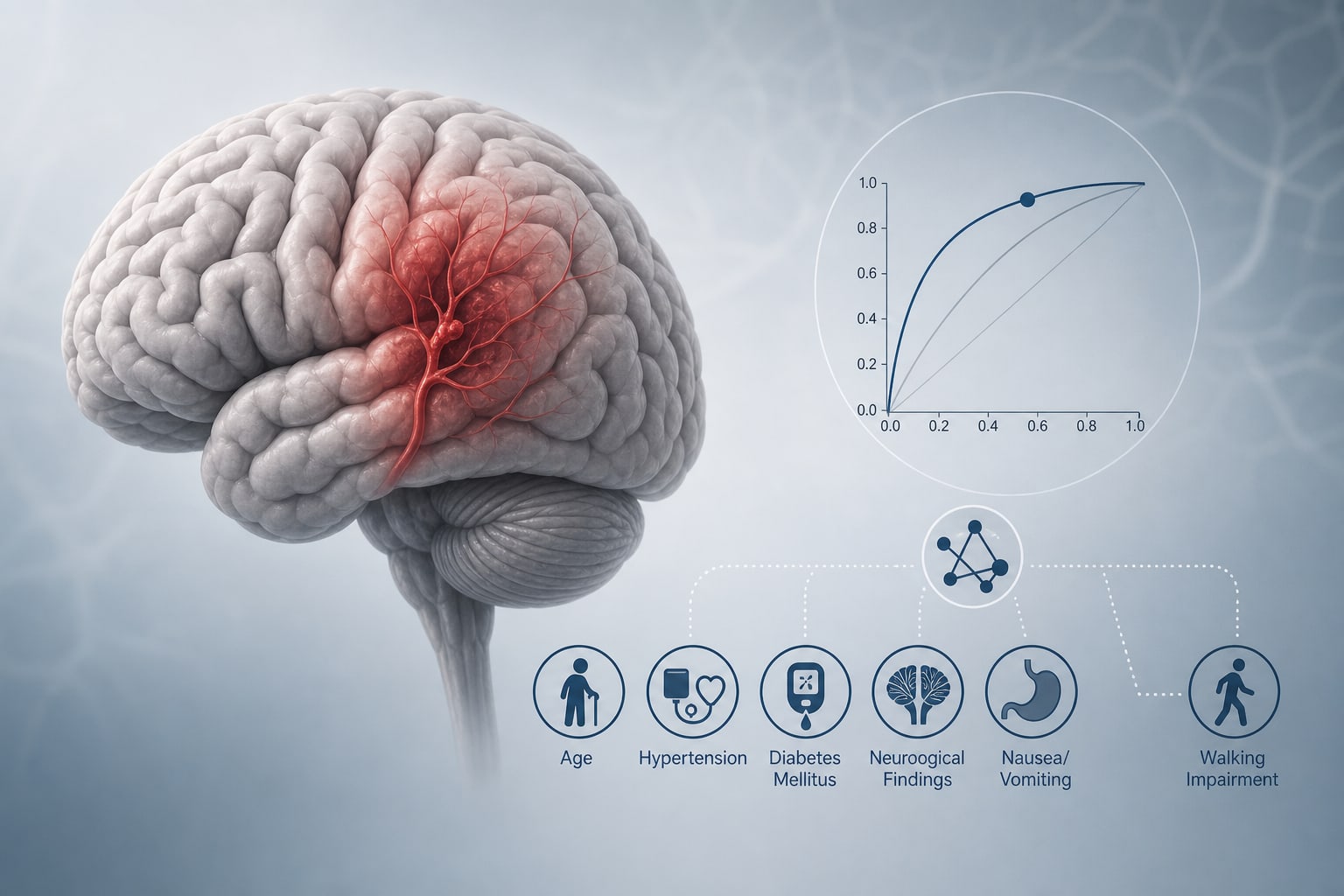
  • Nomogram demonstrated robust discriminative performance (AUC = 0.858)
  • Calibration curves confirmed favorable calibration between predicted and observed probabilities
  • Clinical impact analyses revealed meaningful net benefit across threshold probabilities

Guideline-Based Recommendations

Diagnosis

  • Acute ischemic stroke diagnosis confirmed by imaging techniques such as CTA, MRA, or DSA

Management

  • Personalized rehabilitation planning based on identified predictors

Monitoring & Follow-up

  • Regular assessment of predictors such as IADL, NIHSS score, and psychological state

Risks

  • Increased incidence of psychological disorders in non-RTW patients

Patient & Prescribing Data

350 consecutive AIS-LVO patients who underwent EVT

Focus on multidisciplinary interventions including vocational rehabilitation and nutritional support

Clinical Best Practices

  • Utilize the nomogram for early risk stratification of non-RTW
  • Incorporate neurological, cognitive, and psychological dimensions into patient assessment
  • Implement tailored rehabilitation strategies based on individual risk factors

Related Resources & Content

Original Source(s)

Related Content