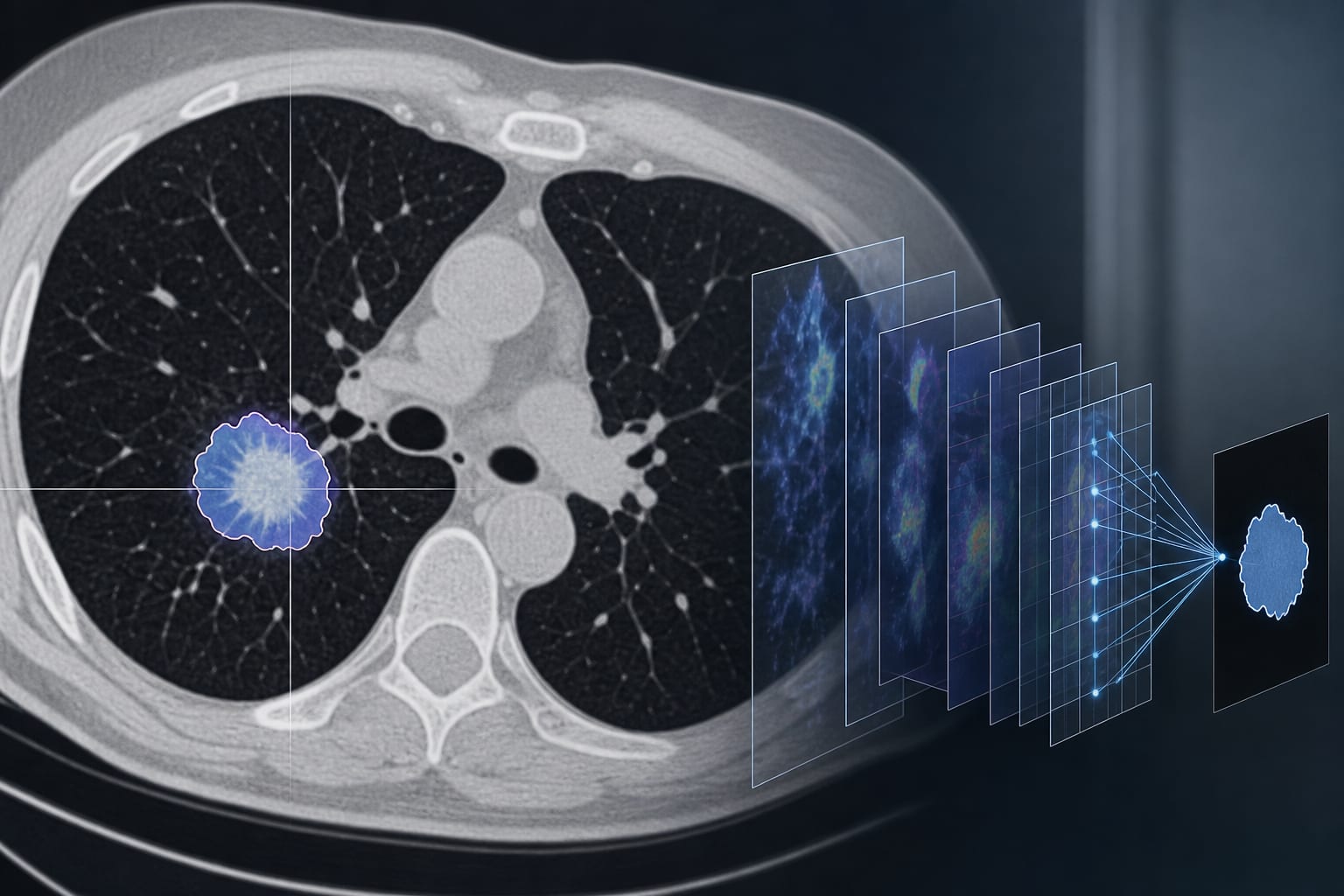
EGP-Net: a lung nodule segmentation network integrating edge guidance and pyramidal multi-scale contextual attention mechanisms
-
By
-
Xiangsuo Fan
-
Lihong Deng
-
Jiachen Hou
-
Tao Li
-
Zhougui Ling
-
Shuping Li
-
July 2, 2026
-
Clinical Scorecard: EGP-Net: A Network for Lung Nodule Segmentation Utilizing Edge Guidance and Pyramidal Multi-Scale Contextual Attention Techniques
At a Glance
| Category | Detail |
|---|
| Condition | Lung Nodule Segmentation |
| Key Mechanisms | Edge guidance and pyramidal multi-scale contextual attention techniques |
| Target Population | Patients undergoing CT imaging for lung cancer screening |
| Care Setting | Clinical imaging and diagnosis |
Key Highlights
- EGP-Net achieved an IoU of 88.32% and a Dice coefficient of 92.65% on the LIDC dataset.
- The model integrates a Res2Net-50 encoder and dynamic attention fusion module.
- Ablation experiments confirmed the effectiveness of each component of EGP-Net.
- EGP-Net improves segmentation accuracy and supports clinical evaluation of lung cancer.
- The method addresses challenges like blurred boundaries and complex structures.
Guideline-Based Recommendations
Diagnosis
- Utilize EGP-Net for accurate segmentation of pulmonary nodules in CT images.
Management
- Incorporate automated segmentation methods in clinical workflows for lung cancer detection.
Monitoring & Follow-up
- Assess segmentation performance using metrics such as IoU, Dice, F2-score, and F0.5-score.
Risks
- Consider the limitations of traditional segmentation methods in low contrast and blurred boundaries.
Patient & Prescribing Data
Individuals with suspected lung cancer requiring CT imaging.
Accurate segmentation can facilitate timely identification of malignant lesions.
Clinical Best Practices
- Employ deep learning-based methods for improved segmentation accuracy.
- Utilize low-dose CT for lung cancer screening to minimize radiation exposure.
- Integrate edge-guided and multi-scale contextual techniques in segmentation workflows.
Related Resources & Content