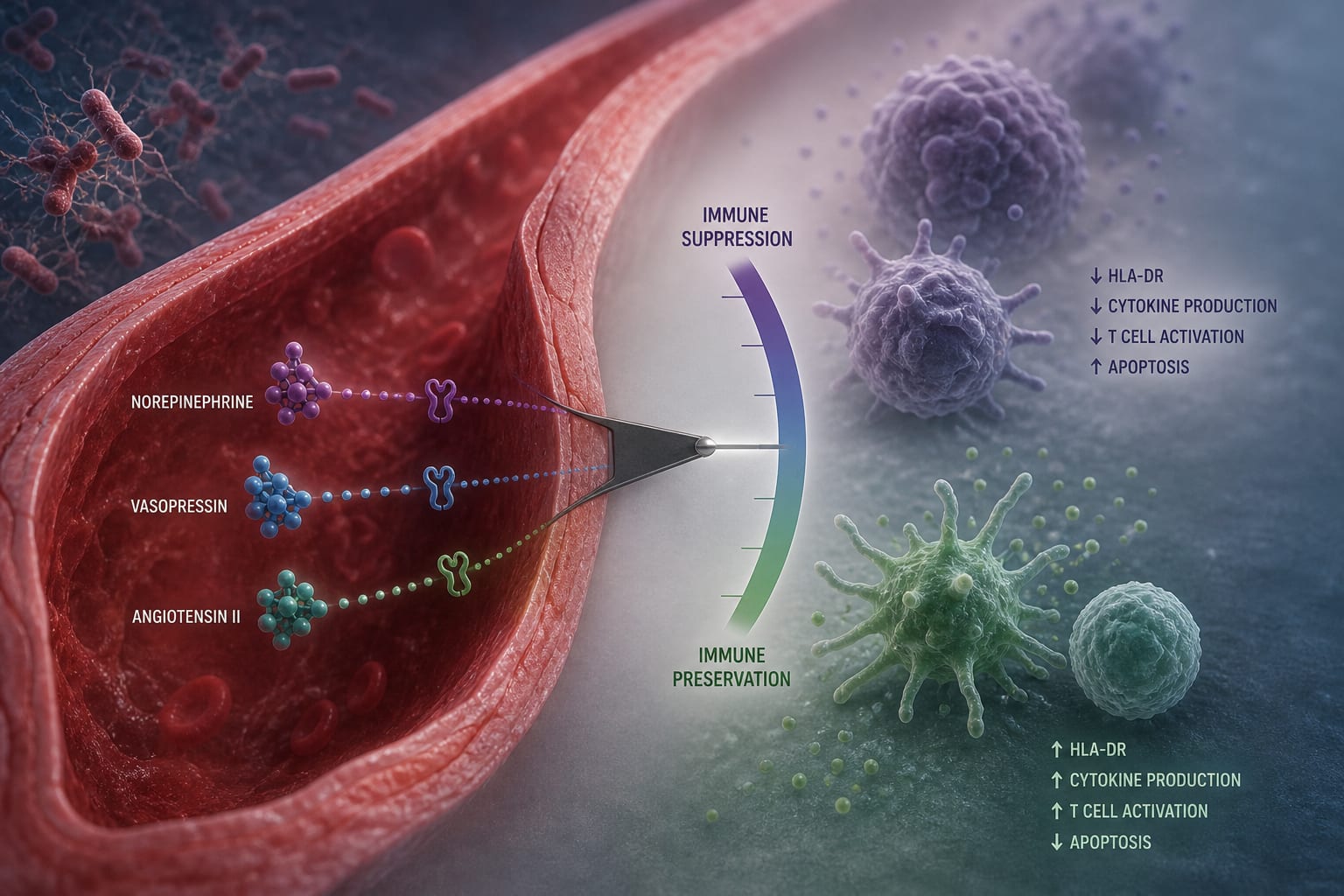
Vasopressors and Immune Regulation: An Underrecognized Pathway in Septic Shock
-
By
-
Daniel E. Leisman
-
Matthijs Kox
-
Peter Pickkers
-
November 5, 2026
Clinical Scorecard: Vasopressors and Immune Regulation: An Underrecognized Pathway in Septic Shock
At a Glance
| Category | Detail |
|---|---|
| Condition | Septic shock and its associated dysregulated host immune response |
| Key Mechanisms | Vasopressors may have differing immune effects: catecholamines can suppress immune activity through β-adrenergic signaling, vasopressin has fewer reported direct immune effects, and angiotensin-II can stimulate immune activity through AT1R. |
| Target Population | Patients with septic shock receiving or being considered for vasoactive support |
| Care Setting | Critical care; the article reviews experimental and clinical evidence and proposes future study of vasopressor strategies in septic shock. |
Key Highlights
- Catecholamine β2-signaling raises intracellular cAMP and inhibits NF-κB translocation; experimental evidence links catecholamines to reduced pro-inflammatory cytokines, ROS generation, and phagocytosis, alongside increased IL-10 and endotoxin tolerance.
- In an observational cohort of 195 patients with septic shock, higher norepinephrine dose correlated with a lower blood TNF/IL-10 ratio; the association was attenuated among patients receiving chronic beta-blockers.
- In experimental models, vasopressin did not alter cytokines, neutrophil ROS production, or bacterial dissemination; VASST cytokine differences disappeared after adjustment for baseline characteristics.
- Experimental angiotensin-II administration improved bacterial clearance, increased innate-cell phagocytosis, and restored monocyte responsiveness to endotoxin; these effects were abolished by selective myeloid-lineage AT1R deletion.
- The proposed vasopressor-immune gradient is a hypothesis, and the article states that further studies are needed to determine whether alternative vasopressor strategies affect clinical outcomes.
Guideline-Based Recommendations
Diagnosis
Management
- The article proposes considering the heterogeneous immune effects of vasoactive therapies when studying or selecting vasopressor strategies; it does not provide a clinical treatment recommendation to replace norepinephrine.
- Future vasopressor studies should account for intervention timing and substrate, according to the article.
Monitoring & Follow-up
Risks
- The article notes that immune suppression or enhancement might help some patients while harming others.
- Numerous Gram-negative bacteria express catecholamine receptors, and high catecholamine concentrations can enhance bacterial virulence.
- The immune effects of vasopressors may vary by cell type and over time; hyperinflammation and immunosuppression are interrelated.
Patient & Prescribing Data
Patients with septic shock; the article discusses heterogeneous hyperinflammatory and immunosuppressed states.
Norepinephrine is identified as the first-line vasopressor in septic shock. The article describes differing, predominantly experimental immune effects of norepinephrine, vasopressin, and angiotensin-II, but does not establish comparative clinical outcome benefits or a patient-specific prescribing approach.
Clinical Best Practices
- Interpret the proposed vasopressor-immune gradient as a hypothesis rather than an established treatment algorithm.
- Distinguish experimental findings from clinical evidence: the article characterizes evidence for vasopressor immune effects as predominantly experimental.
- Account for potential indirect effects of vasopressin, including reduced catecholamine exposure or elevated cortisol, when interpreting immune findings.
- Consider that angiotensin-II cytokine responses may change over time, with initial increases in some mediators followed by suppression of both pro- and anti-inflammatory cytokines.
- The article identifies forthcoming trials comparing the immunological effects of angiotensin-II versus norepinephrine strategies.
Related Resources & Content
Based on findings from:
Vasopressors as immunomodulators: a hidden axis in septic shock
Daniel E. Leisman, Matthijs Kox, Peter Pickkers. Intensive Care Medicine, 2026.
https://link.springer.com/article/10.1007/s00134-026-08648-3
This content is an AI-generated, fully rewritten summary based on a published scholarly article. It does not reproduce the original text and is not a substitute for the original publication. Readers are encouraged to consult the source for full context, data, and methodology.