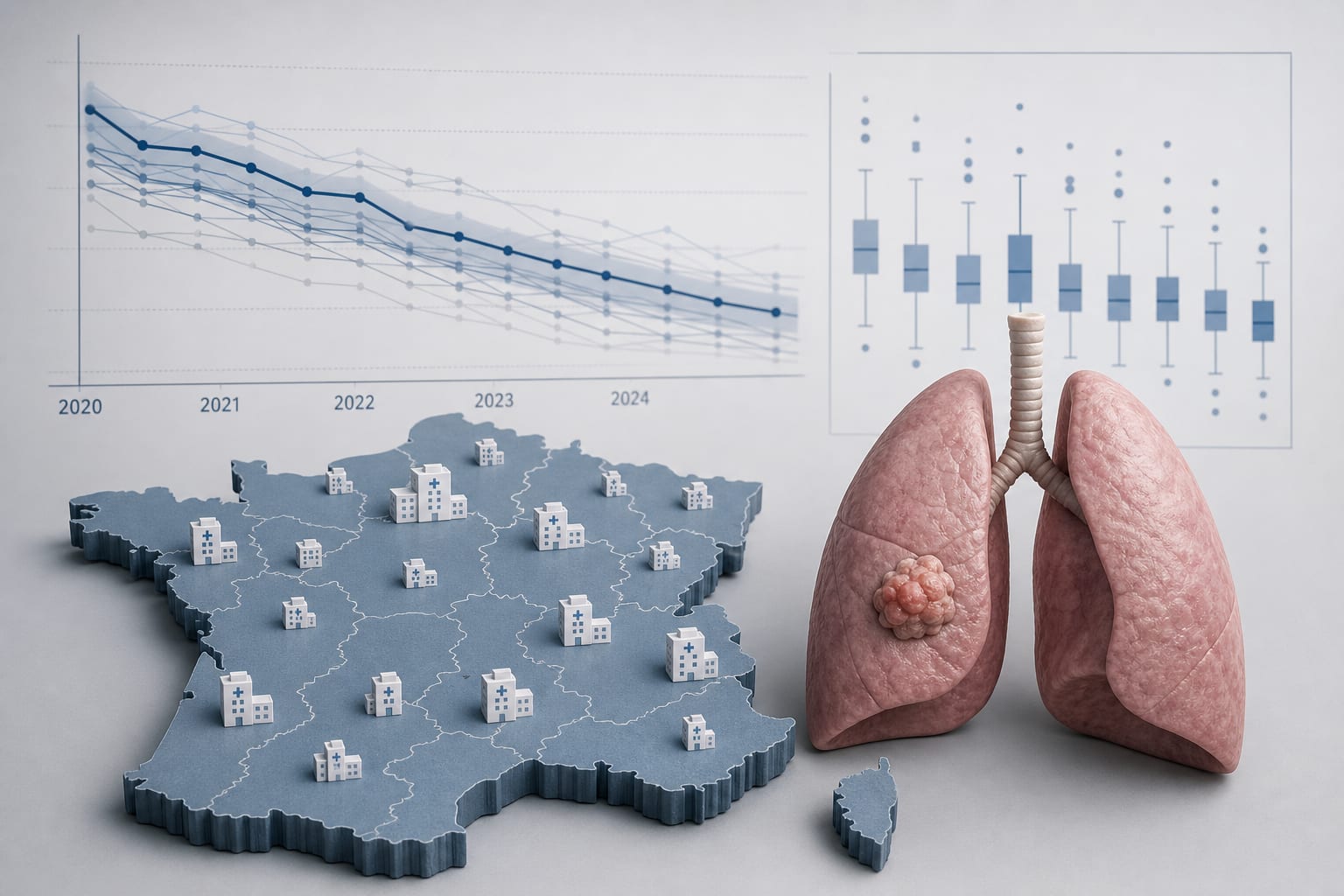
Assessing Longitudinal Performance Trends in Lung Cancer Surgery: Insights from the French National Hospital Database (2020-2024)
By
Alain Bernard
Jonathan Cottenet
Pascale Tubert-Bitter
Catherine Quantin
June 22, 2026
Clinical Scorecard: Assessing Longitudinal Performance Trends in Lung Cancer Surgery: Insights from the French National Hospital Database (2020-2024)
At a Glance
Category Detail
Condition Lung Cancer Surgery Key Mechanisms Trajectory modelling using Hidden Markov Models and group-based trajectory modelling to assess performance and quality evolution. Target Population Adult patients undergoing surgical lung resection for primary lung cancer in France (n=56,299). Care Setting French national hospital database analysis.
Key Highlights
First national trajectory analysis of lung cancer surgery performance across French hospitals. Medium-volume hospitals showed optimal improvement trajectories with a 45% reduction in risk-adjusted complications. Some low-volume hospitals experienced a catastrophic decline in performance, with complication rates increasing nearly ninefold. A subgroup of high-volume hospitals also showed concerning performance degradation. The study highlights the importance of systematic outcome monitoring to target quality improvement. Guideline-Based Recommendations
Diagnosis
Management
Monitoring & Follow-up
Implement systematic outcome monitoring using existing administrative data. Risks
Postoperative morbidity rates of 15%–40% and mortality rates of 2%–5%. Patient & Prescribing Data
Adult patients undergoing surgical lung resection for primary lung cancer.
Volume-based centralisation policies alone are insufficient; organisational factors and continuous performance feedback are crucial.
Clinical Best Practices
Utilize trajectory-based analytical frameworks for assessing hospital performance. Focus on continuous quality improvement through benchmarking and outcome tracking. Related Resources & Content