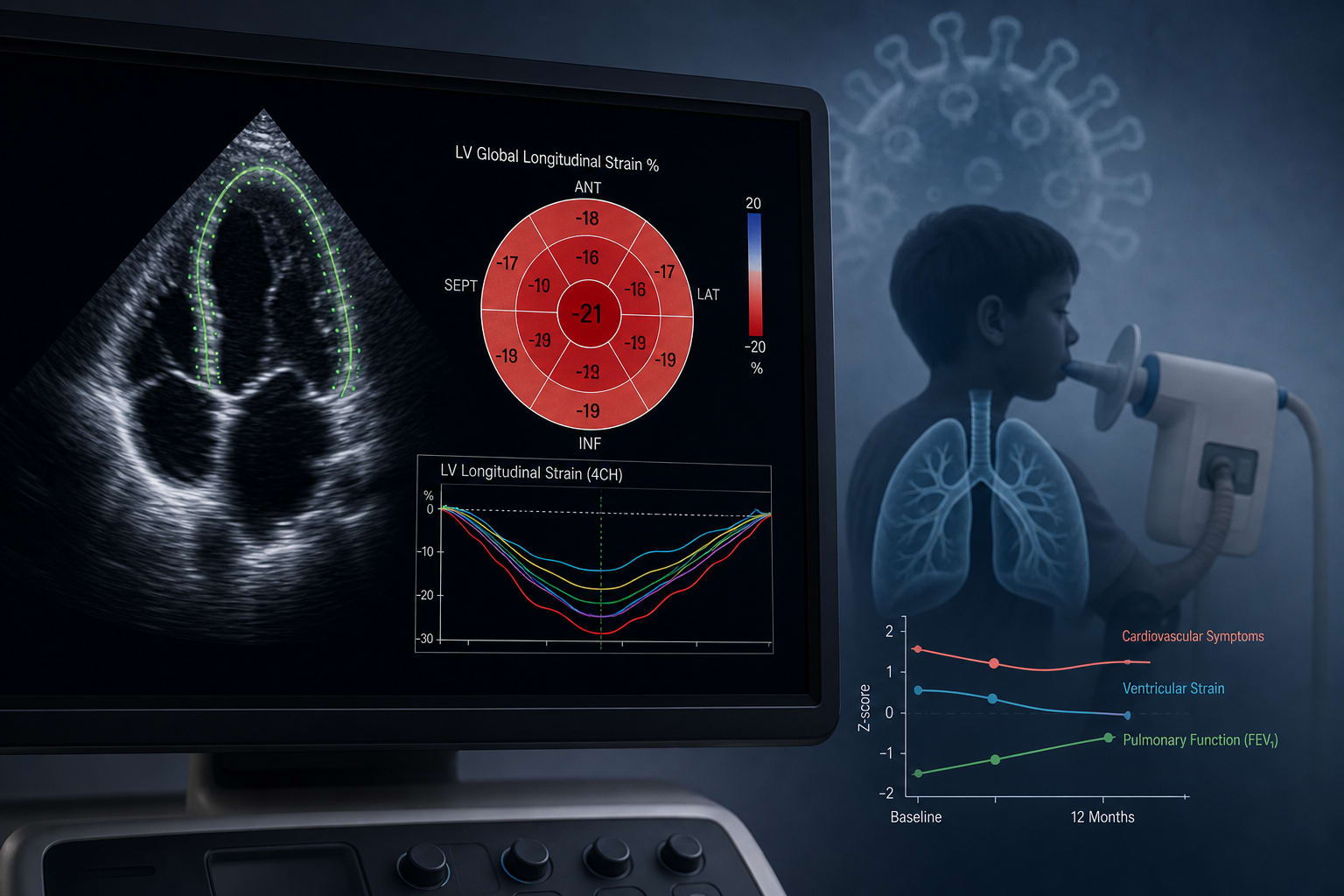
Ventricular Strain and Correlation with Cardiovascular Symptoms and Pulmonary Function Testing in Pediatric Patients with a History of COVID-19: Results from the Pediatric SARS-CoV-2 Long Term Outcomes Study - Scorecard - MDSpire
Conexiant’s news site is now MDSpire News. Learn more
Advertisement
Ventricular Strain and Its Relationship with Cardiovascular Symptoms and Pulmonary Function in Children with Previous COVID-19: Findings from the Pediatric SARS-CoV-2 Long-Term Outcomes Study
Clinical Scorecard: Ventricular Strain and Its Relationship with Cardiovascular Symptoms and Pulmonary Function in Children with Previous COVID-19: Findings from the Pediatric SARS-CoV-2 Long-Term Outcomes Study
At a Glance
Category
Detail
Condition
Postinfectious cardiac function in pediatric patients with a history of COVID-19
Key Mechanisms
Echocardiographic assessment of ventricular function and longitudinal strain
Target Population
Infected and uninfected participants aged 0 to 21 years
Care Setting
Prospective, multisite observational study
Key Highlights
The analysis included 830 participants: 683 infected and 147 uninfected.
Cardiac function did not differ between infected and uninfected participants at baseline or 12 months.
Among participants with abnormal baseline values and follow-up data, several echocardiographic measures improved at 12 months.
Among 73 crossover participants, most cardiac indices did not change significantly after infection; one developed abnormal right ventricular strain measures.
Infected participants frequently reported cardiac, constitutional, and respiratory symptoms, but strain measures did not differ between those with and without symptoms.
Guideline-Based Recommendations
Diagnosis
The study evaluated cardiac function using conventional echocardiographic and ventricular strain measurements.
Management
The study did not evaluate treatments or provide management recommendations.
Monitoring & Follow-up
Cardiac function and symptoms were evaluated at baseline and 12-month follow-up.
Risks
Reported post-COVID-19 symptoms were not associated with differences in ventricular strain measures.
Patient & Prescribing Data
The study included participants aged 0 to 21 years with and without previous COVID-19 infection.
It did not evaluate medications or provide prescribing recommendations.
Clinical Best Practices
Interpret the findings as observational rather than as recommendations for routine echocardiographic screening.
Consider that obstructive pulmonary function test results were associated with differences in some right ventricular strain measures.
Account for 12-month attrition and the absence of intraobserver and interobserver reproducibility analyses.
Related Resources & Content
Pediatric SARS-CoV-2 Long Term Outcomes Study
Pediatric echocardiographic reference values
Pediatric ventricular strain reference values and Z-score equations
by Michael He, Thomas R. Burklow, Craig A. Sable, Stephanie R. Lacey, James E. Bost, Andrew J. Lipton, Anastassios C. Koumbourlis, Maggie E.S. Curry, Farokh Choodar, Malgorzata Lasota, Suhyoun Park, Mistir Dubale, Michael DiMaggio, Kevin B. Rubenstein, Karyl Barron, Gina A. Montealegre Sanchez, Roberta L. DeBiasi, Ashraf S. Harahsheh