Retinal Layer Thickness Correlates with Plasma Biomarkers in Individuals at Risk for Alzheimer’s Disease
-
By
-
Jane W. Chan
-
Ziyuan Wang
-
Emily Xu
-
Ibrahim Abboud
-
Aya Alhasany
-
Sophia Xu
-
Xiaomeng Wu
-
Natalie Astraea
-
Fei Jiang
-
Zhihong Jewel Hu
-
May 18, 2026
Clinical Scorecard: Retinal Layer Thickness Correlates with Plasma Biomarkers in Individuals at Risk for Alzheimer’s Disease
At a Glance
| Category | Detail |
|---|
| Condition | Alzheimer’s Disease (AD) |
| Key Mechanisms | Association of retinal layer thickness with plasma biomarkers indicating neurodegeneration and amyloidosis. |
| Target Population | Cognitively normal adults at increased risk for AD, characterized by low plasma Aβ42/40 ratio. |
| Care Setting | Research setting, specifically a brain aging cohort. |
Key Highlights
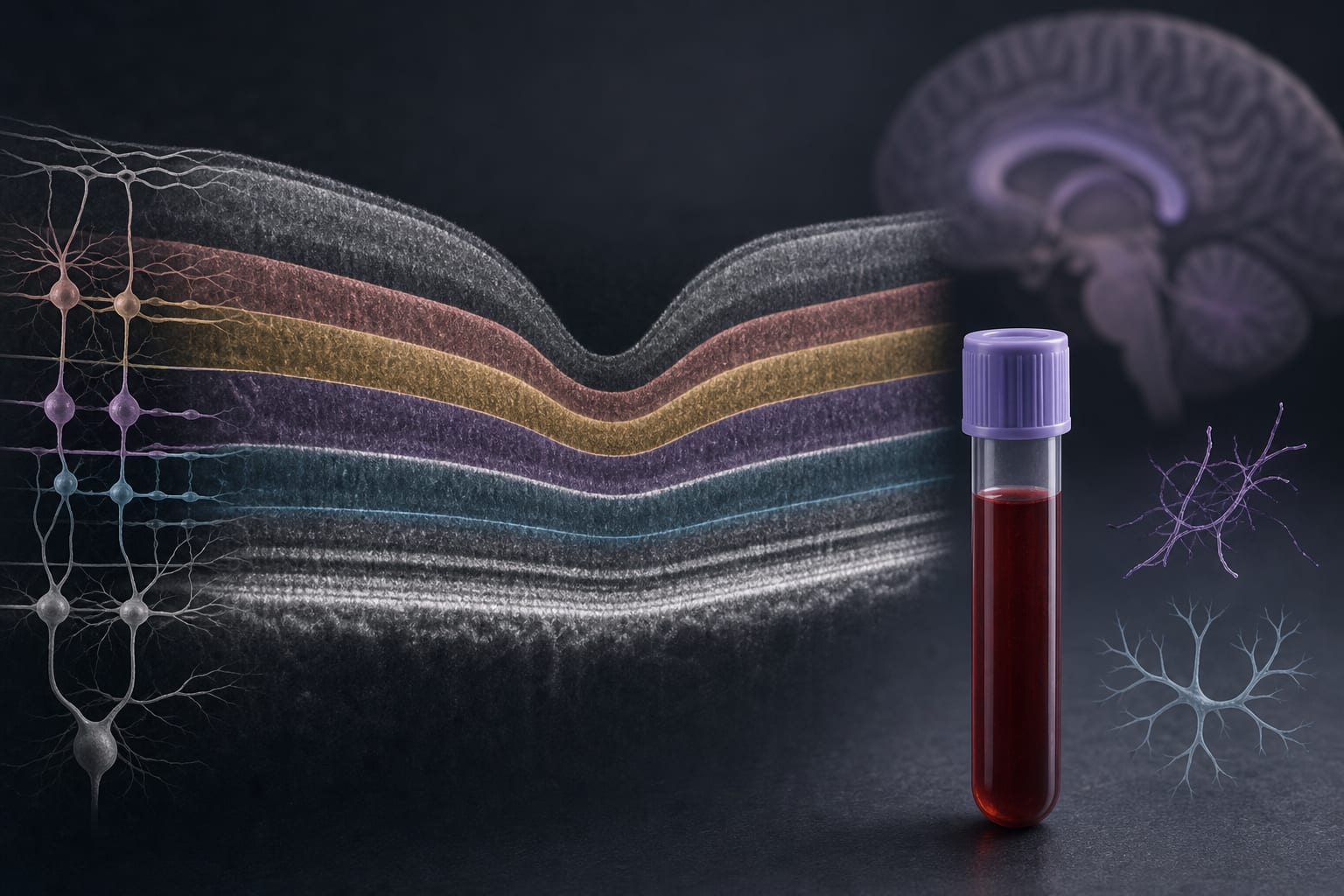
- Thinner inner nuclear layer (INL) and ganglion cell layer (GCL) correlate with higher levels of p-tau217 and GFAP.
- Study utilized spectral-domain optical coherence tomography (SD-OCT) for retinal measurements.
- Findings suggest potential for retinal imaging as a complementary tool to plasma biomarkers for early AD risk assessment.
- Exploratory pilot study with a small sample size (11 participants).
- Need for larger, longitudinal studies to validate preliminary findings.
Guideline-Based Recommendations
Diagnosis
- Use of plasma biomarkers such as Aβ42/40, p-tau217, and GFAP for assessing AD risk.
Management
- Consider retinal imaging as a non-invasive method for monitoring individuals at risk for AD.
Monitoring & Follow-up
- Regular assessment of plasma biomarkers and retinal layer thickness in at-risk populations.
Risks
- Potential for misclassification of cognitive status based on plasma biomarker cut-offs.
Patient & Prescribing Data
Cognitively normal adults with a pathological Aβ42/40 ratio indicating increased risk for AD.
Current study does not provide direct treatment recommendations; focuses on risk assessment.
Clinical Best Practices
- Incorporate retinal imaging in the evaluation of individuals at risk for AD.
- Utilize a combination of plasma biomarkers and retinal measurements for comprehensive risk assessment.
Related Resources & Content