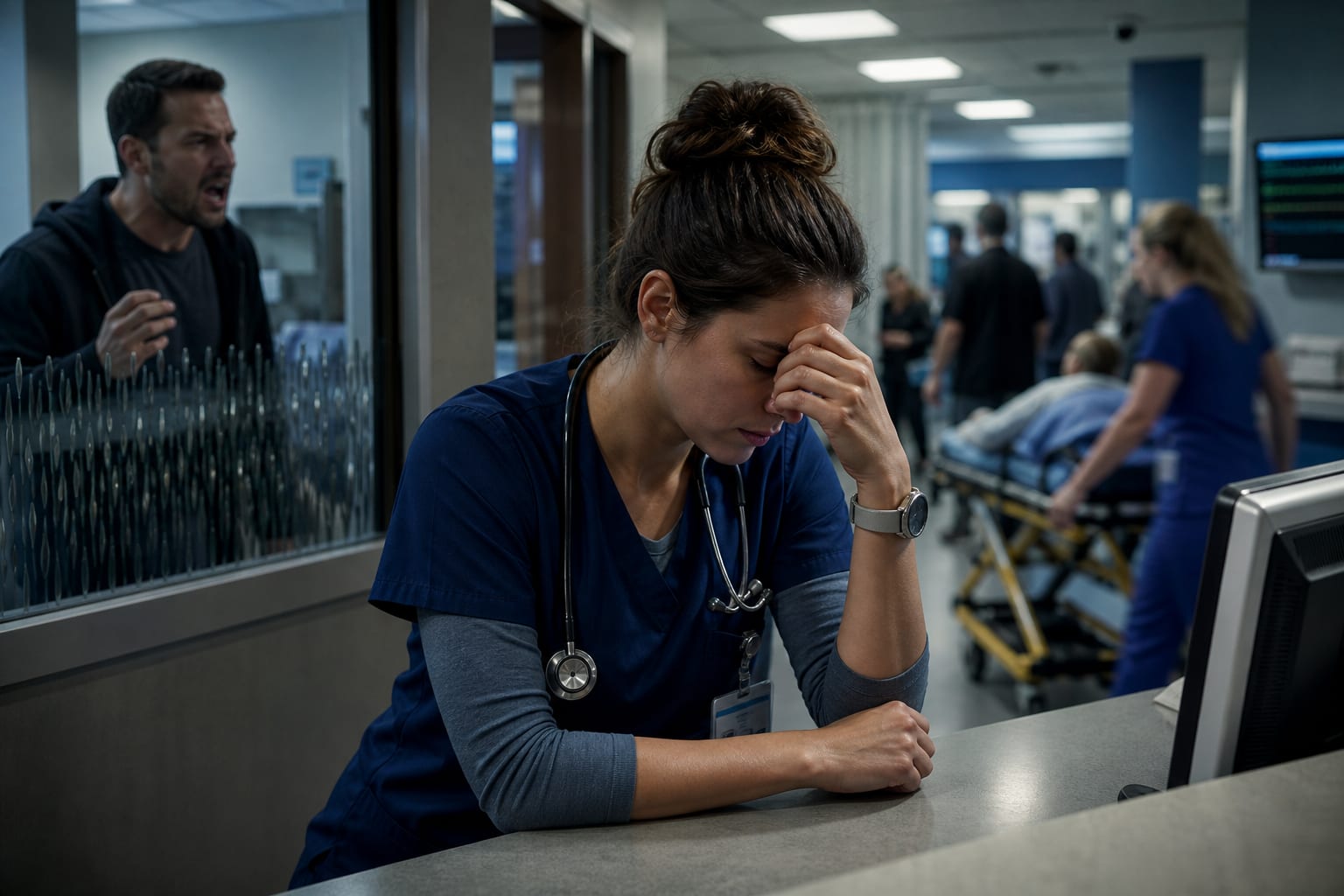
Workplace Violence Targeting Nurses: An Emergency Department Crisis
-
By
-
Marla C. Doehring
-
Megan M. Palmer
-
Benton R. Hunter
-
November 13, 2026
Clinical Scorecard: Workplace Violence Targeting Emergency Department Nurses
At a Glance
| Category | Detail |
|---|---|
| Condition | Workplace violence (WPV) affecting emergency department nurses, including bullying, unwanted sexual attention, threats, verbal abuse, and physical violence. |
| Key Mechanisms | WPV was perpetrated by patients, visitors, or coworkers; the article describes associations with overtime, shift timing, and ED type but does not establish causation. |
| Target Population | Emergency department nurses, including nurses exposed to patient-, visitor-, or coworker-perpetrated WPV. |
| Care Setting | Emergency departments, including freestanding EDs; evidence comes from 11 EDs in one multisite health system. |
Key Highlights
- In a cross-sectional study of 337 ED nurses, 87.8% reported WPV exposure during the preceding month.
- Among 296 nurses reporting WPV, 98.6% reported incidents involving patients or visitors; 20.3% also reported coworker-perpetrated incidents.
- Adjusted analyses found overtime associated with higher odds of WPV and night-shift work and employment at a freestanding ED associated with lower odds; the cross-sectional study does not establish causation.
- The commentary notes that high WPV prevalence can make odds ratios appear large relative to risk differences and suggests the overtime association may reflect greater workplace exposure.
- The article calls for multifaceted prevention approaches and further study of team- and system-level factors and coworker-perpetrated WPV.
Guideline-Based Recommendations
Diagnosis
- The study defined WPV to include bullying, unwanted sexual attention, threats, verbal abuse, and physical violence by patients, visitors, or coworkers.
Management
- The article supports developing, evaluating, and implementing multifaceted WPV prevention approaches involving bedside clinicians, hospital leaders, and policymakers.
- The article recommends tailoring mitigation strategies to individual ED environments; strategies for coworker-perpetrated WPV may differ from those for patient-perpetrated WPV.
- The commentary states that the study findings do not warrant restricting or eliminating overtime.
Monitoring & Follow-up
- Further investigate team- and system-level opportunities to address WPV.
- Conduct studies specifically examining coworker-perpetrated WPV.
- Further validate reported associations with overtime, shift timing, and ED type; the article notes that shift-related findings have been inconsistent across studies.
Risks
- WPV was reported by 87.8% of surveyed nurses for the preceding month.
- Overtime was associated with increased odds of WPV, but the cross-sectional findings do not establish a distinct causal effect of overtime.
- Night-shift work and employment at a freestanding ED were associated with lower odds in the adjusted analysis; the article notes that local operational conditions may affect these relationships.
- The racial or ethnic minority subgroup was small, and its numerically lower odds of WPV were not statistically significant.
Patient & Prescribing Data
Not applicable; the article concerns workplace violence exposure among emergency department nurses.
No medication or patient treatment data are provided. The article discusses prevention of WPV against frontline health care workers.
Clinical Best Practices
- The article frames ED WPV as a broad workplace problem rather than only a series of isolated incidents.
- The article recommends distinguishing patient- and visitor-perpetrated WPV from coworker-perpetrated WPV when investigating prevention approaches.
- The commentary advises interpreting the overtime association cautiously because WPV was common and the study was cross-sectional.
- The article supports developing and evaluating prevention approaches with bedside clinicians, hospital leaders, and policymakers.
Related Resources & Content
Based on findings from:
Workplace Violence Against Nurses—A Crisis in the Emergency Department
Marla C. Doehring, Megan M. Palmer, Benton R. Hunter. Jama Network Open, 2026.
https://jamanetwork.com/journals/jamanetworkopen/fullarticle/2856642
This content is an AI-generated, fully rewritten summary based on a published scholarly article. It does not reproduce the original text and is not a substitute for the original publication. Readers are encouraged to consult the source for full context, data, and methodology.