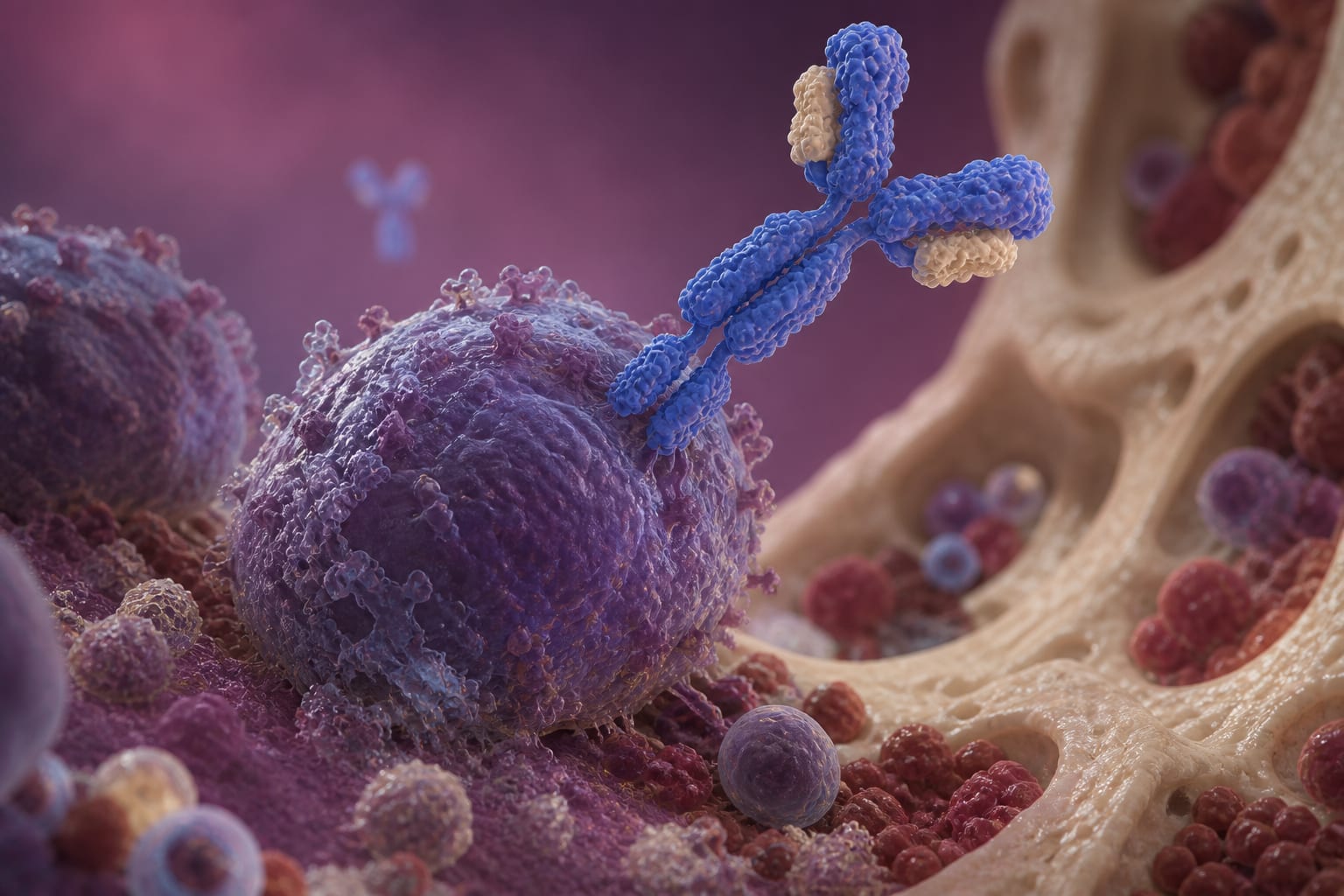
Vyriad Begins First-in-Human Trial of In Vivo CAR T Therapy VV169
Phase I study will test whether a targeted lentiviral vector can generate BCMA-directed CAR T cells inside patients with multiple myeloma
Clinical Scorecard: Vyriad Begins First-in-Human Trial of In Vivo CAR T Therapy VV169
At a Glance
| Category | Detail |
|---|
| Condition | Multiple Myeloma |
| Key Mechanisms | In vivo generation of BCMA-targeted CAR T cells using a lentiviral vector. |
| Target Population | Patients with relapsed or refractory multiple myeloma. |
| Care Setting | Phase I clinical trial at Mayo Clinic. |
Key Highlights
- VV169 is an off-the-shelf lentiviral therapy for CAR T cell generation.
- The trial is open-label and nonrandomized, enrolling up to 40 adults.
- Primary endpoints include adverse events and maximum tolerated dose.
- Secondary assessments focus on objective response rate and CAR T cell persistence.
- The study aims to reduce waiting times for CAR T cell therapy.
Guideline-Based Recommendations
Diagnosis
- Patients must have relapsed or refractory multiple myeloma.
Management
- VV169 administered intravenously as a T-cell-targeted lentiviral vector.
Monitoring & Follow-up
- Participants will be followed for safety and tolerability for up to two years.
Risks
- Safety, specificity, and clinical activity of VV169 have not yet been established.
Patient & Prescribing Data
Adults with aggressive multiple myeloma.
VV169 aims to eliminate the need for individualized manufacturing of CAR T cells.
Clinical Best Practices
- Monitor for adverse events and dose-limiting toxicities during the trial.
- Evaluate the expansion and persistence of CAR T cells generated in vivo.
Related Resources & Content