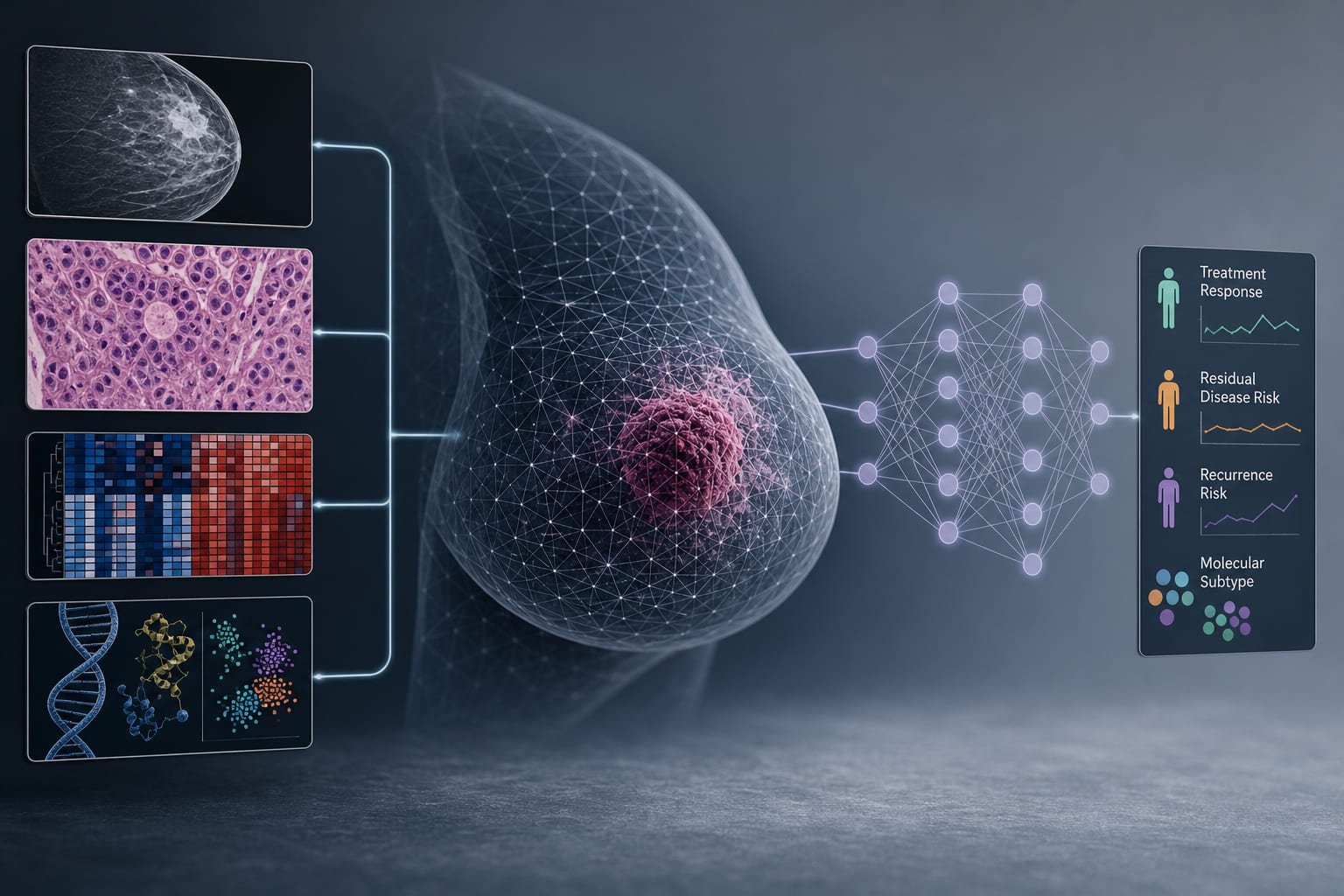
Artificial intelligence for triple-negative breast cancer from imaging to multi-omics
Clinical Scorecard: Utilizing Artificial Intelligence in Triple-Negative Breast Cancer: From Imaging Techniques to Multi-Omics Approaches
At a Glance
Category Detail
Condition Triple-Negative Breast Cancer (TNBC) Key Mechanisms Artificial intelligence (AI) applied to imaging, computational pathology, and molecular data. Target Population Patients diagnosed with triple-negative breast cancer. Care Setting Clinical oncology and research settings focused on breast cancer.
Key Highlights
AI has been utilized for lesion segmentation, subtype classification, and prediction of treatment response in TNBC. Multimodal fusion and radiogenomic frameworks show promise for capturing TNBC heterogeneity. Current studies face limitations such as small cohorts and inadequate external validation. Guideline-Based Recommendations
Diagnosis
AI methods should be validated for reliable diagnosis in TNBC. Management
AI can assist in predicting treatment response and recurrence risk. Monitoring & Follow-up
Ongoing assessment of AI tools is necessary to ensure their clinical utility. Risks
Study-design limitations and weak generalization across centers pose risks to AI implementation. Patient & Prescribing Data
Patients with triple-negative breast cancer.
AI can enhance treatment-response prediction and recurrence-risk assessment.
Clinical Best Practices
Ensure robust validation and transparent reporting of AI studies. Focus on biologically grounded interpretation of AI results. Related Resources & Content