Comparing manual vs. automated machine learning and deep learning models for predicting one-year mortality in elderly hip fracture patients - Scorecard - MDSpire

Comparing manual vs. automated machine learning and deep learning models for predicting one-year mortality in elderly hip fracture patients

  • By

  • Adi Shuchami

  • Maxim Glebov

  • Maksim Katsin

  • Yotam Portnoy

  • Haim Berkenstadt

  • Dina Orkin

  • Teddy Lazebnik

  • June 1, 2026

  • 0 min

Share

Clinical Scorecard: Evaluating Manual and Automated Approaches in Machine Learning and Deep Learning for Forecasting One-Year Mortality in Older Adults with Hip Fractures

At a Glance

CategoryDetail
ConditionHip fractures in elderly patients
Key MechanismsMachine learning and deep learning algorithms for mortality prediction
Target PopulationElderly patients (≥65 years) undergoing hip fracture surgery
Care SettingTertiary care center

Key Highlights

  • Study included 2,604 elderly patients undergoing urgent hip fracture surgery.
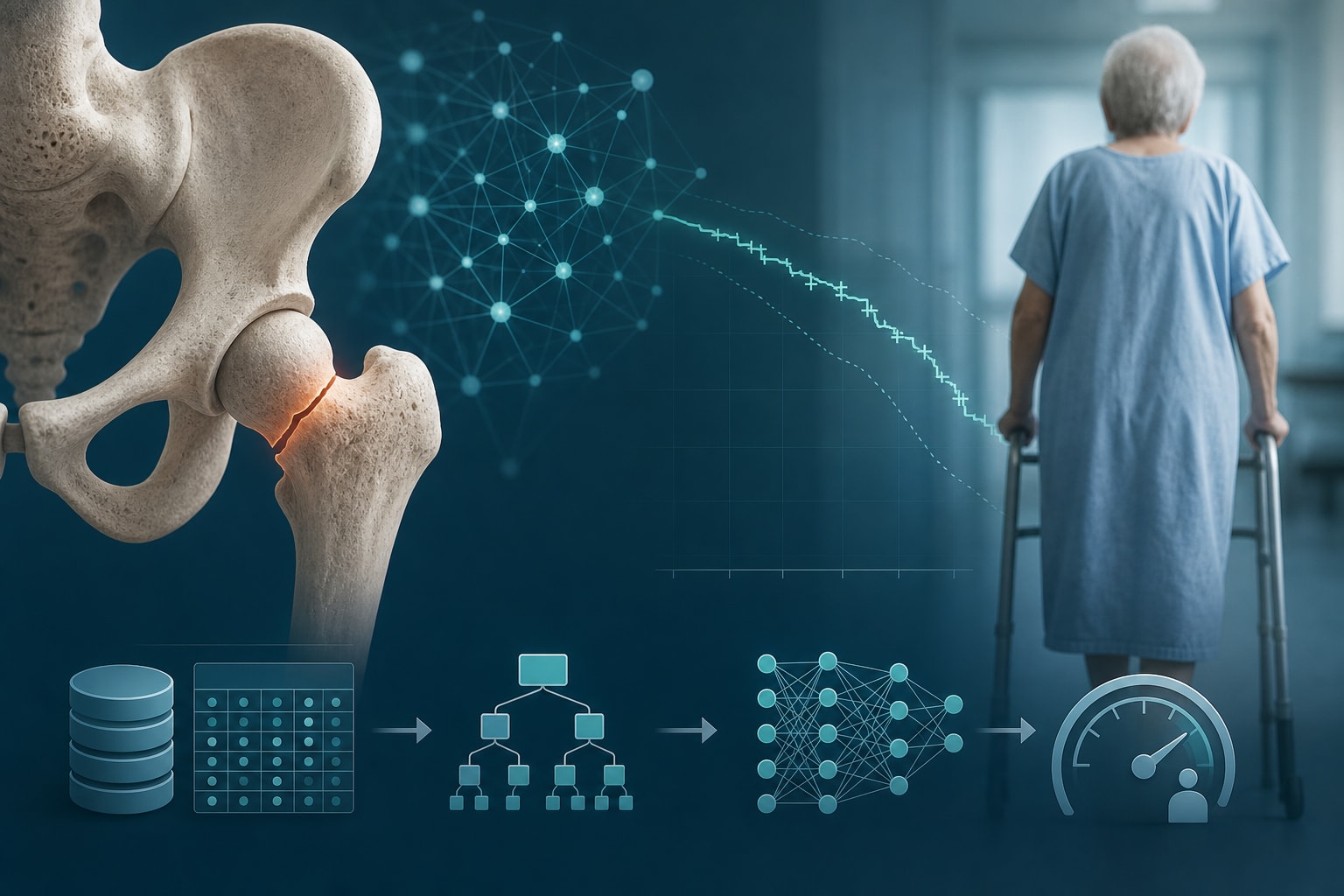
  • Manually optimised Extreme Gradient Boosting (XGB) algorithm showed superior predictive performance (AUC = 0.846).
  • Automated ML model using LLM and TPOT demonstrated comparable performance (AUC = 0.844).
  • Key predictors included serum albumin, urea levels, patient age, intraoperative hypothermia, and number of chronic diseases.
  • ML models enhance predictive accuracy for one-year mortality in elderly hip fracture patients.

Guideline-Based Recommendations

Diagnosis

  • Utilize comprehensive clinical, demographic, perioperative, and laboratory variables for risk assessment.

Management

  • Implement ML-based models to guide perioperative care and resource allocation.

Monitoring & Follow-up

  • Regularly assess model performance using metrics such as AUC, accuracy, and F1-score.

Risks

  • Consider high postoperative mortality rates, which can reach up to 36% within the first year.

Patient & Prescribing Data

Elderly patients aged 65 years and older with hip fractures.

Focus on identifying high-risk patients for targeted perioperative management.

Clinical Best Practices

  • Employ ML algorithms to manage complex, nonlinear predictor interactions.
  • Utilize automated ML platforms to democratize access to predictive analytics in clinical settings.
  • Ensure rigorous model validation through stratified cross-validation and addressing class imbalance.

Related Resources & Content

Original Source(s)

Related Content