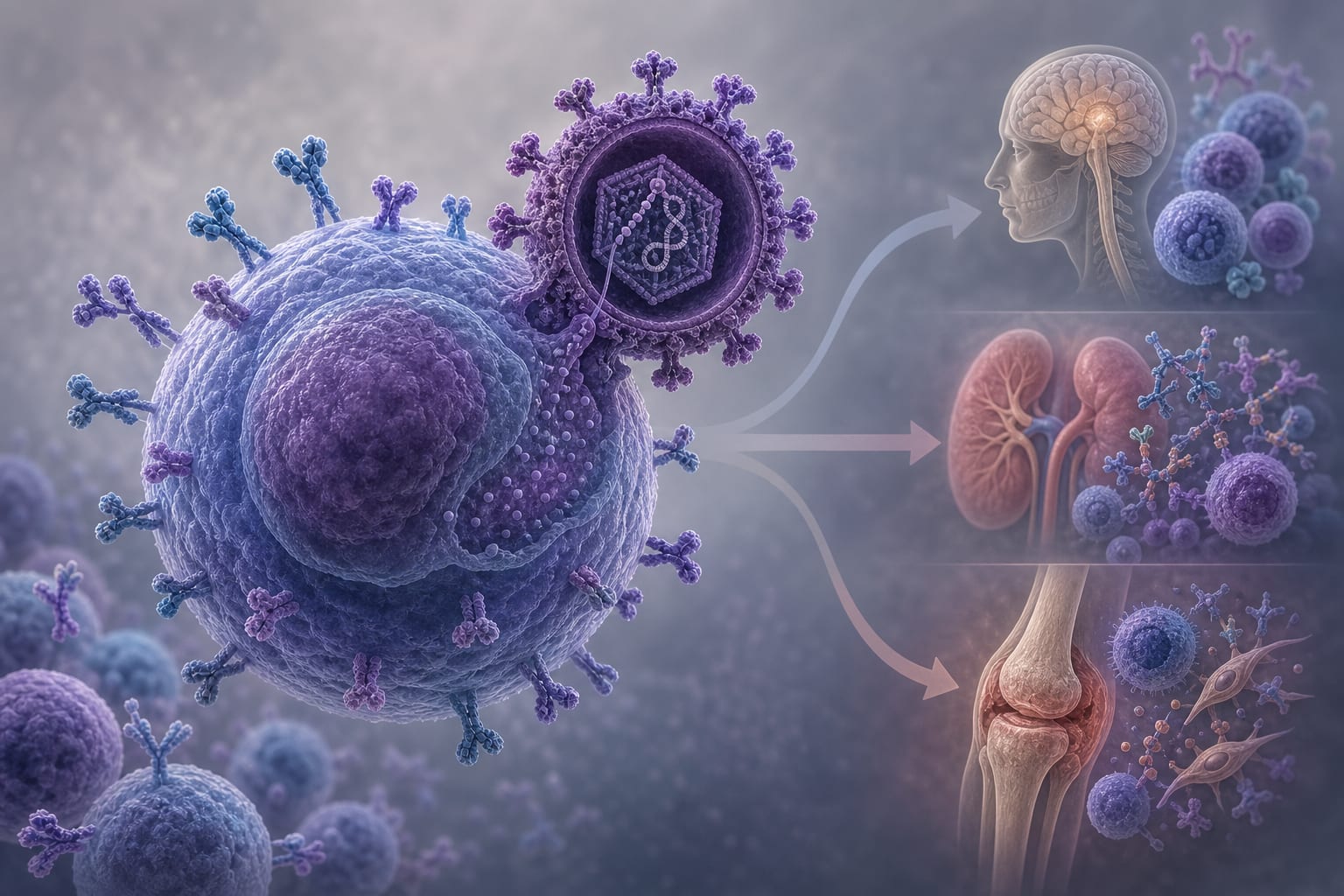
Systematic Review of CAR T-Cell Therapy for Refractory Systemic Lupus Erythematosus: Addressing Overlapping Data
-
By
-
Sheng-Guang Li
-
Ruohan Yu
-
Lina Zhang
-
Jing Zhang
-
Yadan Zou
-
Ji Li
-
Ting Long
-
Yanfeng Zhang
-
Jing Pan
-
July 1, 2026
Clinical Scorecard: Systematic Review of CAR T-Cell Therapy for Refractory Systemic Lupus Erythematosus: Addressing Overlapping Data
At a Glance
| Category | Detail |
|---|
| Condition | Refractory Systemic Lupus Erythematosus |
| Key Mechanisms | CAR-based cellular therapy targeting autoreactive B-lineage cells. |
| Target Population | Patients with relapsed or refractory systemic lupus erythematosus, particularly those with renal involvement. |
| Care Setting | Clinical research and trials evaluating CAR-based therapies. |
Key Highlights
- CAR-based cellular therapy shows promising remission signals in refractory systemic lupus erythematosus.
- Overlap-controlled synthesis reduces duplicate counting in this rapidly expanding evidence base.
- Endpoint-specific proportions are descriptive only and remain limited by sparse exact evaluability.
- Future trials need harmonised efficacy, immune-reconstitution and immune-effector toxicity endpoints.
Guideline-Based Recommendations
Diagnosis
- Identify patients with relapsed or refractory systemic lupus erythematosus.
Management
- Consider CAR-based cellular therapy for patients with severe manifestations, particularly renal involvement.
Monitoring & Follow-up
- Monitor for cytokine release syndrome and immune effector cell-associated neurotoxicity syndrome.
Risks
- Be aware of potential severe inflammatory toxicities in selected paediatric or highly inflammatory settings.
Patient & Prescribing Data
Predominantly female, median age 32 years, heavily pretreated.
Autologous CD19 CAR-T and BCMA-containing platforms are most commonly used.
Clinical Best Practices
- Conduct standardised prospective studies with harmonised efficacy and toxicity endpoints.
- Utilize overlap-controlled methods to ensure accurate patient-level data synthesis.
Related Resources & Content