Case Report: Possible spatially-distinct de novo invasive cervical carcinoma in the setting of isolated persistent HPV16 after ALA-PDT-mediated histological clearance of CIN3 - Scorecard - MDSpire
Conexiant’s news site is now MDSpire News. Learn more
Advertisement
Case Study: Potentially Spatially-Separated De Novo Invasive Cervical Carcinoma Following Isolated Persistent HPV16 After Histological Clearance of CIN3 via ALA-PDT
Clinical Scorecard: Case Study: Potentially Spatially-Separated De Novo Invasive Cervical Carcinoma Following Isolated Persistent HPV16 After Histological Clearance of CIN3 via ALA-PDT
At a Glance
Category
Detail
Condition
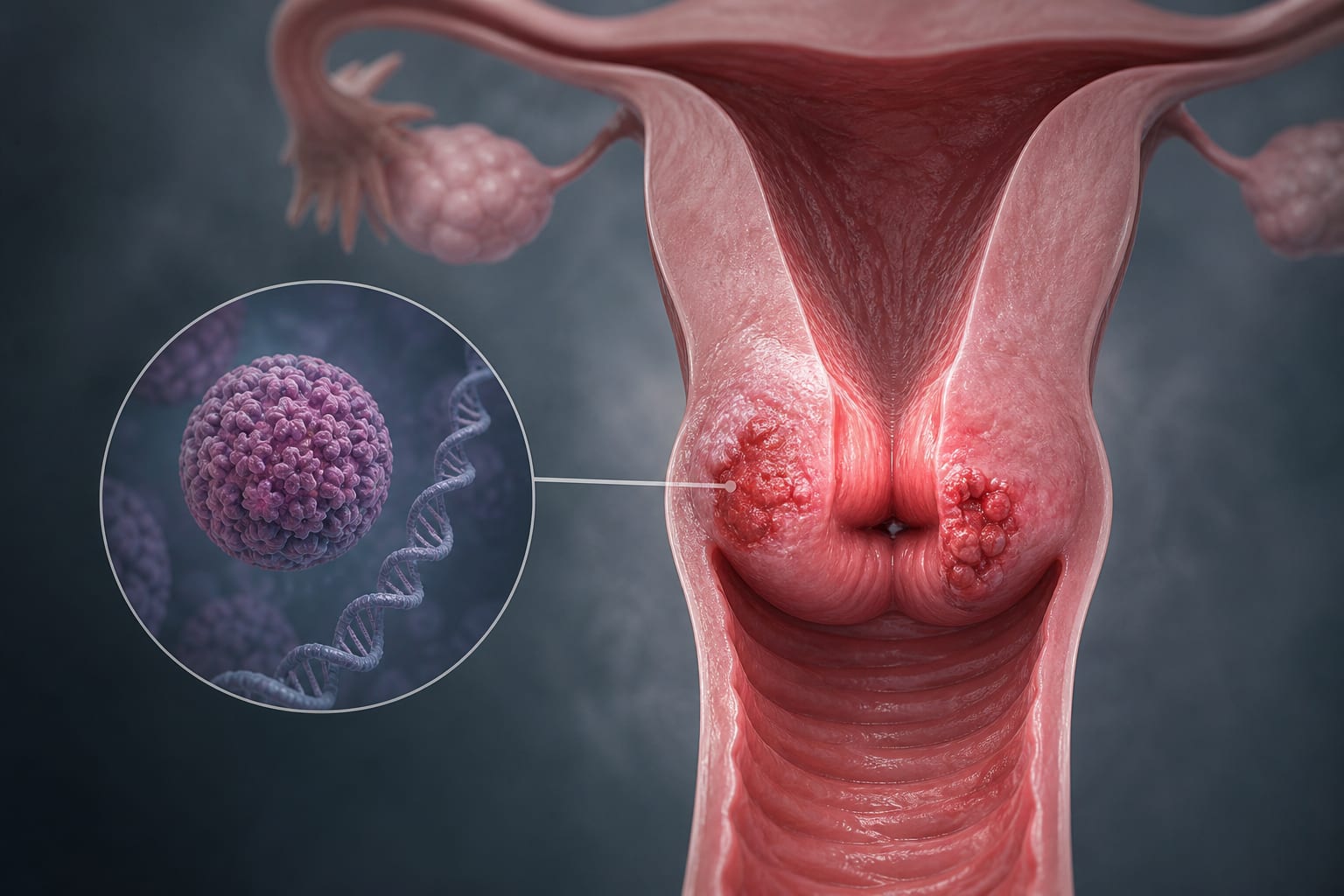
Cervical Intraepithelial Neoplasia Grade 3 (CIN3) and HPV16 Infection
Key Mechanisms
Persistent HPV16 infection may retain long-term malignant potential after CIN3 resolution.
Target Population
Women with CIN3 seeking fertility preservation.
Care Setting
Oncology and gynecology outpatient settings.
Key Highlights
Persistent HPV16 infection can occur after histological remission of CIN3.
A 32-year-old woman developed invasive cervical carcinoma after 20 months of loss to follow-up.
ALA-PDT is an off-guideline treatment option for fertility preservation in CIN3.
Risk-stratified surveillance is necessary for patients with persistent HPV16.
The case highlights the potential for de novo malignant transformation associated with HPV16.
Guideline-Based Recommendations
Diagnosis
Histological confirmation of CIN3 via biopsy.
Monitoring for persistent HPV16 post-treatment.
Management
Consider ALA-PDT for fertility-preserving treatment in select patients.
Standard treatments include LEEP and cold-knife conization.
Monitoring & Follow-up
Implement risk-stratified surveillance for patients with persistent HPV16.
Risks
Potential for disease progression and development of invasive carcinoma.
Patient & Prescribing Data
Women with CIN3 and persistent HPV16 infection.
ALA-PDT may not be formally recommended for CIN3 but is used for fertility preservation.
Clinical Best Practices
Ensure comprehensive counseling on treatment options and associated risks.
Promote adherence to follow-up surveillance to prevent advanced disease.