Implications of different SOFA score variants for outcome prediction in emergency department patients with an infection: a multicenter cohort study - Scorecard - MDSpire
Clinical Scorecard: Comparing SOFA Score Variants for Outcome Prediction in Emergency Department Patients With Infection: A Multicenter Cohort Study
At a Glance
Category
Detail
Condition
Risk assessment for in-hospital mortality and/or intensive care unit (ICU) admission among emergency department (ED) adults with confirmed infection.
Key Mechanisms
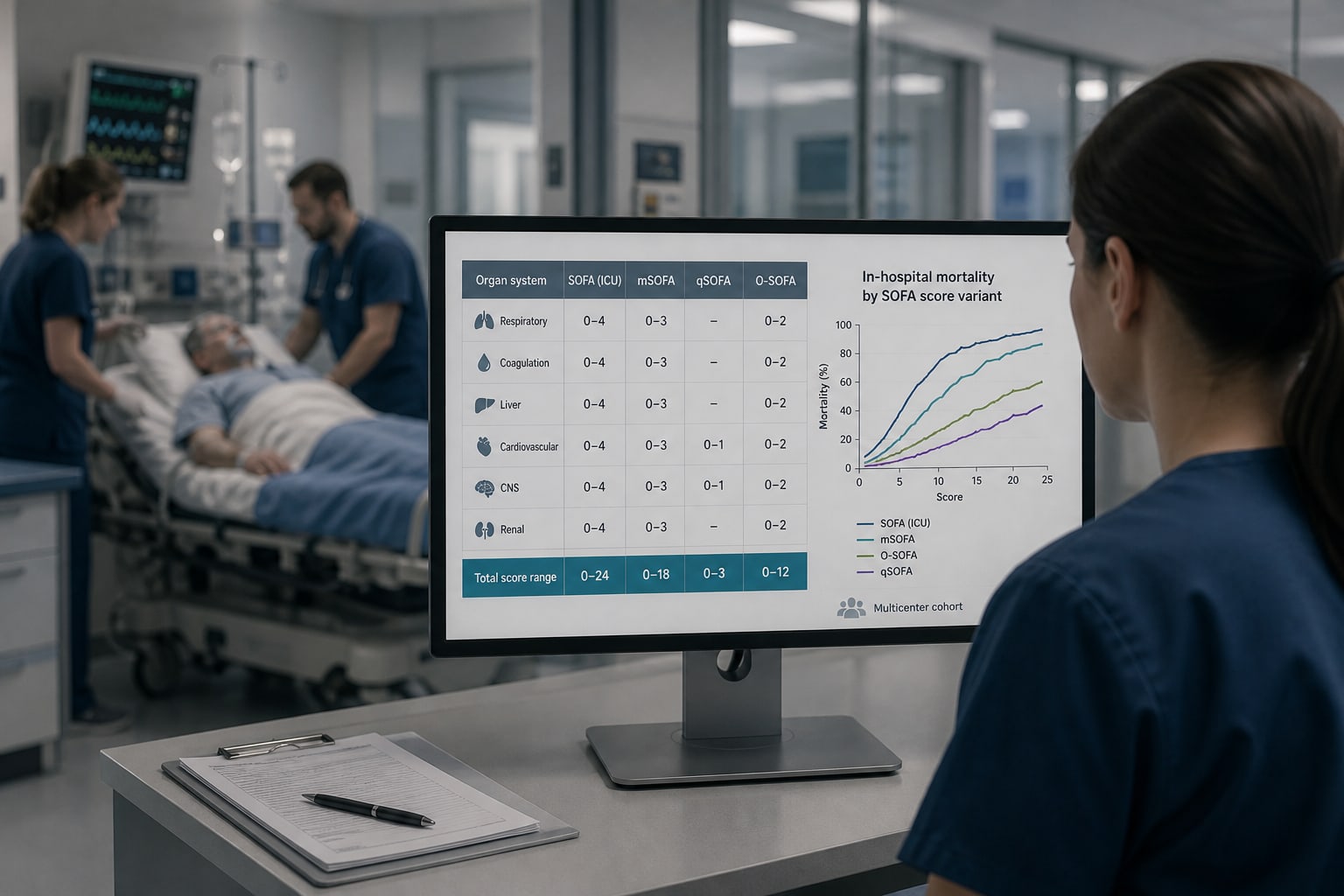
Seven Sequential Organ Failure Assessment (SOFA) variants differ in missing-data handling, baseline organ-function adjustment, automated calculation, or score complexity.
Target Population
Adults with physician-confirmed infection from the Acutelines, Sepsis 2-3, and SUSPECT cohorts who meet cohort-specific eligibility and culture-antibiotic timing requirements.
Care Setting
Two academic hospitals in the Netherlands; scores generally use the worst values within 24 hours after ED presentation, including measurements obtained on wards or in the ICU.
Key Highlights
The post hoc analysis includes 2036 patients; 348 (17%) experience in-hospital mortality and/or ICU admission.
Original SOFA, AW-SOFA, SF-SOFA, ΔSOFA, and mSOFA show broadly similar discrimination, with areas under the receiver operating characteristic curve of 0.80, 0.79, 0.80, 0.80, and 0.82, respectively.
MICE-SOFA and eSOFA have lower discrimination, with corresponding values of 0.76 and 0.74.
At a threshold of ≥8, mSOFA has 99.82% specificity but 22.99% sensitivity.
Urine output is excluded where applicable because of data-reliability concerns. Any norepinephrine use receives 4 points in the primary analysis because dose recordings do not reliably distinguish low-dose from high-dose administration.
Guideline-Based Recommendations
Diagnosis
The study evaluates prognosis rather than diagnostic accuracy. Its findings do not establish a preferred SOFA variant for diagnosing sepsis in unselected ED patients.
Management
The study does not compare treatments or establish score-directed treatment recommendations. The authors support selecting a SOFA implementation suited to the setting and available data.
Monitoring & Follow-up
Scores generally reflect the worst measurements within the first 24 hours after ED presentation. The study does not establish a routine reassessment schedule.
Variants requiring baseline organ-function data may be less feasible when historical records are unavailable.
Risks
Missing-data assumptions, baseline correction, and threshold selection can change which patients are classified as having organ dysfunction.
High specificity at a selected threshold can accompany low sensitivity, as demonstrated by mSOFA ≥8.
Results require cautious generalization because the cohorts are enriched for high-acuity illness or sepsis.
Patient & Prescribing Data
Participants have a median age of 67 years, and 57% are male. Among 2036 patients, 236 (12%) are admitted to the ICU and 178 (9%) die in hospital; these groups overlap.
Patients require physician-confirmed infection and qualifying culture sampling and antibiotic administration within prespecified intervals. The analysis provides no treatment-effect or prescribing comparisons.
Clinical Best Practices
Report the score variant, assessment window, missing-data rules, baseline correction, and scoring thresholds transparently.
Distinguish overall discrimination from sensitivity and specificity at individual thresholds.
Treat urine-output omission and norepinephrine scoring as study-specific adaptations rather than universal scoring instructions.
Consider data availability and the limitations of hospital-only baseline records when selecting an implementation.
Related Resources & Content
Vincent JL, Moreno R, Takala J, et al. The SOFA (Sepsis-related Organ Failure Assessment) score to describe organ dysfunction/failure. On behalf of the working group on sepsis-related problems of the European Society of Intensive Care Medicine. Intensive Care Med. 1996;22(7):707–710.
Singer M, Deutschman CS, Seymour CW, et al. The third international consensus definitions for sepsis and septic shock (Sepsis-3). JAMA. 2016;315(8):801–810.
Rhee C, Zhang Z, Kadri SS, et al. Sepsis surveillance using adult sepsis events simplified eSOFA criteria versus Sepsis-3 sequential organ failure assessment criteria. Crit Care Med. 2019;47(3):307–314.
Grissom CK, Brown SM, Kuttler KG, et al. A modified sequential organ failure assessment score for critical care triage. Disaster Med Public Health Prep. 2010;4(4):277–284.
Lambden S, Laterre PF, Levy MM, Francois B. The SOFA score-development, utility and challenges of accurate assessment in clinical trials. Crit Care. 2019;23(1):374.
by Tamar J. van der Aart, Carolina Hincapié-Osorno, Isaac Santiago Arango-Gil, Konstantin Föhse, Jacobien J Hoogerwerf, Fabián Jaimes, Jacqueline Koeze, Marco van Londen, Jan C. ter Maaten, Jaap ten Oever, Renée A.M. Tuinte, Carlos E. Vallejo, Raymond J. van Wijk, Hjalmar R. Bouma, Douwe F. Postma