Congenital aerodigestive fistula with extraordinarily delayed adult presentation: a case report and review of endoscopic closure for bronchoesophageal fistula - Scorecard - MDSpire

Congenital aerodigestive fistula with extraordinarily delayed adult presentation: a case report and review of endoscopic closure for bronchoesophageal fistula

  • By

  • Ning Liang

  • Jiang-Long Liu

  • Ke Zhan

  • Yi-Shi Li

  • Yang Bai

  • July 2, 2026

  • 0 min

Share

Clinical Scorecard: Adult Presentation of Congenital Aerodigestive Fistula: A Case Study and Examination of Endoscopic Techniques for Bronchoesophageal Fistula Closure
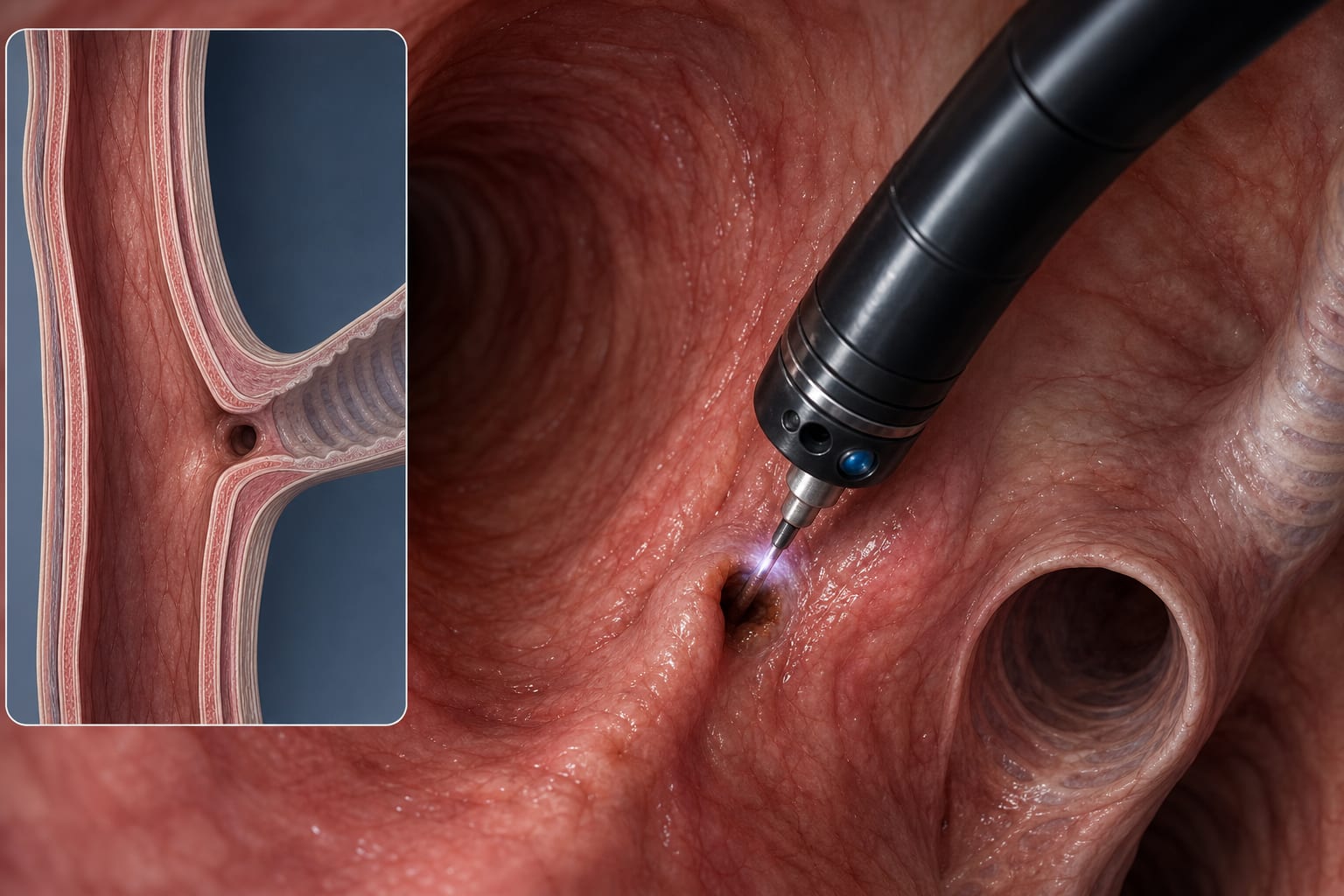

At a Glance

CategoryDetail
ConditionCongenital Aerodigestive Fistula (Bronchoesophageal Fistula)
Key MechanismsDisrupted embryological separation of the primitive foregut leading to abnormal communications between the respiratory and gastrointestinal tracts.
Target PopulationAdults with chronic liquid-induced paroxysmal cough or recurrent aspiration pneumonia.
Care SettingEndoscopic intervention for congenital bronchoesophageal fistula.

Key Highlights

  • Congenital bronchoesophageal fistula (BEF) can present in adulthood after decades of undetected symptoms.
  • Endoscopic techniques, including argon plasma coagulation and over-the-scope clip closure, are effective for managing BEF.
  • Surgical repair carries significant risks and may not be suitable for all patients.

Guideline-Based Recommendations

Diagnosis

  • Use combined bronchoscopy and esophagoscopy for diagnosis of congenital BEF.

Management

  • Consider endoscopic interventions as a minimally invasive alternative to surgical repair in eligible patients.

Monitoring & Follow-up

  • Follow-up imaging and endoscopy are recommended to assess for fistula closure and complications.

Risks

  • Surgical repair has substantial perioperative risks, especially in patients with comorbidities.

Patient & Prescribing Data

Adults with isolated congenital bronchoesophageal fistula presenting with chronic cough.

Endoscopic closure techniques can provide effective management with lower risk compared to surgical options.

Clinical Best Practices

  • Maintain a high index of suspicion for congenital BEF in patients with chronic cough.
  • Utilize multidisciplinary approaches for assessment and management of congenital ADF.

Related Resources & Content

Original Source(s)

Related Content