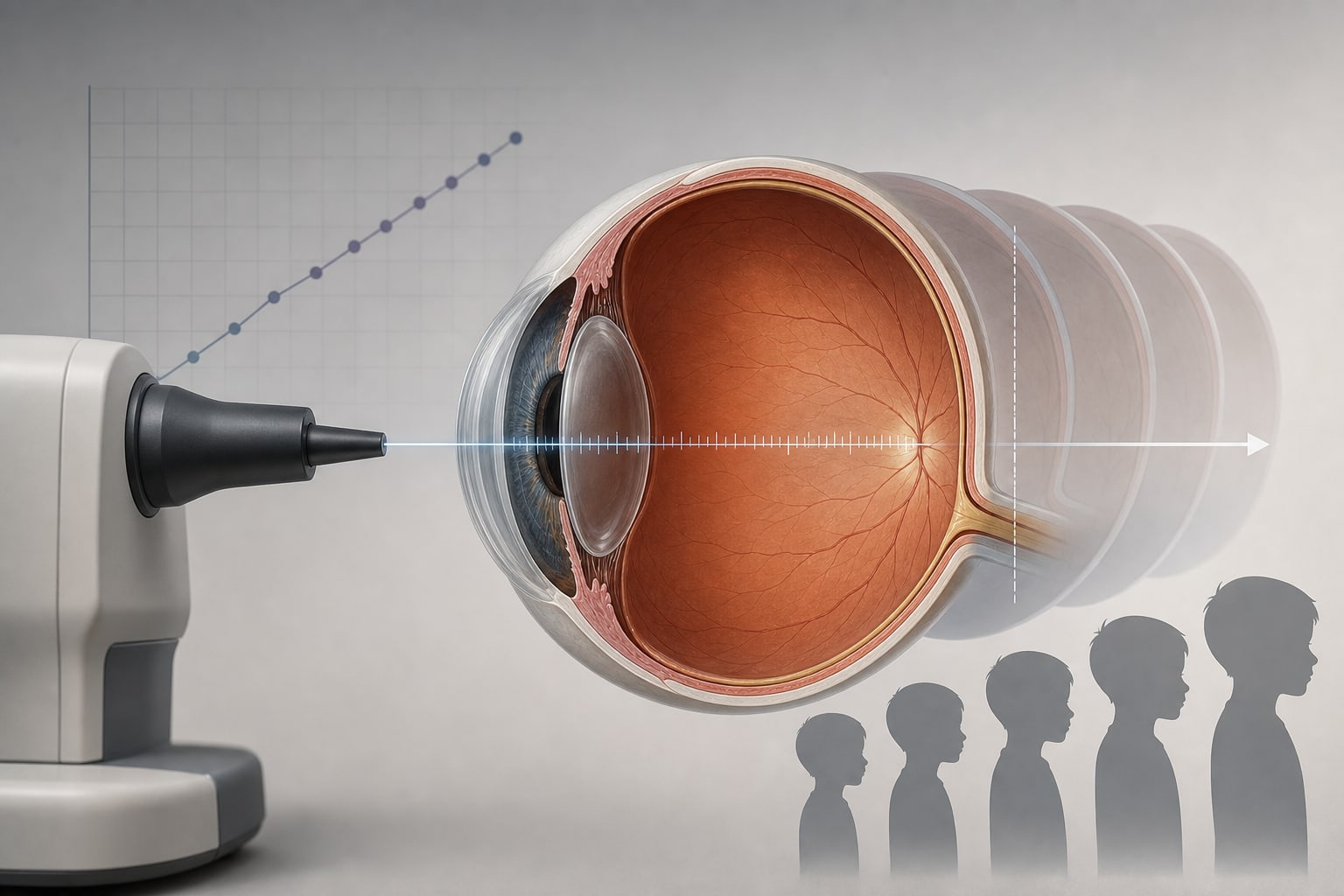
Age-Related Effects on the Transition from Pre-Myopia to Myopia: A One-Year Retrospective Study
-
By
-
Shuang Wang
-
Keke Huang
-
Xingyu He
-
Zhanfeng Wang
-
July 7, 2026
Clinical Scorecard: Age-Related Effects on the Transition from Pre-Myopia to Myopia: A One-Year Retrospective Study
At a Glance
| Category | Detail |
|---|
| Condition | Pre-myopia to Myopia Transition |
| Key Mechanisms | Age influences axial elongation during the transition from pre-myopia to myopia. |
| Target Population | Children aged 6–10 years. |
| Care Setting | Retrospective study in a clinical setting. |
Key Highlights
- Annual axial elongation decreases with increasing age.
- Children aged 6 and 7 years show significantly greater axial elongation than those aged 9 years.
- Each additional year of age correlates with a 0.093 mm decrease in annual axial elongation.
Guideline-Based Recommendations
Diagnosis
- Pre-myopia defined as spherical equivalent refraction ≤ + 0.75 D and > − 0.50 D.
Management
- Early surveillance and preventive strategies in the pre-myopic stage, particularly for children aged 6–7 years.
Monitoring & Follow-up
- Regular follow-ups every 6 months for children transitioning from pre-myopia to myopia.
Risks
- Younger age at myopia onset is associated with a higher risk of developing high myopia.
Patient & Prescribing Data
Children aged 6–10 years diagnosed with pre-myopia.
No specific treatments mentioned; focus on monitoring and early intervention.
Clinical Best Practices
- Consider age as a significant factor in the risk of myopia progression.
- Implement regular eye examinations for early detection of myopia.
Related Resources & Content