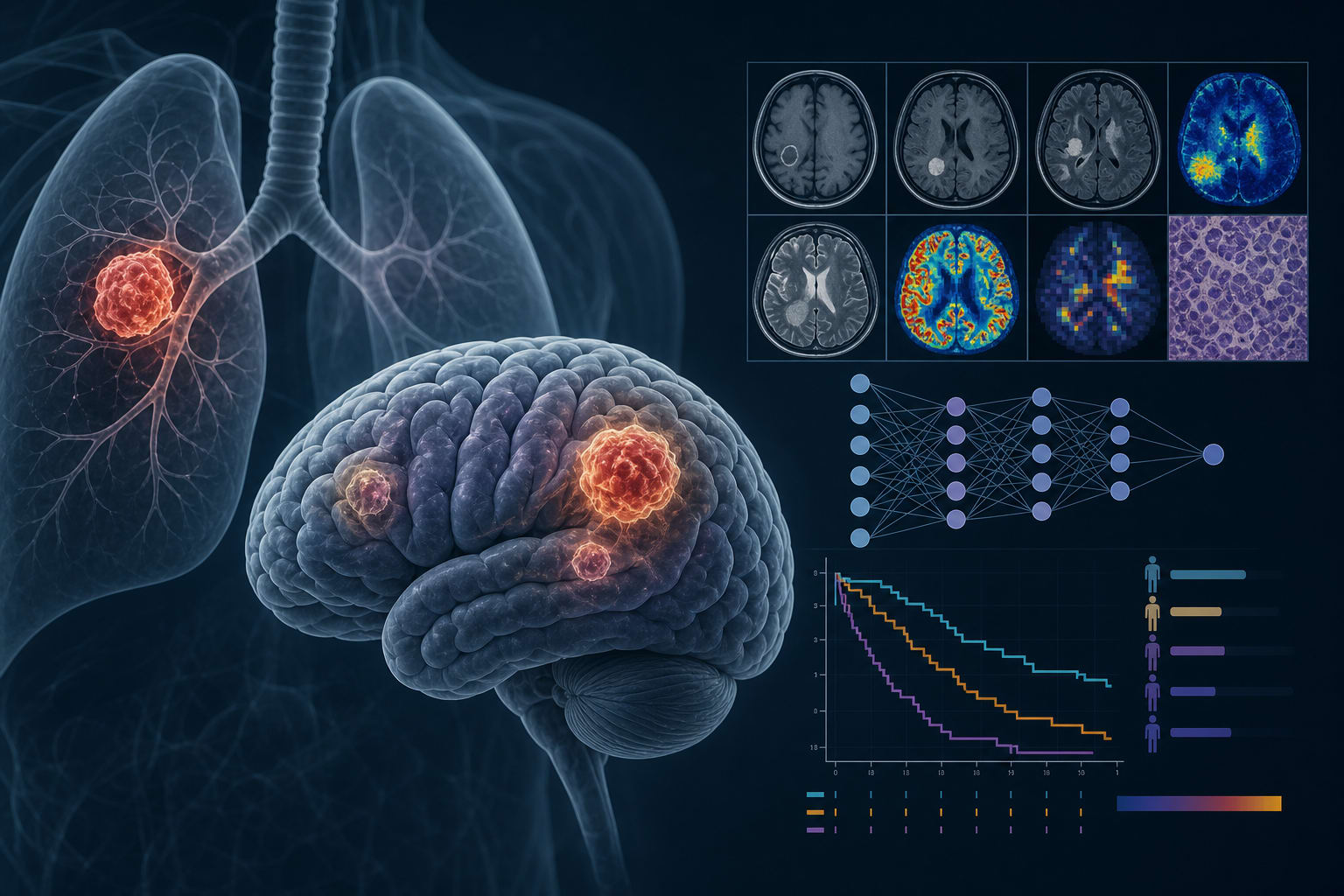
Survival Outcome Prediction in Lung Cancer Patients with Brain Metastases: A Brief Review of Recent Studies
Clinical Scorecard: Survival Outcome Prediction in Lung Cancer Patients with Brain Metastases: A Brief Review of Recent Studies
At a Glance
| Category | Detail |
|---|
| Condition | Lung Cancer with Brain Metastases |
| Key Mechanisms | Traditional scoring systems and advanced predictive modeling using machine learning and deep learning. |
| Target Population | Patients with lung cancer who have developed brain metastases. |
| Care Setting | Oncology and neurology clinics focusing on personalized treatment plans. |
Key Highlights
- Brain metastases occur in approximately 30-40% of lung cancer patients.
- Traditional scoring systems like GPA and Lung-molGPA are widely used for survival prediction.
- Recent studies highlight the potential of machine learning and deep learning for improved survival modeling.
- Multimodal data integration may enhance prediction performance compared to unimodal models.
- Median overall survival varies significantly based on prognostic scoring.
Guideline-Based Recommendations
Diagnosis
- Use clinical scoring systems to assess prognosis in lung cancer patients with brain metastases.
Management
- Incorporate advanced predictive modeling to personalize treatment plans.
Monitoring & Follow-up
- Regularly evaluate survival outcomes using established prognostic scores.
Risks
- Consider the heterogeneous prognosis influenced by clinical, radiologic, and molecular factors.
Patient & Prescribing Data
Lung cancer patients with brain metastases.
Utilization of traditional and advanced predictive models to guide treatment decisions.
Clinical Best Practices
- Employ the Lung-molGPA for better survival prediction in NSCLC patients with brain metastases.
- Integrate radiomic features with clinical data for enhanced prognostic accuracy.
Related Resources & Content