Development and validation of an interpretable machine learning model for predicting 5-year recurrence in breast cancer
-
By
-
Shaoda Meng
-
Sicheng Liu
-
Minghua Lai
-
Li Li
-
June 10, 2026
-
Clinical Scorecard: Creation and assessment of a transparent machine learning model for forecasting 5-year breast cancer recurrence
At a Glance
| Category | Detail |
|---|
| Condition | Breast Cancer Recurrence |
| Key Mechanisms | Machine learning model utilizing Extreme Gradient Boosting (XGBoost) and SHapley Additive exPlanations (SHAP) for risk stratification. |
| Target Population | Breast cancer patients with invasive carcinoma undergoing curative surgery. |
| Care Setting | Retrospective cohort study conducted at The First People’s Hospital of Yunnan Province. |
Key Highlights
- XGBoost model achieved an AUC of 0.877 for predicting recurrence, outperforming logistic regression and TNM staging.
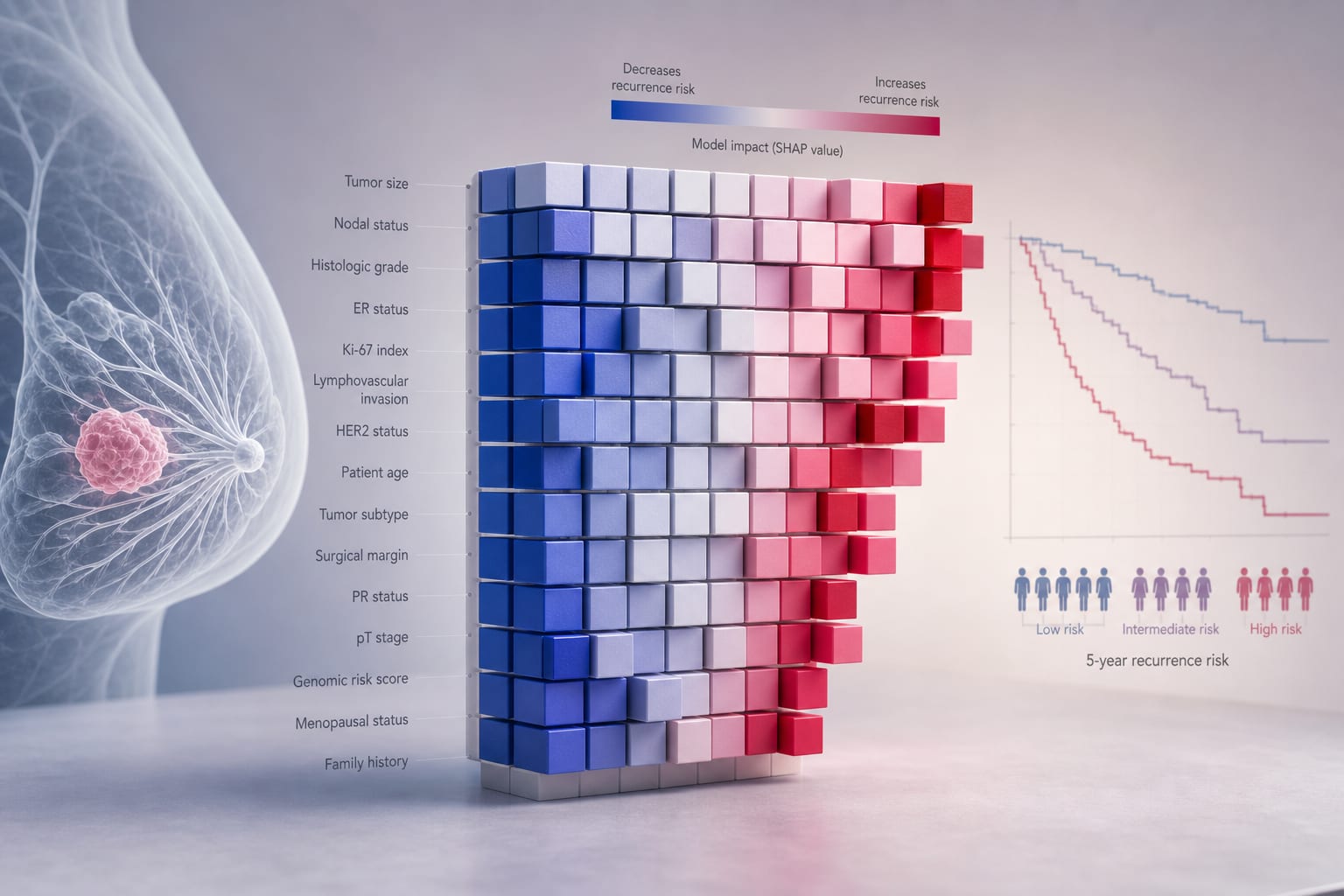
- SHAP analysis identified Ki-67 index and positive lymph nodes as key predictors.
- Model effectively stratified patients within TNM Stages II and III into distinct risk groups.
Guideline-Based Recommendations
Diagnosis
- Utilize clinicopathological features for risk stratification beyond traditional TNM staging.
Management
- Consider personalized adjuvant therapy based on machine learning risk predictions.
Monitoring & Follow-up
- Implement risk-stratified surveillance protocols for high-risk patients.
Risks
- Address intra-stage heterogeneity in breast cancer recurrence risk.
Patient & Prescribing Data
578 breast cancer patients with invasive carcinoma.
Incorporate machine learning predictions to optimize adjuvant therapy intensity.
Clinical Best Practices
- Employ interpretable machine learning models for enhanced prognostic accuracy.
- Utilize visual nomograms for clinical decision-making.
Related Resources & Content