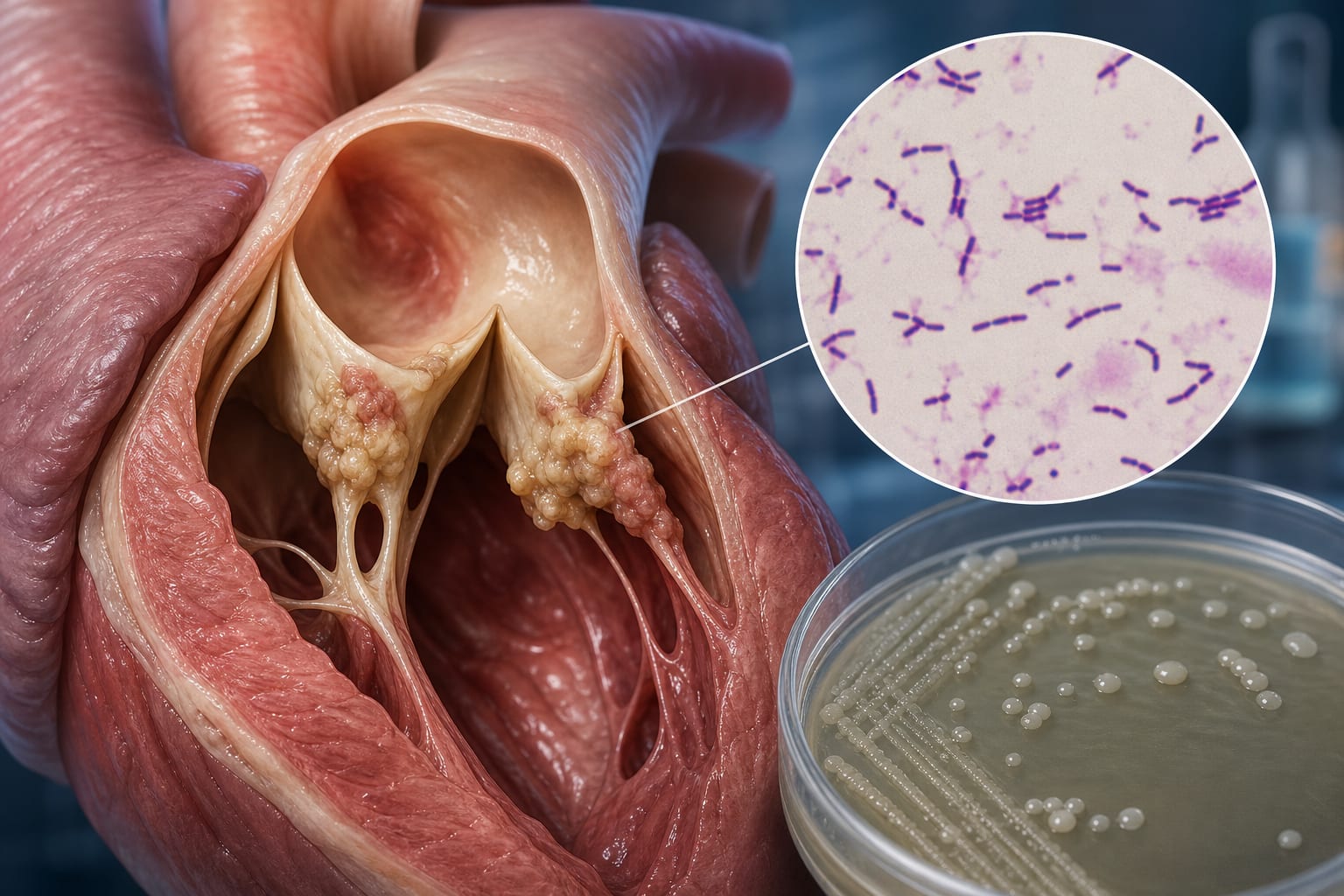
Curtobacterium oceansedimentum Endocarditis: A Plant-Associated Bacterium Linked to Acute Heart Failure and Severe Valve Dysfunction
-
October 20, 2026
Clinical Scorecard: Curtobacterium oceansedimentum Endocarditis: A Plant-Associated Bacterium Linked to Acute Heart Failure and Severe Valve Dysfunction
At a Glance
| Category | Detail |
|---|---|
| Condition | Curtobacterium oceansedimentum infective endocarditis with severe aortic insufficiency |
| Key Mechanisms | Aortic valve tissue culture identified Curtobacterium oceansedimentum despite negative blood cultures; transesophageal echocardiography showed left coronary cusp perforation. |
| Target Population | A 53-year-old man with polysubstance use disorder, retained facial-fracture hardware, acute heart failure, and culture-negative endocarditis. |
| Care Setting | Hospital evaluation and treatment, including echocardiography, aortic valve replacement, tissue microbiology, and empiric antibiotic therapy. |
Key Highlights
- The authors describe this as the first documented case of Curtobacterium infective endocarditis.
- Blood cultures remained negative; the organism was identified from intraoperative aortic valve tissue after referral to an outside laboratory.
- The patient had severe aortic insufficiency, left coronary cusp perforation, reduced left ventricular ejection fraction, and valvular cardiogenic shock with end-organ hypoperfusion.
- The isolate was reported sensitive to ceftriaxone.
- The patient left rehabilitation against medical advice before completing the prescribed antibiotic therapy.
Guideline-Based Recommendations
Diagnosis
Management
Monitoring & Follow-up
Risks
Patient & Prescribing Data
A 53-year-old man with polysubstance use disorder presented with dyspnea, lethargy, edema, severe aortic insufficiency, and reduced ejection fraction; blood cultures were negative.
Treatment included inotropic and afterload-reducing support, surgical bioprosthetic aortic valve replacement, and empiric vancomycin plus ceftriaxone. The isolate was subsequently identified from valve tissue and reported sensitive to ceftriaxone.
Clinical Best Practices
- In this case, valve tissue culture identified the organism despite negative blood cultures.
- The report states that species-level identification required referral because the local laboratory could not identify the unusual organism.
- The case used transthoracic and transesophageal echocardiography to assess valve structure and ventricular function.
- The patient left rehabilitation before completing the prescribed antibiotic therapy.
Related Resources & Content
Based on findings from:
Curtobacterium oceansedimentum Infective Endocarditis: A Plant-Associated Pathogen Causing Acute Heart Failure From Severe Valvular Dysfunction
Annals Of Internal Medicine: Clinical Cases, 2026.
https://www.acpjournals.org/doi/10.7326/aimcc.2026.0337
This content is an AI-generated, fully rewritten summary based on a published scholarly article. It does not reproduce the original text and is not a substitute for the original publication. Readers are encouraged to consult the source for full context, data, and methodology.